
English


Noise can make a well-designed room feel tiring. In a meeting room, sharp echoes may blur speech; in a restaurant, clattering dishes can overwhelm conversation. An Indoor Acoustic Wall Panel can help reduce reflected sound when it is selected and positioned for the space. The difference is often noticeable near hard surfaces, where voices otherwise bounce back.
Good results depend on more than appearance. Room size, ceiling height, furnishings, and the source of noise all matter. Panels typically absorb some sound inside a room; they do not automatically block noise passing through walls. That distinction is easy to miss. Before choosing a finish, review available acoustic test data, panel thickness, mounting method, and care instructions. Confirm that the product suits the project’s fire, moisture, and cleaning requirements, especially in busy public spaces.
Placement deserves equal attention. A few panels behind a speaker or along a reflective wall may improve clarity, while scattered pieces can leave problem areas untreated. Still, more coverage is not always better. Each project has limits, including budget, wall space, and the need to preserve a room’s character. A useful plan balances measured performance with practical installation and visual goals. If the room has persistent noise issues, consider an acoustic professional’s assessment before ordering. The right panels can make a space calmer and easier to use, but expectations should stay realistic.
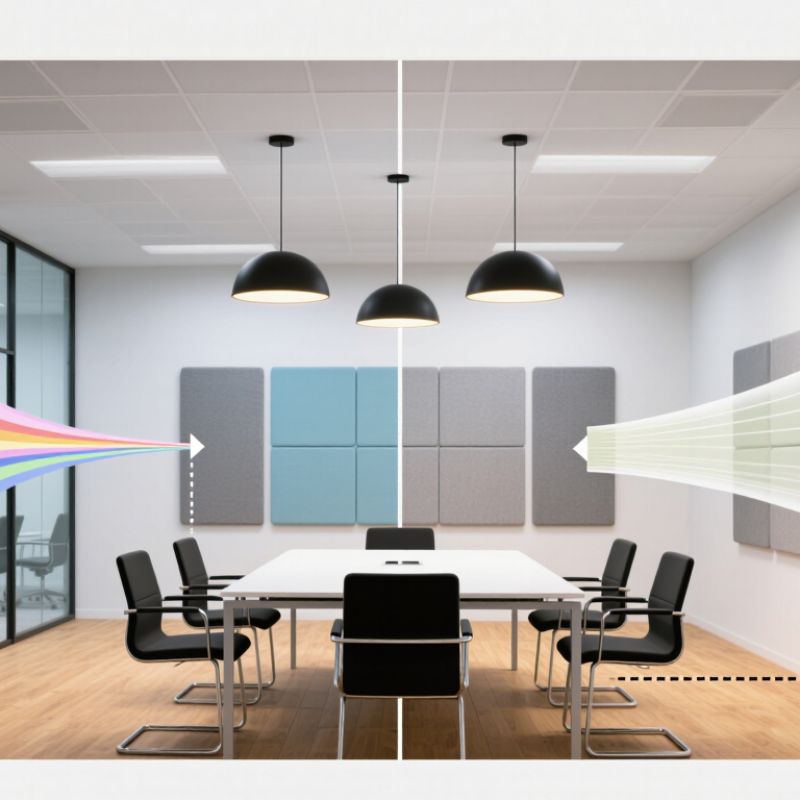
Indoor acoustic wall panels are porous or fibrous surfaces designed to absorb sound energy inside a room. Sound waves enter the panel, where friction within its material converts some energy into small amounts of heat. Less sound returns from the wall, which can reduce reflections and reverberation. They do not block all sound traveling between rooms. That distinction matters.
Panel performance depends on material, thickness, mounting method, coverage, and room shape. A hard-walled meeting room may produce a sharp echo; adding well-placed absorptive panels can make speech clearer. The World Health Organization’s Guidelines for Community Noise (1999) recommend indoor classroom noise levels below 35 dB LAeq during teaching sessions to support speech communication. ANSI/ASA S12.60-2010 also sets a 0.6-second reverberation-time limit for certain smaller core learning spaces. These are room-acoustic targets, not guarantees that panels alone can achieve them. Placement and existing finishes matter. A little humility helps: adding panels without measuring the room can still leave uneven sound, especially near ceilings or glass walls. Good design starts with the room’s actual use, noise sources, and surfaces.
QUICK LINKS
CONTACT US
Office: (+86) 755 23040566
Tel: (+86) 158 9965 5195
E-mail: sale@pcbledmodule.com
Skype: Hans@Rocket-PCB
Whatsapp: 86 1589965 5195
Office Address: 2207,Bid 4,He Gu Shan Hui Cheng,35#,Guang Tian RoYanluo street, Song Gang Town,518105 SHENZHENG, CHINA
Plant ADD.: No 69, Lianfeng North Road, Xianxi Area, ChangAn Town, Dongguan, China.


Copyright © 2025 Rocket PCB Solution Ltd. | All Rights Reserved Sitemap Friendship link: CNC machining heat sink

