
English


A kitchen can look spotless while cooking emissions linger in the air. Steam rises from a pot, oil spatters across a hot pan, and fine particles spread beyond the stove. A Range Exhaust Hood helps capture smoke, odors, moisture, and combustion pollutants near their source. But performance is not automatic. Hood shape, installation height, fan speed, and whether air vents outdoors all matter.
Research from Lawrence Berkeley National Laboratory, including work by Singer and colleagues published in Building and Environment, shows that cooking exhaust devices vary widely in their ability to capture emissions. A powerful fan alone does not guarantee effective capture; the hood must cover the cooking area and draw air properly. Indoor-air researcher Brett Singer’s practical guidance is: “Use a range hood whenever you cook, and make sure it vents outdoors.” That small habit can make a difference. Still, a hood is not a substitute for sensible ventilation or regular cleaning.
Choosing one means weighing more than appearance. Consider capture coverage, airflow, noise, filter access, and duct routing before comparing finishes or controls. Picture a wide skillet sending a ribbon of smoke toward the cabinets. A well-matched hood can catch much of it before it spreads. A poorly placed one may leave the room smelling of dinner long after the plates are cleared. The details matter. And they deserve a closer look.
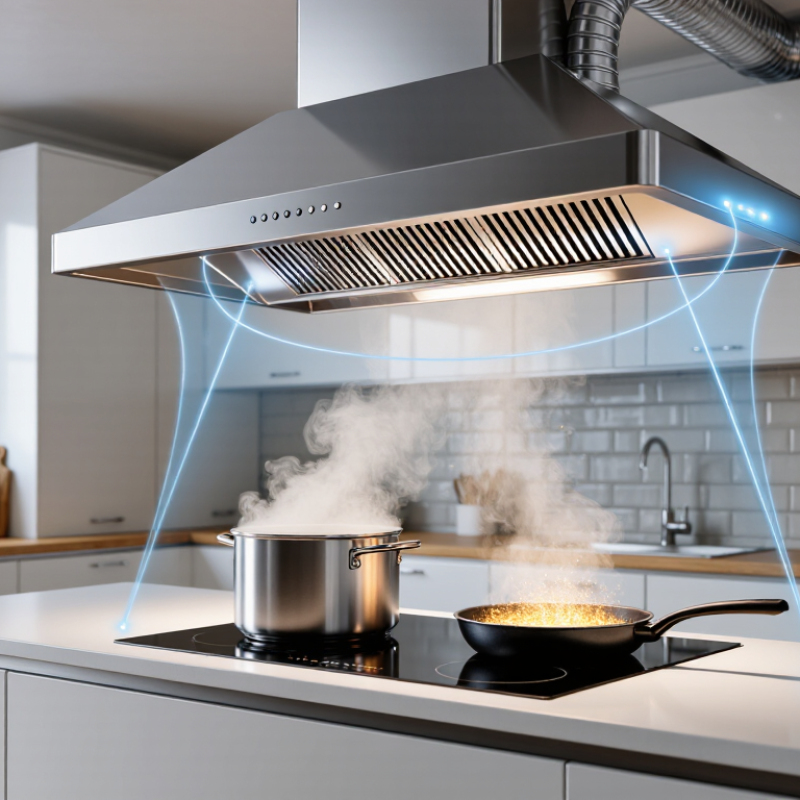
A range hood works best when it catches smoke and grease before they spread across the kitchen. Positioning matters: the hood should cover the cooking area and follow the recommended installation height. A narrow or overly high hood can miss rising plumes, especially from a front burner. Smoke moves quickly.
Turn the hood on before oil begins to shimmer or food starts to brown. This gives airflow time to pull emissions toward the filters before they drift to cabinets and walls. Choose a setting that clears the plume without making conversation difficult. After cooking, let it run briefly to remove lingering vapor. Not magic.
Grease filters collect particles, but they need regular cleaning. A sticky filter can restrict airflow. Wash reusable filters as directed, and check that the exhaust path is clear. Ducted systems send air outdoors; recirculating models filter it and return it to the room. Their performance differs. No hood removes every odor or particle. Choose one suited to your range and cooking habits, then check whether it captures emissions where they begin.
QUICK LINKS
CONTACT US
Office: (+86) 755 23040566
Tel: (+86) 158 9965 5195
E-mail: sale@pcbledmodule.com
Skype: Hans@Rocket-PCB
Whatsapp: 86 1589965 5195
Office Address: 2207,Bid 4,He Gu Shan Hui Cheng,35#,Guang Tian RoYanluo street, Song Gang Town,518105 SHENZHENG, CHINA
Plant ADD.: No 69, Lianfeng North Road, Xianxi Area, ChangAn Town, Dongguan, China.


Copyright © 2025 Rocket PCB Solution Ltd. | All Rights Reserved Sitemap Friendship link: CNC machining heat sink

