
English


A Rail Web Broadband Damper is a vibration-control device fitted to the web of a railway rail. The rail web is the vertical steel section between the head and foot. It can vibrate when wheels pass over joints, switches, welds, or irregular track surfaces. These vibrations may create rolling noise, structural resonance, and uncomfortable sound inside nearby buildings.
Unlike a narrow-band tuned damper, a Rail Web Broadband Damper targets a wider range of frequencies. It usually combines resilient materials, constrained layers, or carefully designed masses. These elements absorb part of the rail’s vibrational energy. The result can be quieter track and reduced vibration transmission. Performance depends on rail geometry, fastening stiffness, train speed, temperature, and installation quality.
Railway noise specialist Dr. David Thompson has expressed a useful engineering principle: “Railway vibration control must be considered as a system problem, not only a component problem.” This principle matters here. A damper cannot correct poor grinding, weak fasteners, or damaged rail surfaces. Field measurements remain essential.
Small details matter.
Engineers may compare acceleration levels before and after installation. They may also inspect clips, pads, bolts, and contact surfaces beside the track. Results can vary between curves, bridges, tunnels, and open ballast sections. The term “broadband” can also be used inconsistently across suppliers. That deserves careful review. This article explains the structure, operating mechanism, applications, testing methods, and practical limitations of the Rail Web Broadband Damper. It also considers where expectations may exceed real-world performance.
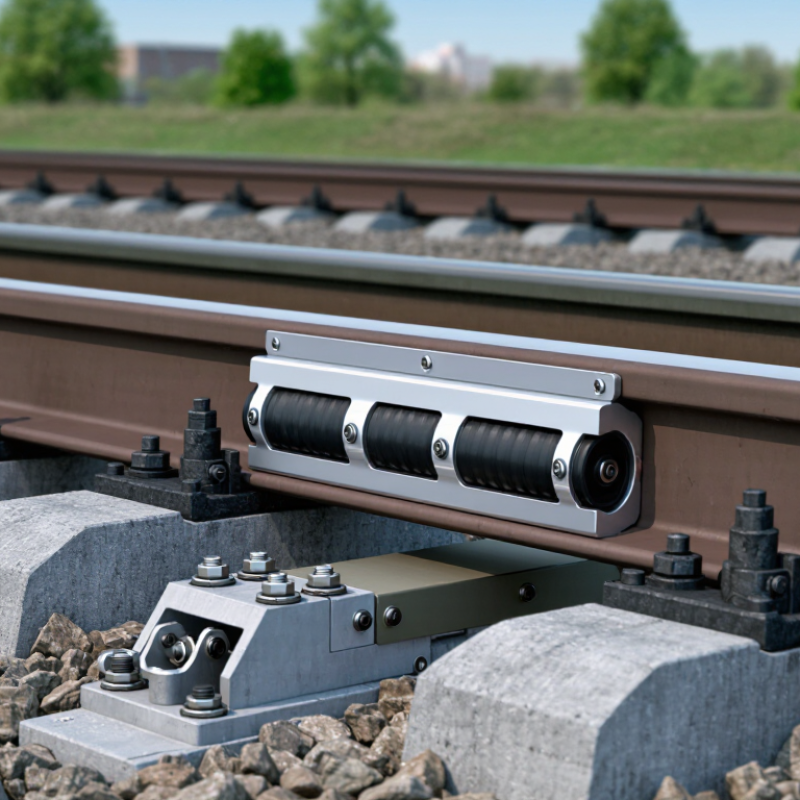
A rail web broadband damper is a vibration-control device fitted to the rail web, the vertical section between the head and foot. Its structure commonly includes a damping mass, resilient material, and a clamp or bonded attachment. Some designs use layered elastomers or metal elements. These parts move slightly when the rail vibrates, converting mechanical energy into heat.
“Rail web” identifies the mounting location. “Broadband” means the device targets a wide range of vibration frequencies, rather than one narrow resonance. “Damper” describes its energy-dissipating function. The term can vary between technical documents, so it should not be confused with a rail pad, fastening component, or acoustic barrier. In field work, engineers should check drawings, installation details, and measured vibration data. A familiar name does not always indicate identical construction.
Tips: Inspect the web surface before installation. Remove loose contamination, check clamp pressure, and confirm clearances near fasteners. Record temperature and rail condition during testing. Results may change with wheel condition, track stiffness, and train speed. That part is easy to overlook. The most useful assessment combines visual inspection with frequency-based measurements, although measurement quality can still be imperfect. A damper that appears secure may not be working effectively. Recheck it after traffic exposure.
QUICK LINKS
CONTACT US
Office: (+86) 755 23040566
Tel: (+86) 158 9965 5195
E-mail: sale@pcbledmodule.com
Skype: Hans@Rocket-PCB
Whatsapp: 86 1589965 5195
Office Address: 2207,Bid 4,He Gu Shan Hui Cheng,35#,Guang Tian RoYanluo street, Song Gang Town,518105 SHENZHENG, CHINA
Plant ADD.: No 69, Lianfeng North Road, Xianxi Area, ChangAn Town, Dongguan, China.


Copyright © 2025 Rocket PCB Solution Ltd. | All Rights Reserved Sitemap Friendship link: CNC machining heat sink