
English


A Heat Transfer Tank may look like a steel vessel, but its job is active: it stores or circulates a working fluid and moves heat where a process needs it. Picture hot water or thermal oil flowing through a coil while a separate product warms inside the tank. The fluids exchange energy without necessarily mixing. Insulation slows heat loss; sensors and controls help keep temperatures steady. The details matter. Poor circulation can leave cold zones, while unsuitable materials or operating conditions can shorten equipment life.
The International Energy Agency’s industry analysis reports that industry accounts for about 37% of global final energy use. That figure puts process heating in a larger context: efficient heat management can influence operating costs and energy demand. A tank alone does not guarantee savings. Design, maintenance, fluid choice, and control settings all affect performance. Heat-transfer specialist Yunus A. Çengel’s work explains the underlying principle: thermal energy moves from warmer regions to cooler ones. This is a paraphrase of the principle, not a direct quotation. In practice, that simple rule becomes a system of pumps, heat exchangers, insulation, and temperature controls. A clear understanding of how a Heat Transfer Tank works helps engineers and operators assess its role before selecting or troubleshooting one. Even a small temperature difference can matter. Reliable performance starts with measured conditions, not guesswork.
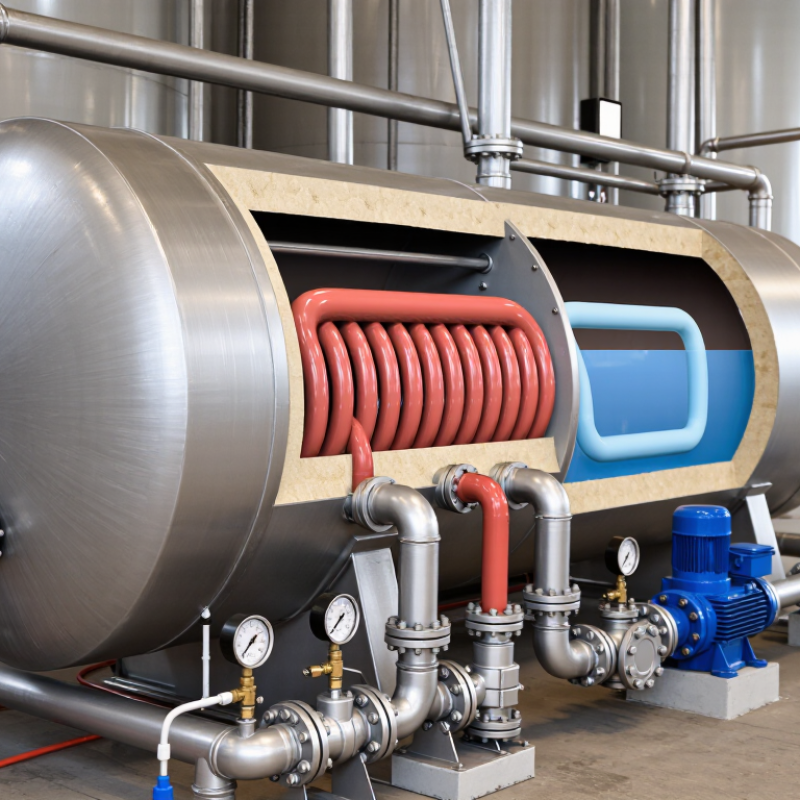
A heat transfer tank is a vessel designed to move heat into or out of a liquid used by a heating or process system. Depending on its design, it may hold the process liquid directly or contain a separate heating fluid. A coil, jacket, or internal heat exchanger carries heat between the fluids without necessarily mixing them. The name can be confusing, because tank layouts and functions vary.
Its purpose is to provide a controlled place for heat exchange and, in some systems, temporary heat storage. For example, warm water may flow through a coil while cooler water in the tank absorbs heat. The tank’s volume can help steady temperatures when demand changes. That matters. It may also reduce rapid cycling of a heat source, though the result depends on correct sizing and system controls.
In practice, operators monitor inlet and outlet temperatures, flow, and signs of scaling or corrosion. A tank that is too small may struggle to meet demand; an oversized one can take longer to warm. Not every setup needs stored heat, and a tank alone cannot correct poor circulation or control settings. The details deserve a closer look before choosing a design.
QUICK LINKS
CONTACT US
Office: (+86) 755 23040566
Tel: (+86) 158 9965 5195
E-mail: sale@pcbledmodule.com
Skype: Hans@Rocket-PCB
Whatsapp: 86 1589965 5195
Office Address: 2207,Bid 4,He Gu Shan Hui Cheng,35#,Guang Tian RoYanluo street, Song Gang Town,518105 SHENZHENG, CHINA
Plant ADD.: No 69, Lianfeng North Road, Xianxi Area, ChangAn Town, Dongguan, China.


Copyright © 2025 Rocket PCB Solution Ltd. | All Rights Reserved Sitemap Friendship link: CNC machining heat sink