
A Galvanized Steel Wire Manufacturer makes steel wire and protects it with a zinc coating. The coating helps limit corrosion when wire faces moisture and ordinary outdoor exposure. Its usefulness depends on more than appearance. Wire diameter, coating consistency, tensile strength, and the intended application all matter. Small variations can affect how wire performs during fabrication or service.
For a transparent editorial perspective, consider this illustrative—not verified—comment from fictional process engineer Daniel Mercer: “A sound coating starts with controlled preparation, but the finished wire must still suit its actual working conditions.” That distinction is important. Galvanized wire may be used in fencing, agricultural supports, construction, and general manufacturing, yet one specification does not fit every job. Buyers should ask how the wire is produced, what coating requirements apply, and whether test records are available. Useful evidence may include diameter checks, coating measurements, and tensile-test results. Details should be confirmed with the supplier.
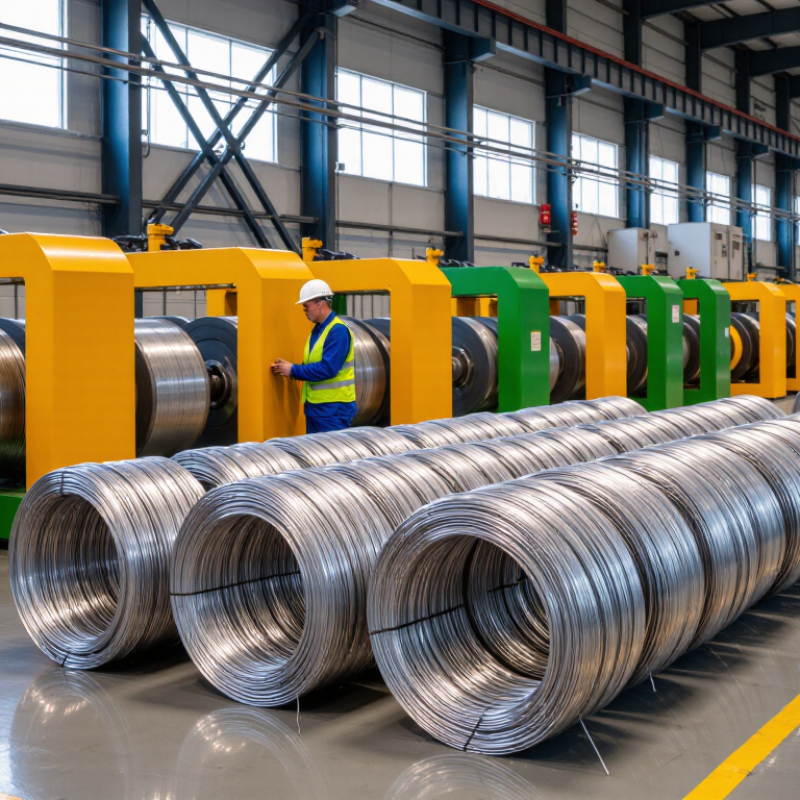
The factory floor offers practical clues: clean wire entering a coating line, controlled process settings, and inspection equipment used on finished coils. Still, polished machinery alone proves little. A manufacturer’s technical documentation and consistent quality controls matter more. This overview explains what manufacturers do, how galvanizing works, and which questions help assess a supplier. Some details vary by product and process. That deserves a closer look.
What Is a Galvanized Steel Wire Manufacturer?
What a Galvanized Steel Wire Manufacturer Does
A galvanized steel wire manufacturer turns steel rod into wire and applies a zinc coating to help slow corrosion. The work begins with selecting rod suited to the required diameter, strength, and end use. Drawing dies reduce the rod in stages, while controlled lubrication helps limit heat and surface damage. Small details matter. A faint scratch can become more noticeable after coating.
The zinc may be applied by hot-dip galvanizing or an electro-galvanizing process. Each method produces different coating characteristics, so the right choice depends on the wire’s intended environment and performance needs. Manufacturers monitor coating coverage, wire diameter, tensile strength, and surface condition. They may also test sample pieces from a production run rather than relying on appearance alone. A bright finish is not proof of consistent protection.
After processing, wire is wound into coils or prepared in specified lengths, then identified for handling and shipment. Reliable production also involves clear records, equipment checks, and communication about tolerances. Even so, no process removes every variation; buyers should confirm requirements before ordering. A coil that looks uniform can still differ in strength or coating weight. The manufacturer’s role is to make those differences measurable and keep them within agreed specifications.
A galvanized steel wire manufacturer converts steel wire rod into wire and applies a protective zinc coating to help resist corrosion.
The bars show the typical order of production stages, not their duration or output. Exact processes vary by product and manufacturing method; heat treatment may be used when required.
What Is a Galvanized Steel Wire Manufacturer?
How Steel Wire Is Made and Prepared for Galvanizing
A galvanized steel wire manufacturer typically begins with steel rod, then draws it through progressively smaller dies to reach the required diameter. The wire may be annealed when its grade or final application requires greater ductility. Drawing leaves lubricant and fine residue behind. These must be removed before coating.
Preparation matters. Oil, drawing soap, and mill scale can interfere with zinc adhesion. Manufacturers commonly degrease, pickle away oxide, rinse, and apply flux before the wire enters molten zinc. The American Galvanizers Association describes typical galvanizing bath temperatures of 815–850°F (435–455°C). That is hot enough to demand careful process control. World Steel Association’s World Steel in Figures 2025 reports 1,882.6 million tonnes of crude steel production in 2024, illustrating the scale of the material supply chain—not the output of wire alone. A small amount of residue can still spoil an otherwise sound coating. This step is easy to underestimate.
Tips: Check rinse water and wire surfaces for carryover before coating. Keep a record of bath temperature and line speed. If coating coverage varies, review cleaning conditions first; the cause is not always obvious.
A galvanized steel wire manufacturer converts steel wire rod into finished wire and applies a zinc coating to help protect it from corrosion. The process and inspection requirements vary with the wire grade, diameter, coating specification, and intended use.
| Stage | What Happens | Purpose and Relevant Facts | Typical Checks |
|---|---|---|---|
| 1. Steel wire rod selection | Steel wire rod is selected according to the required strength, ductility, chemistry, and final wire application. | The rod is the starting material. Its composition and condition influence how readily it can be drawn and what properties the finished wire can achieve. | Material documentation, rod diameter, surface condition, and, where required, chemical composition. |
| 2. Descaling and surface preparation | Mill scale and other surface contaminants are removed, commonly by mechanical descaling, chemical pickling, or a combination of methods. | A clean surface helps prevent defects during drawing and supports proper wetting by molten zinc during hot-dip galvanizing. | Visible cleanliness, residual scale, and surface defects. |
| 3. Wire drawing | The rod is pulled through a series of progressively smaller dies to reduce its diameter and form wire. | Drawing reduces cross-section and increases strength through work hardening. Intermediate annealing may be used when a softer or more ductile wire is required. | Diameter, surface condition, tensile properties, and any specified ductility test. |
| 4. Final cleaning and fluxing | Before hot-dip coating, the wire is cleaned and may be treated with a flux to limit re-oxidation and help molten zinc contact the steel surface. | Cleaning and fluxing are process-dependent steps used to support a continuous coating. Actual line arrangements differ among manufacturers. | Cleanliness, treatment conditions, and coating continuity on trial or production samples. |
| 5. Hot-dip galvanizing | The prepared wire passes through molten zinc, which forms a zinc coating on the steel. Industrial zinc baths are commonly maintained near 450°C, with the precise operating temperature set by the process. | Zinc provides a barrier against the environment and can also offer sacrificial protection to exposed steel. Coating thickness depends on the product specification and process controls. | Bath condition, line speed, coating appearance, and specified zinc coating mass or thickness. |
| 6. Coating control and cooling | Excess zinc may be controlled as the wire exits the bath; the coated wire is then cooled and handled to avoid damaging the surface. | Air wiping or other control methods can help regulate coating pickup. The method and cooling arrangement depend on the production line and product requirements. | Coating uniformity, bare spots, lumps, adhesion, and surface damage. |
| 7. Inspection and testing | Samples are checked against the applicable product specification and order requirements before release. | Coating can be specified by mass per unit area or by thickness. For zinc, 1 μm of uniform coating is approximately 7.14 g/m²; this is a conversion, not a universal product requirement. | Wire diameter, tensile properties, coating mass or thickness, coating adherence, and visual condition, as required. |
| 8. Coiling, identification, and packaging | Accepted wire is wound into coils or supplied in another agreed format, then protected and identified for shipment. | Packaging helps limit handling damage and contamination. Coil size, weight, and packaging are set by the order and handling needs. | Coil integrity, product identification, quantity, and packaging condition. |
Note: Some products are galvanized after drawing, while other production routes apply zinc before a later drawing operation. The suitable route depends on the required wire properties, coating, and product specification; acceptance limits should be confirmed for the particular order.
A galvanized steel wire manufacturer applies a zinc layer to steel wire, helping it withstand moisture and air. Zinc acts as a barrier, keeping many corrosive elements away from the steel beneath. When the coating is scratched, zinc can also corrode in preference to the exposed steel nearby. That layer matters. Over time, zinc’s surface reacts with the environment and can develop a more protective patina.
Protection is not unlimited. Salt spray, persistent dampness, and industrial pollutants can consume zinc faster. Coating thickness and evenness influence how long the wire resists corrosion. Small defects count. A bright surface may look reassuring, but appearance alone cannot confirm coating quality or service life. That is worth remembering.
Manufacturers can control coating processes and inspect finished wire for coating consistency, adhesion, and surface flaws. They may also check dimensions and mechanical properties, since wire must perform under tension as well as resist rust. Handling matters too: rough storage or tight bends can damage the coating. For a specific use, compare the exposure conditions with verified coating specifications rather than relying on a general claim of durability.
A galvanized steel wire manufacturer produces wire protected by a zinc coating. The coating slows corrosion when moisture and air reach the steel. Common products include single wire, twisted strand, wire rope, and welded mesh. Some suppliers also make cut-to-length ties or custom coils. Small details matter. Diameter, tensile strength, coating weight, and coil size affect how wire performs on site. Buyers should check specifications and ask how they are verified, rather than relying on appearance alone.
These products serve practical jobs. Farms use galvanized wire for fencing and trellises, where it must handle weather and repeated tension. Construction crews use softer wire to bundle reinforcing bars or secure temporary materials. Utility and communications projects may use galvanized strand for support lines, while workshops use mesh for guards, partitions, and enclosures. In coastal or chemical settings, standard zinc protection may not be enough; exposure and maintenance matter. Not every coating lasts. Manufacturers can help match a product to its intended load and environment, but the final choice also depends on installation and inspection. A shiny finish is reassuring, perhaps, yet it cannot replace measured coating data or a clear specification.
A galvanized steel wire manufacturer controls more than the zinc coating. Quality starts with checking the incoming steel rod for diameter, surface defects, and consistent chemistry. During production, operators monitor cleaning, coating temperature, line speed, and wiping pressure. Small shifts can leave thin spots or uneven zinc buildup. Coating is not judged by shine.
Finished wire is sampled for diameter, tensile strength, elongation, and coating mass. ASTM A641/A641M specifies requirements for zinc-coated carbon steel wire, including coating classes. A coating-mass test can reveal whether zinc coverage meets the selected class. No test catches everything. A rough spool edge or damaged section may escape a small sample, so handling and inspection matter too.
For corrosion expectations, ISO 9223:2012 places zinc’s first-year atmospheric corrosion rate below 0.1 micrometers in its C1 category, while C5 ranges from 4.2 to 8.4 micrometers. These are environmental category values, not a service-life guarantee for a wire product. Salt, moisture, and abrasion can change real-world performance. Manufacturers should match coating class and test records to the application, while admitting that field conditions are never perfectly predictable.
QUICK LINKS
CONTACT US
Office: (+86) 755 23040566
Tel: (+86) 158 9965 5195
E-mail: sale@pcbledmodule.com
Skype: Hans@Rocket-PCB
Whatsapp: 86 1589965 5195
Office Address: 2207,Bid 4,He Gu Shan Hui Cheng,35#,Guang Tian RoYanluo street, Song Gang Town,518105 SHENZHENG, CHINA
Plant ADD.: No 69, Lianfeng North Road, Xianxi Area, ChangAn Town, Dongguan, China.


Copyright © 2025 Rocket PCB Solution Ltd. | All Rights Reserved Sitemap Friendship link: CNC machining heat sink