English


A Shipbuilding Panel Line is not a single machine. It is a coordinated production system for cutting, assembling, and welding steel panels. The main types include flat-panel lines, stiffener-fitting lines, panel sub-assembly lines, and flexible automated lines. Each suits different production volumes, panel dimensions, and vessel designs. The right choice affects more than speed. It shapes material flow, worker access, weld quality, and the space needed around each station.
Ship-production scholar Thomas Lamb’s work offers a useful principle, paraphrased here: “Choose the production line to fit the product and workflow, not the machine alone.” That distinction matters. A flat-panel line may handle large deck sections efficiently, while a stiffener line focuses on attaching longitudinal or transverse members. Sub-assembly stations can prepare smaller sections before they reach the main line. Flexible systems may combine several tasks, but added automation also brings setup and maintenance demands. Details matter. Steel plate thickness, panel size, and crane access can change the practical layout. No type is best in every yard. Categories also overlap, and real facilities may combine equipment from several line types. That is worth remembering when comparing options. This overview examines the leading configurations and the production needs each one is built to serve.
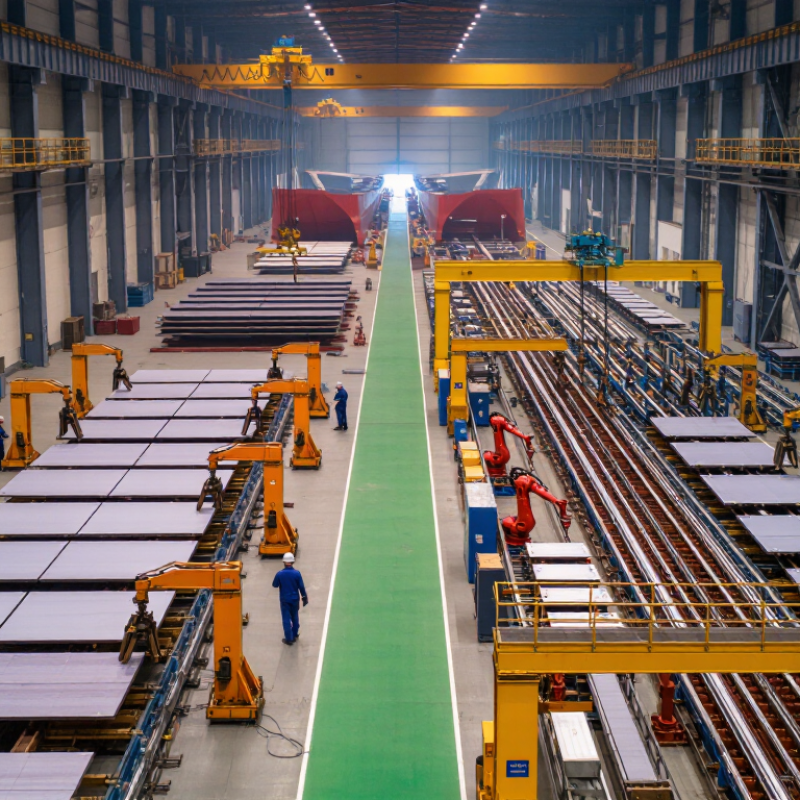
A shipbuilding panel line is a connected production area for turning steel plate into flat hull sections. It may include plate marking, cutting, edge preparation, and station-based assembly. Workers or automated equipment position stiffeners, brackets, and other structural members on the plate. Welding then joins these parts into a panel that can be fitted into a larger hull block.
The finished panel is more than a sheet of steel. It may form part of a deck, bulkhead, or side shell, with stiffeners arranged to meet the vessel’s structural design. A typical workflow uses jigs or fixtures to hold components in place, while measurements help control alignment and distortion. Small errors travel. A misplaced stiffener can complicate later assembly, so checks during production matter as much as final inspection.
Panel lines vary in how much work they automate and how panels move between stations. Some rely on overhead cranes and manual positioning; others use conveyors and mechanized welding. The right layout depends on panel size, production volume, available floor space, and the yard’s mix of vessels. The layout is not always elegant. Rework can still happen when heat pulls a plate out of shape, and actual shop conditions may differ from a clean process diagram.
| Panel Line Type | Typical Workpiece | Main Operations | What It Produces | Common Applications |
|---|---|---|---|---|
| Flat-panel line | Flat steel plates arranged into a panel | Plate preparation, positioning, tack welding, panel assembly, and seam welding | Large flat plate panels, often used as the base for further stiffening or assembly | Flat portions of decks, bulkheads, and ship sides |
| Stiffened-panel line | Flat plate panels with longitudinal or transverse stiffeners | Stiffener feeding and positioning, fitting, tack welding, and welding to the panel | Stiffened panels designed to resist bending and support structural loads | Decks, bottoms, bulkheads, and side-shell sections |
| Stiffener fabrication line | Rolled sections, flat bars, and built-up stiffener components | Cutting, end preparation, marking, and, where required, joining web and flange plates | Prepared stiffeners and built-up members ready for panel assembly | Longitudinal and transverse framing in ship structures |
| Sub-assembly panel line | Smaller panels or structural units made from plates and stiffeners | Component fitting, alignment, tack welding, and welding into a larger unit | Sub-assemblies that can be joined into larger blocks or hull sections | Block construction for hulls, decks, and internal structures |
| Curved-panel line | Plates formed to a single or compound curvature | Plate forming, positioning, fit-up, and welding with checks against the required shape | Curved panels and shell sections | Bow and stern areas, curved side shell, and other shaped hull regions |
| Mechanized or robotic panel line | Flat or stiffened panels suited to repeatable, programmed operations | Mechanized or automated material handling, positioning, and welding; manual fitting may also be used | Panels or stiffened panels produced with repeatable weld paths and process settings | Production runs with recurring panel designs and compatible fabrication layouts |
Note: A shipbuilding panel line is a coordinated set of equipment and workstations for fabricating plate panels and related structural components. Panel dimensions, equipment configuration, and production rates vary with the vessel design, material, and shipyard process.
QUICK LINKS
CONTACT US
Office: (+86) 755 23040566
Tel: (+86) 158 9965 5195
E-mail: sale@pcbledmodule.com
Skype: Hans@Rocket-PCB
Whatsapp: 86 1589965 5195
Office Address: 2207,Bid 4,He Gu Shan Hui Cheng,35#,Guang Tian RoYanluo street, Song Gang Town,518105 SHENZHENG, CHINA
Plant ADD.: No 69, Lianfeng North Road, Xianxi Area, ChangAn Town, Dongguan, China.


Copyright © 2025 Rocket PCB Solution Ltd. | All Rights Reserved Sitemap Friendship link: CNC machining heat sink