
English


Choosing a Residual Circuit Breaker is not just a matter of matching a current rating. The device must also respond to the kinds of residual current a circuit can produce. That detail matters in homes, workshops, and commercial installations, where a small mismatch may leave protection less suitable than expected.
The risk is not abstract. NFPA’s Home Electrical Fires report, published in 2022, estimated that U.S. fire departments responded to an average of 46,700 home fires involving electrical failure or malfunction each year from 2015 to 2019. The report does not measure residual-breaker performance, but it underscores why protection choices deserve careful attention. Small devices. Serious consequences.
This guide compares the main options, including RCCBs and RCBOs, as well as Type AC, A, F, and B devices. IEC 61008 and IEC 61009 define requirements for RCCBs and RCBOs, while IEC 62423 covers additional Type F and Type B requirements. These distinctions relate to the residual-current waveforms a breaker can detect, not simply its size or appearance. In practice, the right choice depends on the connected equipment, the installation, and the manufacturer’s specifications. Labels can be confusing, and no single type fits every circuit. A qualified electrical professional can verify the application against current standards and local requirements.
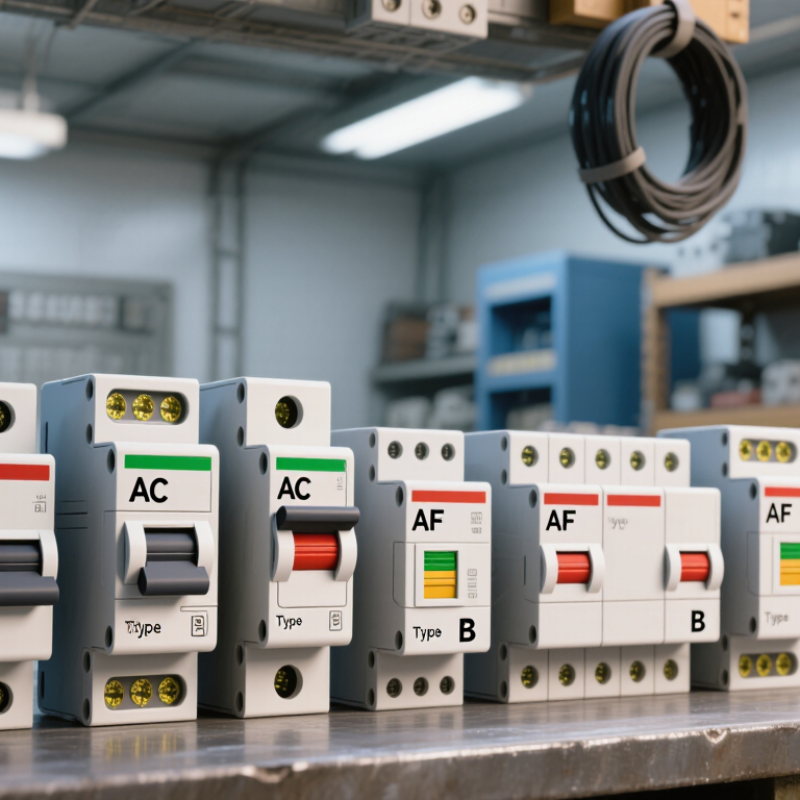
Residual circuit breakers are classified by what they detect and what protection they provide. An RCCB detects leakage current but does not usually protect against overloads or short circuits. An RCBO combines residual-current protection with those additional protections. The distinction matters inside a distribution board, where a breaker’s role should be clear.
They are also grouped by the shape of residual current they can detect. Type AC responds to sinusoidal AC leakage, while Type A also detects pulsating DC. Type F is designed for certain single-phase equipment with variable-speed drives. Type B can detect smooth DC and other complex residual currents. Devices may also be classified by sensitivity, pole count, and whether they trip instantly or with a delay. The letter codes are easy to misread; diagrams and equipment instructions offer a useful cross-check.
Tips: Match the breaker’s detection type to the connected equipment, especially where electronic drives are present. Check the rated residual current and wiring arrangement before installation. If specifications are unclear, ask a qualified electrician rather than guessing.
| Classification | What It Detects or Does | Overcurrent Protection | Typical Use or Selection Note |
|---|---|---|---|
| RCCB Residual current circuit breaker | Disconnects a circuit when residual current exceeds its specified operating threshold. Its waveform capability depends on the device’s assigned Type AC, A, F, or B classification. | No. It does not provide overload or short-circuit protection; suitable overcurrent protection must be provided separately. | Used where residual-current protection is needed alongside separate circuit overcurrent protection. |
| RCBO Residual current circuit breaker with overcurrent protection | Combines residual-current detection with circuit-breaker functions. Its residual-current waveform capability depends on its assigned Type AC, A, F, or B classification. | Yes. It provides residual-current protection and overcurrent protection in one device. | Often selected to protect an individual circuit while limiting the effect of a trip to that circuit. |
| Type AC Waveform sensitivity | Detects sinusoidal alternating residual current. | Not determined by this Type designation; depends on whether the device is an RCCB or an RCBO. | For circuits where the expected residual current is sinusoidal AC. Check local rules and connected equipment before selection. |
| Type A Waveform sensitivity | Detects sinusoidal AC and pulsating DC residual currents. | Not determined by this Type designation; depends on whether the device is an RCCB or an RCBO. | Commonly considered for circuits with electronic equipment that may produce pulsating DC residual current. |
| Type F Waveform sensitivity | Detects Type A residual currents and specified composite-frequency residual currents associated with certain single-phase power-conversion equipment. | Not determined by this Type designation; depends on whether the device is an RCCB or an RCBO. | May be suitable for some single-phase variable-speed or inverter-powered loads; confirm the equipment requirements and applicable standards. |
| Type B Waveform sensitivity | Detects AC and pulsating DC residual currents, as well as smooth DC residual current and specified frequency components within the applicable standard’s limits. | Not determined by this Type designation; depends on whether the device is an RCCB or an RCBO. | Considered for equipment that can produce smooth DC residual current, such as some EV charging or power-conversion installations. Verify system and code requirements. |
| Type S Time-delay/selective characteristic | Uses a specified time delay to provide selectivity with downstream residual-current devices. This is a timing characteristic, not a waveform-sensitivity Type. | Not determined by the S designation; depends on the device design. | May be used upstream in coordinated protection arrangements. Selection and coordination must follow applicable installation rules. |
Note: RCCB and RCBO describe device functions, while Type AC, A, F, and B describe residual-current waveform sensitivity. Type S describes a time-delay/selective characteristic. Availability and permitted applications vary by product standard and local electrical regulations.
QUICK LINKS
CONTACT US
Office: (+86) 755 23040566
Tel: (+86) 158 9965 5195
E-mail: sale@pcbledmodule.com
Skype: Hans@Rocket-PCB
Whatsapp: 86 1589965 5195
Office Address: 2207,Bid 4,He Gu Shan Hui Cheng,35#,Guang Tian RoYanluo street, Song Gang Town,518105 SHENZHENG, CHINA
Plant ADD.: No 69, Lianfeng North Road, Xianxi Area, ChangAn Town, Dongguan, China.


Copyright © 2025 Rocket PCB Solution Ltd. | All Rights Reserved Sitemap Friendship link: CNC machining heat sink

