

loading

BLOG

Top 10 Types of Sand Casting Parts for Global Buyers

Sand casting remains a practical route for producing large, complex, and cost-sensitive metal components. The World Foundry Organization’s 2023 Census of World Casting Production reported global casting output above 100 million tonnes in 2022. Its figures cover all casting methods, not sand casting alone. That limitation matters. Still, the data confirms foundries remain essential across construction, energy, transport, agriculture, and industrial machinery.

This guide introduces the Top 10 Types of Sand Casting Parts for Global Buyers. It examines housings, valve bodies, pump casings, engine blocks, manifolds, brackets, impellers, gear cases, base plates, and custom structural parts. Each category presents different requirements. Wall thickness, core design, alloy selection, dimensional tolerance, machining allowance, and surface finish can change the final cost. A heavy pump casing may need internal sand cores and pressure testing. A small bracket may require simpler tooling but tighter machining control.

John Campbell, a leading casting researcher and author of Castings Practice, stated, “The quality of a casting is determined by the quality of the liquid metal.” That principle remains highly relevant. Buyers should review melt chemistry, pouring temperature, process controls, inspection records, and traceability. ISO 9001 certification helps, but it does not replace process evidence. Even a promising supplier can miss a requirement.

The best choice is rarely the cheapest quote. It is the part that performs reliably, fits the application, and survives production reality. Mistakes happen. Careful questions reduce them.
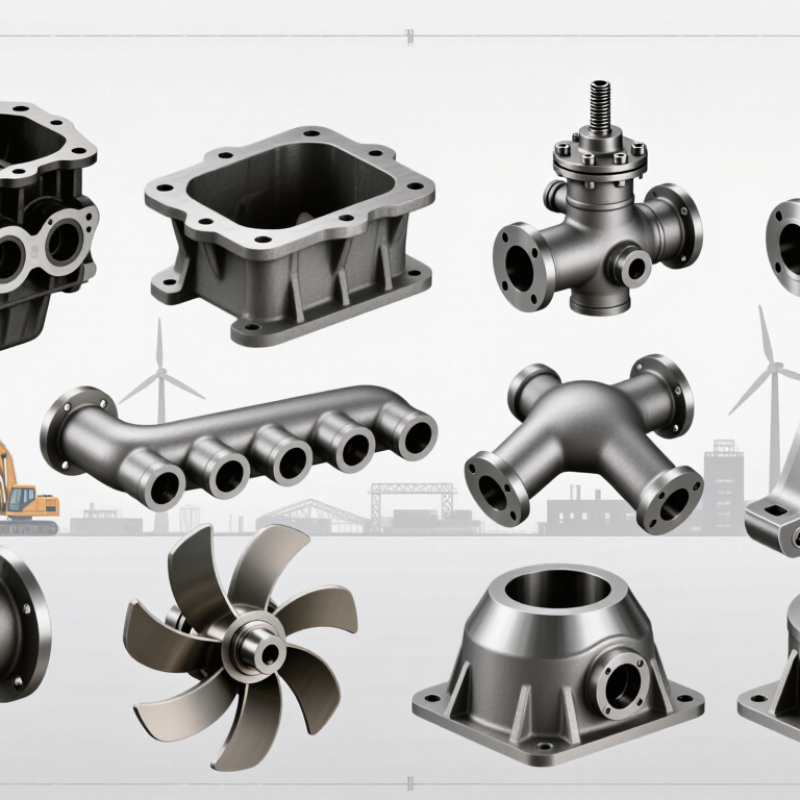
Top 10 Types of Sand Casting Parts for Global Buyers

Define the Top 10 Sand-Cast Parts by Function, Geometry, and Industry

Sand casting remains a practical route for parts with large sizes, complex cavities, or moderate production volumes. The World Foundry Organization’s 2023 census recorded approximately 109.6 million tonnes of global castings in 2022. Its applications span transportation, energy, construction, and general machinery. The top four parts by function are engine blocks, cylinder heads, pump housings, and valve bodies. Engine blocks need rigid internal webs. Cylinder heads require controlled cooling passages. Pump housings favor curved cavities and thick pressure walls. Valve bodies depend on accurate cores and reliable sealing surfaces.

The next three types are pipe fittings, impellers, and brake drums. Pipe fittings serve fluid distribution and often use repeated core shapes. Impellers combine curved blades with strict balance requirements. Brake drums need stable geometry under repeated heating. These parts show why function controls alloy choice, draft angles, and machining allowance. Small errors matter. A poor core can shift a passage by several millimeters.

The final three are manhole covers, machine bases, and heat sinks. Manhole covers favor broad, shallow geometry and impact resistance. Machine bases use heavy sections to reduce vibration. Heat sinks require thin fins, although sand casting may limit fin detail. The USGS Mineral Commodity Summaries 2024 reported nearly 100 million metric tons of U.S. industrial sand and gravel production, supporting broad molding-material availability. Still, the categories overlap. That is not a flaw. Buyers should verify wall thickness, porosity controls, dimensional inspection, and actual service loads before approving a design.

Match Part Types with ASTM A48, A216, A351, and A356 Material Classes

Global buyers often source ten common sand-cast parts: pump bodies, valve bodies, pipe fittings, impellers, housings, brackets, pulleys, manifolds, base plates, and machine frames. Material selection should follow service conditions, not shape alone. ASTM A48 gray iron suits machine frames, base plates, pulleys, and general housings. It offers good vibration damping and machinability, but limited tensile strength.

ASTM A216 carbon steel castings fit valve bodies, pump bodies, pipe fittings, and manifolds used in pressure or elevated-temperature service. Welding procedures and heat treatment still require careful review. ASTM A351 austenitic stainless castings suit corrosive-service valve bodies, impellers, fittings, and pump housings. Chlorides can change the decision. ASTM A356 aluminum castings work well for lightweight housings, brackets, pulleys, and selected impellers. They reduce weight, but may need stronger wear protection. These are practical matches, not automatic approvals.

Tips: Confirm the exact ASTM grade, casting thickness, pressure rating, temperature, and corrosion exposure before ordering. Request material test reports and dimensional inspection records. Sand casting can produce slight variation. Allow for machining stock. In my experience, buyers sometimes choose A356 for weight savings, then overlook heat and fatigue. That mistake is avoidable. A216 may appear strong enough, yet poor feeding or shrinkage can still weaken a casting. Review drawings, gating expectations, and inspection points with the foundry before production.

Evaluate Weight, Wall Thickness, and ISO 8062-3 CT Tolerance Grades

Top 10 Types of Sand Casting Parts for Global Buyers

Sand casting supports many industrial parts, including pump bodies, valve bodies, gear cases, motor housings, brackets, flanges, manifolds, impellers, engine blocks, and counterweights. Each type needs a different review of weight, wall thickness, and dimensional control. A 2-kilogram bracket behaves differently from a 300-kilogram pump body during molding, pouring, cooling, and inspection. Weight affects handling, machining allowance, and shipping cost. It can also increase distortion risks when sections cool unevenly.

Wall thickness deserves close attention. Thin walls may cool too quickly and fail to fill completely. Thick sections may develop shrinkage cavities or internal porosity. Sudden thickness changes create stress concentration. Smooth transitions usually improve casting quality. For many sand-cast parts, buyers commonly evaluate ISO 8062-3 CT10 to CT13 ranges, depending on geometry and production conditions. A lower CT number means tighter dimensional tolerance. It may also require better pattern control, process stability, and inspection.

Specify CT grade by feature, not only by the whole part. A sealing face may need tighter control than a rough external surface. Ask for measured dimensions, casting weight records, and a clear machining allowance. A practical mistake is choosing CT12 without checking thin ribs or deep pockets. The estimate may look acceptable on paper, yet cooling can change the result. Review critical dimensions with actual inspection data. Small details matter.

Top 10 Types of Sand Casting Parts for Global Buyers - Evaluate Weight, Wall Thickness, and ISO 8062-3 CT Tolerance Grades

The table compares common sand-cast components using representative planning ranges. Actual part weight, minimum wall thickness, and dimensional tolerance requirements depend on the design, alloy, casting size, tooling, and foundry capability.

Part Type Typical Application Common Casting Materials Representative Part Weight Typical Wall Thickness Indicative ISO 8062-3 CT Grade Buyer Evaluation Point
Pump casing Centrifugal pumps, water systems, and process equipment Gray iron, ductile iron, cast steel 10–500 kg 6–30 mm CT10–CT13 Review pressure-boundary sections, flange dimensions, and machining allowance on sealing faces.
Valve body Industrial flow-control and isolation systems Carbon steel, stainless steel, ductile iron 5–300 kg 6–25 mm CT10–CT13 Specify pressure-test requirements and identify bores, seats, and flange faces that require machining.
Gearbox housing Industrial drives, reducers, and transmission assemblies Gray iron, ductile iron, aluminum alloy 5–250 kg 6–25 mm CT10–CT13 Check bearing-seat alignment, mounting interfaces, and distortion control after cooling.
Machine base or bed Machine tools, presses, and production equipment Gray iron, ductile iron 100–5,000 kg 10–50 mm CT11–CT14 Consider stress relief, flatness requirements, lifting features, and the extent of finish machining.
Engine block Diesel and stationary engine assemblies Gray iron, compacted graphite iron, aluminum alloy 40–500 kg 4–20 mm CT10–CT13 Assess core complexity, internal passage integrity, deck flatness, and machined bore locations.
Impeller Pumps, fans, and selected fluid-handling equipment Cast iron, stainless steel, aluminum bronze 2–150 kg 4–15 mm CT9–CT12 Confirm blade geometry, balance requirements, surface condition, and critical hub dimensions.
Pipe fitting or manifold Fluid distribution, piping, and industrial process systems Ductile iron, cast steel, stainless steel 1–100 kg 5–20 mm CT10–CT13 Define connection dimensions, pressure-test criteria, and any internal passage inspection requirements.
Agricultural machinery housing Tractors, harvesters, and agricultural transmissions Gray iron, ductile iron, aluminum alloy 5–200 kg 6–25 mm CT10–CT13 Check impact and vibration service conditions, mounting points, and machined interface locations.
Counterweight or ballast block Construction machinery, lifting equipment, and industrial assemblies Gray iron, ductile iron 20–2,000 kg 10–60 mm CT11–CT14 Prioritize mass consistency, envelope dimensions, attachment features, and safe handling provisions.
Manhole cover and frame Drainage, utility access, and municipal infrastructure Ductile iron, gray iron 10–100 kg 10–30 mm CT11–CT14 Specify seating fit, load-class requirements, cover-to-frame compatibility, and surface profile.

Important: CT grades shown are indicative examples for early sourcing discussions, not guaranteed tolerances for every casting. ISO 8062-3 dimensional tolerances depend on nominal dimension ranges and the agreed casting requirements. Confirm the required CT grade, machining allowance, datum scheme, and inspection method on the drawing or purchase specification.

Compare AFS Sand Tests, Casting Defects, and NDT Inspection Methods

Top 10 Types of Sand Casting Parts for Global Buyers

Global buyers often source housings, pump bodies, valve bodies, brackets, manifolds, impellers, pulleys, base plates, engine parts, and agricultural frames. Each part needs a different quality plan. AFS sand tests provide useful process evidence. Grain fineness affects surface texture and mould strength. Moisture influences flow and gas formation. Permeability shows how easily gases escape. Clay content and compactability also deserve attention. These values should be recorded beside heat numbers and production dates.

Casting defects can appear as shrinkage cavities, gas porosity, cold shuts, inclusions, or mould erosion. Some are visible after cleaning. Others remain hidden inside a thick valve body. Visual and dimensional checks are essential, but they cannot prove internal soundness. Radiographic testing can reveal porosity and shrinkage. Ultrasonic testing suits many thick sections. Magnetic particle inspection finds surface cracks in suitable ferromagnetic alloys. Dye penetrant testing detects open surface flaws. No method fits every geometry. A low rejection rate does not mean zero risk. AFS results alone do not guarantee a sound casting. That assumption needs review.

Tips: Request the sand-test range, defect photos, inspection frequency, and acceptance criteria before ordering. Match NDT coverage to the part’s load and wall thickness. Keep one sample for independent review. Small records prevent large arguments.

Select Global Suppliers Using ISO 9001 and EN 10204 3.1 Certification

Top 10 Types of Sand Casting Parts for Global Buyers

Sand casting supports many industrial components, from pump bodies and valve housings to impellers and pipe manifolds. Buyers also commonly source gear blanks, pulleys, brackets, counterweights, and machine frames. Each part demands suitable metal grades, mold control, and dimensional inspection. A rough surface is normal after casting, but uncontrolled defects are not acceptable.

For global sourcing, ISO 9001 certification shows that a supplier follows documented quality processes. It does not guarantee every casting is perfect. Buyers should review inspection plans, traceability records, nonconformance handling, and corrective actions. EN 10204 3.1 certification is equally important for metal castings requiring verified material data. The certificate should identify the heat number, chemical composition, mechanical results, and authorized inspection approval. Match these details with the casting’s marking and purchase order.

Tips: Request a sample 3.1 certificate before production. Confirm the stated standard, grade, heat number, and test results. Ask for dimensional reports on critical areas, such as flange faces or bearing seats. A supplier may provide attractive pricing, yet weak documentation can create costly delays. In my experience, buyers sometimes focus too heavily on surface appearance. That is a mistake. Internal porosity, shrinkage, and inconsistent hardness may remain hidden without proper testing. A careful supplier explains limitations clearly, even when the answer is inconvenient.

Top 10 Types of Sand Casting Parts for Global Buyers

Common part families and the nominal density of their commonly used casting alloys

The chart uses representative nominal alloy densities: aluminum alloys are approximately 2.70 g/cm³, gray and ductile iron approximately 7.20 g/cm³, carbon steel approximately 7.85 g/cm³, and stainless steel approximately 7.90 g/cm³. When comparing global suppliers, buyers should verify ISO 9001 quality-system certification and request EN 10204 3.1 inspection certificates for material traceability and test results.

Chat Online
Chat Online
Leave Your Message inputting...
Thank you for your attention. Please kindly describe your question first, or please send your inquiry to our email sale@pcbledmodule.com, and we will reply to you ASAP. Welcome, what can I help you?
Sign in with: