

Choosing among the top IP video intercom manufacturers requires more than comparing camera resolution or product prices. Global buyers now evaluate complete systems, including door stations, indoor monitors, mobile applications, cloud services, and access-control integration. Fortune Business Insights identifies strong growth in the video intercom devices market, driven by smart buildings, residential security, and connected infrastructure. The report also highlights rising demand for remote monitoring and network-based communication.
Market momentum is visible.
Omdia’s video surveillance research consistently points toward analytics, cloud management, and cybersecurity as major purchasing priorities. These trends directly affect Ip Video Intercom deployment. A clear image is useful, but stable connectivity matters more when a facility has multiple entrances, weak network segments, or thousands of daily visitors. Buyers should also examine ONVIF compatibility, SIP support, encryption practices, firmware updates, warranty coverage, and regional technical service. IEC 62676 principles can help buyers assess video performance and system reliability.
Practical procurement experience reveals an uncomfortable detail: a polished datasheet may hide installation limitations. Some systems perform well in bright showrooms but struggle with backlighting, rain, glare, or crowded entrances. No ranking is perfect. Manufacturer selection should therefore combine independent testing, documented certifications, total ownership costs, and feedback from installers in similar markets. This guide reviews leading global suppliers through those practical criteria. It focuses on measurable performance, integration flexibility, supply capability, and long-term support, helping buyers make decisions that remain reliable after installation day.
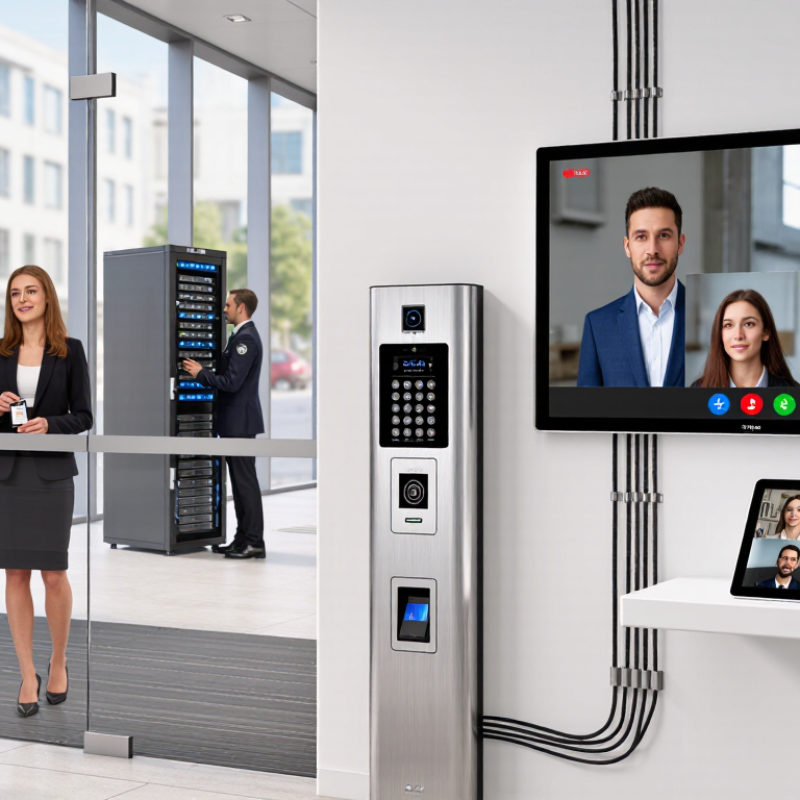
A capable IP video intercom manufacturer does more than assemble cameras, screens, and network ports. It designs a reliable communication system for real buildings. The system should deliver clear video, two-way audio, controlled access, and stable performance during power or network interruptions. Field experience matters. A manufacturer should explain mounting limits, cable distances, lighting conditions, and maintenance needs before installation.
Cybersecurity is equally important. Devices need secure updates, strong authentication, encrypted communication, and documented vulnerability handling. The NIST Cybersecurity Framework 2.0 emphasizes governance, protection, detection, response, and recovery. These principles should appear in product testing, not only in brochures. According to Grand View Research, the global video surveillance market was valued at approximately USD 53.7 billion in 2023. Its projected growth increases the pressure on manufacturers to build safer connected products.
Interoperability also defines professional capability. Support for common network standards, management platforms, and integration interfaces reduces replacement costs. ONVIF’s market role shows why open interoperability remains valuable across security projects. However, compatibility claims need practical testing. A device may connect successfully, yet still lose functions during integration. That detail is often missed. Reliable manufacturers publish test conditions, firmware policies, warranty limits, and response times. They also provide regional technical support and clear documentation. No manufacturer gets everything right. Honest limitations can be more valuable than perfect marketing language.
Top IP Video Intercom Manufacturers for Global Buyers
Modern IP video intercoms rely on several connected technologies. SIP enables voice, video, and call routing across standard networks. H.264 or H.265 compression reduces bandwidth during live viewing. PoE can carry power and data through one Ethernet cable. That simplifies installation at gates, apartments, and commercial entrances.
MarketsandMarkets estimates that the global access control market may grow from USD 9.5 billion in 2023 to USD 14.9 billion by 2028. This expansion increases demand for interoperable IP communication systems. ONVIF support can improve compatibility with cameras, recorders, and management platforms. However, compatibility claims require testing. Small firmware differences still create frustrating failures.
Cybersecurity is equally important. TLS protects signaling, while SRTP helps secure audio and video streams. Secure boot and signed firmware can reduce tampering risks. Edge processing also supports motion detection and visitor recognition without sending every image to a remote server. NIST’s Cybersecurity Framework emphasizes identification, protection, detection, response, and recovery. Those steps should guide product evaluation. In practice, weak passwords remain a common weakness. A clear update policy matters more than impressive specifications. Test it before purchase.
| Technology or Product Dimension | What Modern Systems Commonly Use | Typical Technical Details | Why It Matters to Global Buyers | Evaluation Criteria |
|---|---|---|---|---|
| Video Encoding | H.264 and, in newer equipment, H.265/HEVC compression | H.264 is widely supported; H.265 can reduce bitrate requirements for comparable video quality but may require compatible software and hardware | Affects network capacity, storage costs, device compatibility, and remote-viewing performance | Codec support, licensing implications, image quality at low bitrates, and compatibility with the video management platform |
| Network Video Protocols | SIP for voice and call control, RTP for media transport, and RTSP for video streaming | SIP-based systems can integrate with IP-PBX platforms; RTSP and RTP support video or audio interoperability in suitable deployments | Open protocols help reduce dependence on a single ecosystem and simplify integration with telephony or security systems | Standards compliance, SIP interoperability, authentication options, codec negotiation, and documented API behavior |
| Power and Connectivity | Ethernet networking with Power over Ethernet, commonly IEEE 802.3af or IEEE 802.3at | IEEE 802.3af provides up to 15.4 W at the power-sourcing equipment; IEEE 802.3at provides up to 30 W, with less power available at the device after losses | One network cable can carry data and power, reducing installation complexity and field wiring | PoE class, switch compatibility, cable distance, power budget, surge protection, and optional local power input |
| Camera and Imaging | CMOS image sensors, wide-angle lenses, infrared illumination, and wide dynamic range processing | Wide dynamic range improves scenes with strong backlighting; infrared support enables low-light or night identification when properly designed | Clear visitor identification depends on lighting, viewing angle, lens distortion control, and camera placement—not resolution alone | Effective field of view, minimum illumination, backlight performance, infrared range, privacy masking, and image distortion |
| Audio Technology | Two-way full-duplex audio with echo cancellation, noise reduction, and digital audio codecs | Common codecs include G.711; some systems also support wideband codecs such as G.722, depending on interoperability | Reliable speech is essential when users cannot see the visitor clearly or when the entrance is noisy | Microphone sensitivity, speaker output, acoustic echo cancellation, wind-noise handling, duplex behavior, and environmental testing |
| Access Control | Relay outputs, electric-lock control, exit buttons, door-position monitoring, and request-to-exit inputs | Many installations use a separate secure relay or access controller so the door-release circuit is not exposed directly at the outdoor station | Supports controlled entry while helping protect the locking hardware and access credentials | Relay rating, fail-safe or fail-secure behavior, door sensor support, timed unlock settings, and emergency-release compatibility |
| Credential Technologies | PIN codes, RFID or NFC credentials, QR codes, mobile credentials, and selected biometric methods | Credential support varies by model; encrypted or tokenized credentials are preferable to static credentials for managed deployments | Different sites require different balances of convenience, security, privacy, and visitor throughput | Credential encryption, revocation process, offline behavior, privacy compliance, reader durability, and integration with access-control software |
| Cybersecurity | TLS-encrypted communications, HTTPS administration, signed firmware, role-based access, and secure password policies | Security effectiveness depends on current firmware, unique credentials, network segmentation, certificate management, and vendor vulnerability response | IP intercoms are network endpoints and should be managed like other connected security devices | Security update policy, vulnerability disclosure process, default-password controls, logging, encryption, secure boot, and user permissions |
| Mobile and Remote Access | Mobile applications, SIP clients, browser access, push notifications, and cloud or VPN connectivity | Remote access may use cloud relay services or customer-controlled VPN infrastructure; each approach has different privacy and availability characteristics | Enables staff to answer calls away from a fixed indoor monitor and supports distributed properties | Data residency, subscription requirements, notification reliability, account management, multi-site support, and offline fallback |
| Weather and Vandal Resistance | Outdoor housings designed around ingress protection and impact-resistance requirements | IP ratings address dust and water ingress; IK ratings address mechanical impact resistance. The exact rating must be verified for the specific model | Outdoor entrances face rain, dust, temperature changes, tampering, and repeated physical use | Published IP and IK ratings, operating temperature, UV resistance, drainage, mounting method, and warranty coverage |
| Video Management Integration | ONVIF support, RTSP streams, event outputs, webhooks, SDKs, and documented REST APIs where available | Integration depth differs considerably; basic video streaming does not necessarily provide call control or door-event integration | Integration allows intercom events, video, alarms, and access records to be managed in a broader security workflow | Supported profiles, API documentation, event mapping, licensing, third-party testing, and long-term software support |
| Installation and Management | Web-based configuration, centralized device management, automatic discovery, remote diagnostics, and firmware deployment | Centralized tools can reduce commissioning time, but they require controlled administrator access and a defined update process | Simplifies deployment across apartments, offices, campuses, healthcare facilities, and multi-site properties | Provisioning workflow, configuration backup, audit logs, role separation, bulk updates, and installer documentation |
| Compliance and Regional Requirements | Electrical safety, electromagnetic compatibility, radio regulations where applicable, accessibility, privacy, and local construction requirements | Required approvals vary by destination market and installation type; conformity markings alone may not satisfy every project requirement | Reduces import, inspection, procurement, and project-approval risks | Applicable declarations, test reports, local language materials, privacy controls, accessibility features, and regional warranty terms |
| Lifecycle and Support | Firmware maintenance, spare parts, technical documentation, training, warranty service, and integration support | A dependable lifecycle program should define security-update periods, product end-of-sale notices, repair options, and replacement compatibility | Intercoms are often embedded in building infrastructure and may remain operational for many years | Support response time, local service capability, spare-part availability, documentation quality, warranty duration, and migration path |
Global buyers now expect IP video intercom manufacturers to solve local problems, not merely ship hardware. MarketsandMarkets estimates the global video surveillance market will grow from USD 53.7 billion in 2024 to USD 83.3 billion by 2029. That expansion raises expectations for clearer video, stronger cybersecurity, and dependable remote management.
Leading manufacturers serve different markets through regional engineering and certified distribution networks. They adapt interfaces, power options, mounting kits, and language support for apartments, offices, hospitals, and industrial sites. A reliable supplier also provides API documentation, firmware updates, and installer training. Small details matter. A rainy entrance exposes weak sealing quickly. A noisy lobby tests microphone design.
Interoperability has become a practical buying requirement. ONVIF’s 2024 market work continues to emphasize open standards for connected security devices, reducing dependence on one ecosystem. Manufacturers serving global projects therefore test devices with varied access controllers, network switches, and management software. They also document privacy controls and data-handling settings for regional compliance reviews. That process is not perfect. Technical certificates do not guarantee smooth installation. Local technicians still need clear wiring diagrams, responsive support, and replacement parts within days. Buyers should examine failure rates, update policies, and total installation time, rather than trust impressive specifications alone.
Comparing IP video intercom manufacturers requires more than checking camera resolution. In real installations, network stability often matters more than a sharp product demo. Test video, voice, door release, and mobile alerts under weak network conditions. A system that performs well beside the router may struggle across concrete walls.
Look closely at interoperability. Confirm support for common network standards, access control interfaces, recording platforms, and existing security software. Open protocols can reduce replacement costs later. However, advertised compatibility may be narrower than expected. Ask for a live test with your current equipment, not only a technical brochure.
Review encryption methods, user permissions, firmware updates, and audit logs. These details show how seriously a manufacturer treats operational security.
Hardware quality also deserves practical inspection. Check the keypad response, microphone clarity, infrared performance, weather resistance, and mounting strength. A metal panel can still feel fragile if its buttons loosen after repeated use. Request failure-rate data, warranty terms, spare-part availability, and response times for technical support. Installer training is another useful indicator of expertise. Clear manuals help, but accessible engineers matter more during a failed installation. I have seen projects delayed by small configuration gaps. That experience makes testing and documentation essential, even when the quotation looks attractive.
Choosing an IP video intercom manufacturer starts with the project, not the catalog. A small apartment entrance may need one outdoor station, five indoor monitors, and simple mobile alerts. A hospital requires clearer audio, emergency call routing, durable surfaces, and controlled access integration. In my field evaluations, mismatched features often create more maintenance than value. Keep the use case visible.
For residential developments, assess installation speed, wiring options, and support for multiple units. Ask for sample devices and test speech quality beside a running elevator. For offices, review directory management, user permissions, audit records, and compatibility with existing network equipment.
Industrial sites need weather protection, glove-friendly controls, and stable operation across long cable runs. Request documented test results, not attractive claims. A manufacturer should explain limitations plainly.
Public facilities demand accessibility, cybersecurity updates, spare-part planning, and dependable technical assistance. Global buyers should check regional service coverage, documentation quality, and installer training. Review firmware procedures, warranty terms, response times, and replacement policies before signing. Visit a reference installation when possible. It reveals details brochures omit, such as weak mounting brackets or confusing setup screens. No supplier fits every project. I would also leave budget for failures; early estimates are rarely perfect. A careful review of local installer skills may change the final choice.
QUICK LINKS
CONTACT US
Office: (+86) 755 23040566
Tel: (+86) 158 9965 5195
E-mail: sale@pcbledmodule.com
Skype: Hans@Rocket-PCB
Whatsapp: 86 1589965 5195
Office Address: 2207,Bid 4,He Gu Shan Hui Cheng,35#,Guang Tian RoYanluo street, Song Gang Town,518105 SHENZHENG, CHINA
Plant ADD.: No 69, Lianfeng North Road, Xianxi Area, ChangAn Town, Dongguan, China.


Copyright © 2025 Rocket PCB Solution Ltd. | All Rights Reserved Sitemap Friendship link: CNC machining heat sink


