
English


Firefighting Drone technology is changing how emergency teams see heat, smoke, and dangerous structures. A thermal camera can reveal a trapped person through darkness. It can also expose hidden roof hotspots before crews enter.
The need is measurable. The NFPA’s Fire Loss in the United States During 2022 report recorded approximately 1.5 million fires and $18.1 billion in direct property damage. Meanwhile, the FAA’s 2023 Aerospace Forecast showed continuing growth in registered and commercial drone operations. These figures do not prove that drones solve every firefighting problem. They show why better situational awareness matters.
Charles Werner, founder of DroneResponders, has said, “Drones are a tool, not a replacement for firefighters.” That distinction should guide every purchase. This Top 10 Firefighting Drone selection considers thermal accuracy, flight endurance, wind resistance, obstacle avoidance, payload options, data security, training, and after-sales support. It also considers practical deployment under local aviation rules.
Some models impress in wide-area mapping. Others perform better around high-rise roofs, forests, or industrial sites. A few may look powerful on paper but provide limited support after delivery. That is where buyers can make costly mistakes.
No ranking is perfect. Battery life changes in cold weather. Smoke can distort thermal readings. Software features may depend on regional approvals. Global buyers should verify certification, maintenance access, pilot requirements, and total ownership cost before choosing a platform. The strongest Firefighting Drone is not always the most expensive one. It is the model that performs reliably when visibility drops, minutes matter, and assumptions fail.
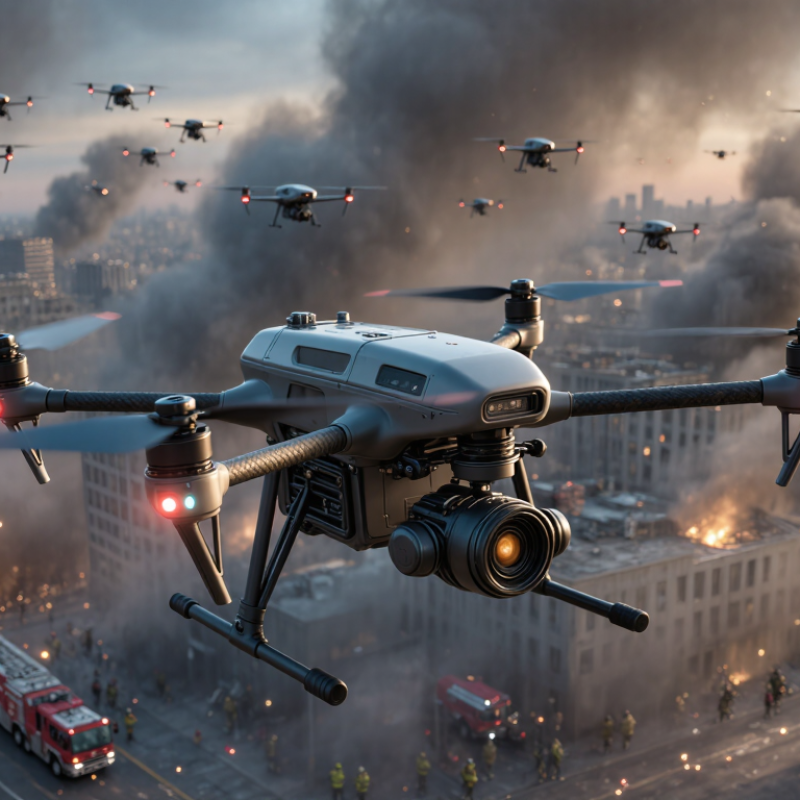
Firefighting drones are remotely operated aircraft built for dangerous fireground tasks. They carry thermal cameras, optical sensors, gas detectors, or compact water systems. Their live video helps commanders see roof heat, hidden flames, and blocked access routes. Some models use tethered power, while others depend on batteries. Battery limits remain a serious weakness.
The U.S. National Fire Protection Association reported 1,504,500 fires in 2022, with property damage reaching about $18.1 billion. That scale explains the demand for faster aerial information. A drone can reach a burning warehouse before crews enter. Its thermal camera may reveal heat behind smoke, while onboard mapping records changing conditions. This is practical, not futuristic.
A firefighting drone usually follows four steps. Sensors collect data. A flight controller stabilizes the aircraft. A secure ground station displays the scene. Operators then guide inspection, mapping, or targeted cooling. High-temperature protection matters greatly. So do wind resistance, payload capacity, signal range, and flight endurance. FAA aerospace forecasts continue to show expanding commercial small-drone operations, but buyers must check local aviation requirements and emergency procedures. A larger water payload may reduce flight time. More automation may also create false confidence. Human judgment still matters. Training gaps can turn useful equipment into an expensive distraction.
QUICK LINKS
CONTACT US
Office: (+86) 755 23040566
Tel: (+86) 158 9965 5195
E-mail: sale@pcbledmodule.com
Skype: Hans@Rocket-PCB
Whatsapp: 86 1589965 5195
Office Address: 2207,Bid 4,He Gu Shan Hui Cheng,35#,Guang Tian RoYanluo street, Song Gang Town,518105 SHENZHENG, CHINA
Plant ADD.: No 69, Lianfeng North Road, Xianxi Area, ChangAn Town, Dongguan, China.


Copyright © 2025 Rocket PCB Solution Ltd. | All Rights Reserved Sitemap Friendship link: CNC machining heat sink

