
English


Cosmetic Squeeze Tubes are a familiar part of everyday beauty packaging, from hand cream to facial cleanser. Their appeal is practical: they are portable, easy to dispense, and adaptable to different product formulas. Market demand also provides useful context. Grand View Research estimated the global cosmetic packaging market at USD 34.8 billion in 2023, with projected growth through 2030. That figure covers more than tubes, so it should not be mistaken for tube-specific sales.
China’s manufacturers serve varied needs, including small trial-size packs, large-volume tubes, printed finishes, and different cap designs. Yet a polished sample tells only part of the story. Seal strength, wall thickness, print consistency, and filling-line compatibility all matter in production. Small details count. A tube that looks good on a desk may behave differently on a fast filling line.
This guide to China’s top 10 cosmetic squeeze tube manufacturers offers a starting point for comparing suppliers, not a universal ranking. The right choice depends on order volume, material requirements, quality controls, customization, and delivery expectations. Buyers should verify technical specifications and request samples before making decisions. Some claims are easy to print in a catalog; repeatable production is harder to prove. That deserves a closer look.
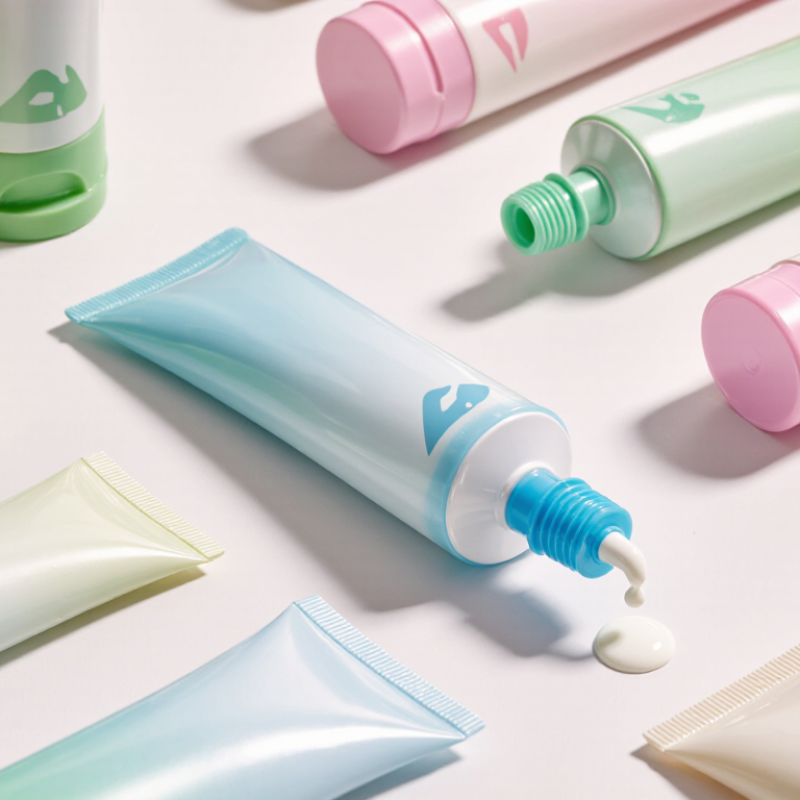
Cosmetic squeeze tubes are flexible containers designed to dispense creams, gels, lotions, and similar products in controlled amounts. A tube typically has a body, a sealed tail, and a cap or nozzle. Its flexible walls collapse as the product is squeezed, helping users apply a small amount without dipping their fingers into the package. Simple, but useful.
People use them for products such as hand cream, cleanser, sunscreen, and hair treatments. A narrow nozzle can make targeted application easier, while a wider opening may suit thicker formulas. When choosing a tube, manufacturers consider how the product flows, how much it should dispense, and whether its ingredients work well with the tube’s materials. The cap also matters: a flip-top can be convenient with wet hands, while a screw cap may feel more secure in a travel bag.
In everyday use, gentle pressure usually gives better control than squeezing from the middle. That small detail helps reduce sudden spills. Tubes are lightweight and easy to carry, but they are not perfect. Thick creams can remain near the sealed end, and very soft walls may make dispensing less precise. A tube that looks suitable on a shelf may behave differently once filled, so testing the actual formula and package together is worthwhile.
This table summarizes ten commonly used cosmetic squeeze-tube formats rather than ranking manufacturers. Capacity ranges are indicative; actual specifications depend on tube diameter, length, product formulation, and closure design.
| No. | Tube Format | Common Construction | Indicative Capacity | Typical Cosmetic Uses | Practical Considerations |
|---|---|---|---|---|---|
| 1 | Sunscreen tube | Flexible polyethylene (PE), multilayer PE, or barrier laminate | 30–200 mL | Facial and body sunscreens, sun-care lotions | Choose materials and closures compatible with the formula; a flip-top cap can support convenient one-handed dispensing. |
| 2 | Facial cleanser tube | PE or co-extruded PE; laminate options are also used | 50–150 mL | Face washes, cleansing gels, foaming cleansers | A wider opening can help dispense thicker cleansers, while a secure cap helps reduce leakage during travel. |
| 3 | Hand cream tube | PE, recycled-content PE, or multilayer laminate | 20–100 mL | Hand creams, barrier creams, cuticle creams | Small and medium formats are easy to carry; tube stiffness affects how easily the remaining product can be squeezed out. |
| 4 | Body lotion tube | PE or co-extruded PE, often with a screw or flip-top closure | 100–250 mL | Body lotions, moisturizers, after-sun products | Larger diameters can provide more capacity; closure and seal design should suit the lotion's viscosity and dispensing needs. |
| 5 | Eye cream tube | PE or multilayer tube, sometimes fitted with a narrow applicator | 10–30 mL | Eye creams, targeted under-eye treatments | A narrow outlet can help control small doses. Applicator materials and shape should be selected for the intended use and formula. |
| 6 | Spot-treatment tube | PE or barrier laminate with a precision nozzle | 5–30 mL | Targeted blemish gels, localized cosmetic treatments | A small orifice supports more precise dispensing; product flow depends on both the opening size and the formula's viscosity. |
| 7 | Hair styling tube | PE or co-extruded PE | 50–200 mL | Hair gels, styling creams, leave-in treatments | Cap and opening design should accommodate the product's thickness and help prevent unwanted product buildup around the outlet. |
| 8 | Mask and exfoliant tube | PE, co-extruded PE, or barrier laminate | 50–150 mL | Clay masks, exfoliating creams, rinse-off treatments | For formulas containing particles, the opening should be large enough to dispense the product without frequent clogging. |
| 9 | Travel-size cosmetic tube | PE or multilayer laminate | 10–50 mL | Travel-size cleansers, moisturizers, sunscreens | Compact dimensions reduce pack size; a reliable closure and sealed tube tail are important for transport. |
| 10 | Barrier-protection tube | Aluminum barrier laminate (ABL) or plastic barrier laminate (PBL) | 15–200 mL | Selected creams and lotions that require enhanced protection from light, oxygen, or moisture | Barrier performance varies by structure. Compatibility and shelf-life suitability should be confirmed through testing with the finished formula. |
QUICK LINKS
CONTACT US
Office: (+86) 755 23040566
Tel: (+86) 158 9965 5195
E-mail: sale@pcbledmodule.com
Skype: Hans@Rocket-PCB
Whatsapp: 86 1589965 5195
Office Address: 2207,Bid 4,He Gu Shan Hui Cheng,35#,Guang Tian RoYanluo street, Song Gang Town,518105 SHENZHENG, CHINA
Plant ADD.: No 69, Lianfeng North Road, Xianxi Area, ChangAn Town, Dongguan, China.


Copyright © 2025 Rocket PCB Solution Ltd. | All Rights Reserved Sitemap Friendship link: CNC machining heat sink