English


Choosing a reliable Corrugated Steel Pipe supplier requires more than comparing catalog prices. Global buyers must examine steel quality, coating systems, production capacity, testing records, and export experience. A pipe that looks suitable on a screen may fail when exposed to abrasive soil, standing water, heavy traffic, or repeated freeze-thaw cycles.
The World Steel Association reported approximately 1.89 billion tonnes of crude steel production in 2023. This scale shows the strength of the supply base, but it does not guarantee consistent pipe quality. ASTM A760/A760M provides important requirements for corrugated steel pipe, while transportation agencies such as the U.S. Federal Highway Administration emphasize hydraulic design, structural loading, installation, and corrosion assessment. These references help buyers ask better questions. Does the supplier provide mill certificates? Are galvanized coatings tested? Can it maintain dimensional accuracy across large production runs?
Small details matter.
This guide reviews five leading Corrugated Steel Pipe suppliers for international buyers. The comparison considers manufacturing capability, product range, quality documentation, customization, delivery support, and experience with infrastructure projects. It also recognizes an uncomfortable limitation: no supplier is best for every application. A coastal drainage project may need different protection from a rural culvert beneath a gravel road. Freight distance, port access, local standards, and after-sales communication can change the final decision. Buyers should verify current certifications, project references, lead times, and landed costs before signing a purchase agreement. Industry reports provide useful direction, but site conditions still decide performance.
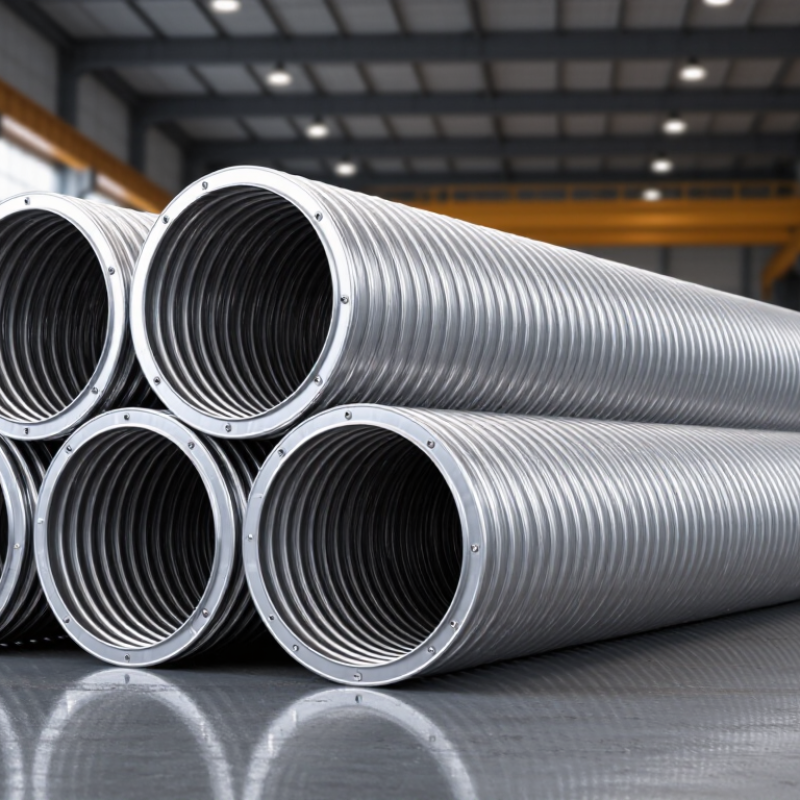
Corrugated steel pipes are round or arched conduits formed with repeated ribs. These corrugations increase stiffness without requiring excessive wall thickness. In practical terms, a pipe can cross beneath a highway while carrying stormwater, sediment, and seasonal runoff. Galvanized or polymer-coated surfaces help resist corrosion, but site chemistry still matters.
Their main global applications include road culverts, railway drainage, agricultural channels, mine-site water control, and stormwater outlets. The Federal Highway Administration’s Hydraulic Design Series No. 5 identifies corrugated metal pipes as established culvert options for highway drainage design. Engineers normally check rainfall intensity, hydraulic capacity, soil loading, cover depth, and outlet erosion. A 1.2-meter pipe under a rural road may need a different coating and thickness from a similar pipe beneath an industrial yard.
Material availability also supports international sourcing. The World Steel Association reported about 1.89 billion tonnes of crude steel production in 2023, showing the scale of the global steel supply base. However, steel volume alone does not guarantee a suitable pipe. Regional standards, groundwater acidity, installation quality, and maintenance access can change service life significantly.
Some projects still underestimate bedding requirements. That mistake can cause deformation, even when the pipe specification looks correct. Suppliers should provide test data, coating details, load calculations, and installation guidance rather than relying on catalog dimensions alone.
QUICK LINKS
CONTACT US
Office: (+86) 755 23040566
Tel: (+86) 158 9965 5195
E-mail: sale@pcbledmodule.com
Skype: Hans@Rocket-PCB
Whatsapp: 86 1589965 5195
Office Address: 2207,Bid 4,He Gu Shan Hui Cheng,35#,Guang Tian RoYanluo street, Song Gang Town,518105 SHENZHENG, CHINA
Plant ADD.: No 69, Lianfeng North Road, Xianxi Area, ChangAn Town, Dongguan, China.


Copyright © 2025 Rocket PCB Solution Ltd. | All Rights Reserved Sitemap Friendship link: CNC machining heat sink