
English


A Roller Table Conveyor can look simple: steel rollers, a sturdy frame, and a motor or gravity doing the work. Yet small design choices matter. Roller diameter, load capacity, spacing, and drive type affect how smoothly goods move between workstations. A poorly matched conveyor can slow a line or make transfers awkward.
This guide introduces ten manufacturers with a worldwide presence in material handling. It considers practical factors such as product range, customization, engineering support, industry experience, and service availability. These details can help buyers compare suppliers for packaging lines, warehouses, production floors, and other operations. A polished catalog is useful, but real performance depends on the application.
There is no universal best choice. Not every manufacturer serves every region or handles every load profile equally well. Specifications should be checked against actual package dimensions, weight, throughput, and site conditions. Ask about installation needs, replacement parts, and maintenance access, too. Those questions are easy to overlook.
The ranking is a starting point, not a final verdict. Company capabilities and product offerings can change, while public information may not reveal every limitation. Use the list to build a shortlist, then confirm details directly with manufacturers. A careful comparison often beats a fast decision.
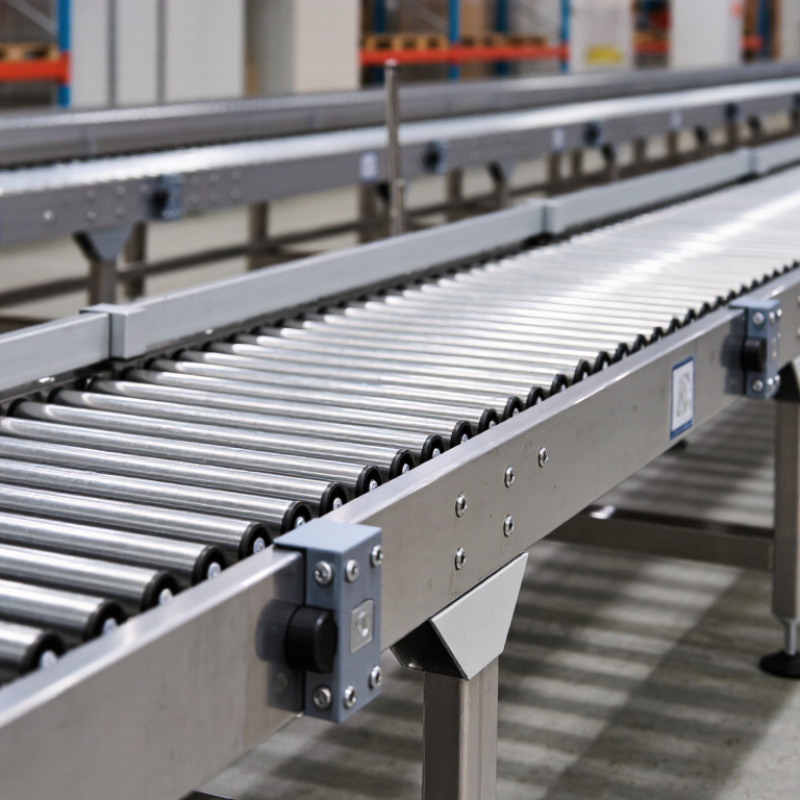
Roller table conveyors move cartons, totes, and rigid packages across powered or gravity-driven rollers. Their open structure makes loads easy to inspect and helps workers spot jams quickly. In a distribution center, a parcel may cross several roller zones before reaching sorting or packing. Small design choices matter: roller pitch must support the shortest load, while frame height and transfer points affect safe, steady movement. They are not suitable for every product. Soft bags can sag between rollers, and unstable loads may turn or slip.
The industrial role is broader than transport. Roller tables connect workstations, buffer uneven production rates, and reduce repeated manual handling. MHI and Deloitte’s 2024 Annual Industry Report found that 55% of surveyed companies planned to invest more than $1 million in supply-chain innovation over the following two years. That figure reflects wider automation interest, not conveyor purchases alone. It is an important distinction. In practice, a conveyor’s value depends on throughput, maintenance access, noise, and how well it fits existing processes. A neglected bearing can stop a line; yet adding automation without studying real load patterns can create new bottlenecks. Engineers should assess the actual packages, operating shifts, and cleaning needs before selecting a system.
QUICK LINKS
CONTACT US
Office: (+86) 755 23040566
Tel: (+86) 158 9965 5195
E-mail: sale@pcbledmodule.com
Skype: Hans@Rocket-PCB
Whatsapp: 86 1589965 5195
Office Address: 2207,Bid 4,He Gu Shan Hui Cheng,35#,Guang Tian RoYanluo street, Song Gang Town,518105 SHENZHENG, CHINA
Plant ADD.: No 69, Lianfeng North Road, Xianxi Area, ChangAn Town, Dongguan, China.


Copyright © 2025 Rocket PCB Solution Ltd. | All Rights Reserved Sitemap Friendship link: CNC machining heat sink