English


An Inverter Inductor may look like a compact coil on a circuit board, but its design affects ripple current, heat, noise, and system reliability. In solar inverters, energy storage, and industrial drives, buyers need parts matched to operating frequency, current, voltage, and cooling conditions. A catalogue rating alone is not enough. Core material, winding layout, insulation, and measured temperature rise all matter.
Power electronics professor Robert W. Erickson’s work emphasizes that magnetic components must be designed around the converter’s operating conditions. Put simply, an inductor that performs well in one circuit may be a poor fit in another. That distinction is easy to miss when comparing suppliers by price or headline specifications. Ask for test conditions, drawings, tolerances, and evidence behind performance claims. Small details matter.
This guide reviews ten manufacturers serving global buyers, with attention to product range, engineering support, customization, and documentation. It is a starting point, not a substitute for qualification testing. Supplier capabilities can vary by facility and product line; even a polished datasheet leaves questions unanswered. A sample can reveal winding consistency, mounting fit, and real-world temperature behavior. The best choice is not always the largest brand. It is the supplier whose verified capabilities match the application, delivery needs, and quality requirements.
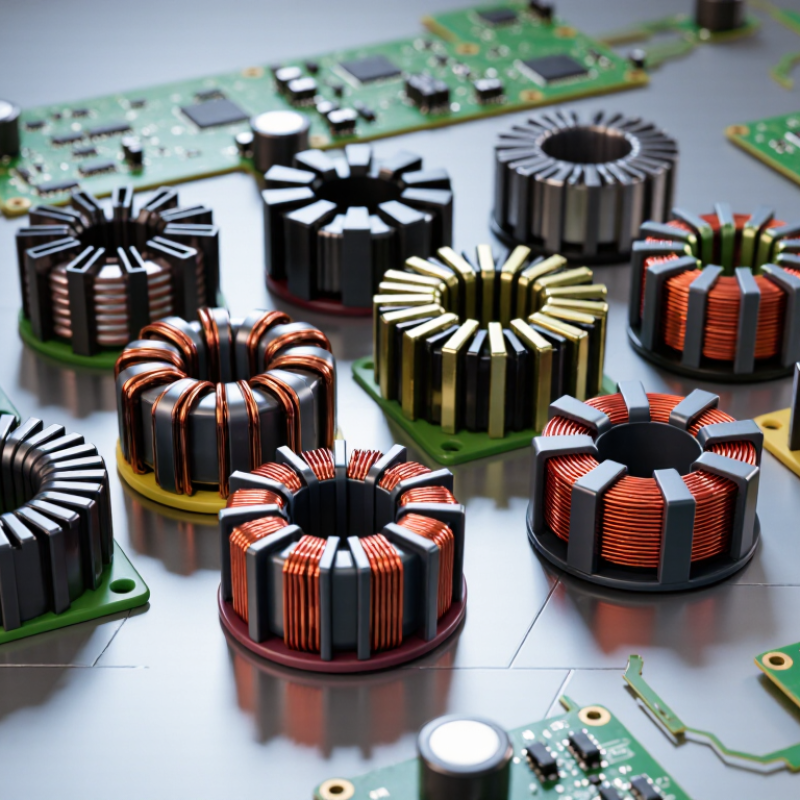
An inverter inductor may look like a simple coil, but its ratings shape efficiency, temperature, and operating stability. Inductance, measured in microhenries (µH), affects current ripple and response to switching changes. A higher value can reduce ripple, yet it may require more turns or a larger core. The best value depends on switching frequency, input voltage, load range, and control design. Check the specified test conditions; two µH figures are not always directly comparable.
RMS current, measured in amperes (A), indicates the continuous heating burden under a stated thermal setup. Compare it with the inverter’s actual current waveform, ambient temperature, airflow, and available board space. It is not the same as peak current. Brief overloads can still push the magnetic core toward saturation, so verify peak-current capability too. DCR, measured in milliohms (mΩ), is the winding’s direct-current resistance. Lower DCR usually means lower copper loss, calculated approximately as I²R, but it can come with trade-offs in size or cost. Small differences matter. At high current, even a few milliohms can create measurable heat. Datasheets may leave practical questions unanswered, such as how a rating changes inside a compact enclosure. That is worth checking with thermal tests.
The table below is an application-oriented buyer’s reference, not a manufacturer ranking or a list of supplier-specific specifications. Values are illustrative engineering ranges; actual requirements depend on topology, switching frequency, ripple current, temperature rise, core material, and cooling. Confirm ratings against the component datasheet and operating conditions.
| No. | Inverter application | Typical inductance range (µH) | Typical RMS current range (A) | Typical DCR range (mΩ) | Key buyer checks |
|---|---|---|---|---|---|
| 1 | Low-power DC-AC inverter | 10–100 | 2–15 | 10–200 | Package size, saturation current, and temperature rise |
| 2 | Residential solar inverter, boost stage | 50–500 | 10–60 | 1–30 | DC bias, core loss at switching frequency, and cooling method |
| 3 | Three-phase grid-tied inverter output filter | 100–2,000 | 10–200 | 0.2–20 | Ripple-current rating, acoustic noise, and insulation requirements |
| 4 | Energy-storage inverter DC-DC stage | 10–500 | 20–300 | 0.1–10 | Bidirectional operation, peak current, and thermal performance |
| 5 | Electric-vehicle traction inverter filter or choke | 1–100 | 50–500 | 0.05–5 | Vibration, thermal cycling, insulation system, and fault current |
| 6 | Industrial motor-drive inverter | 10–1,000 | 10–300 | 0.1–15 | Overload duration, enclosure temperature, and EMC requirements |
| 7 | Uninterruptible power supply inverter | 100–3,000 | 10–250 | 0.1–20 | Continuous-duty losses, transient current, and filter interaction |
| 8 | Microinverter power stage | 10–500 | 2–40 | 1–100 | Compact footprint, ambient-temperature derating, and lifetime |
| 9 | High-frequency transformer-coupled inverter stage | 1–200 | 5–150 | 0.2–30 | Frequency-dependent core loss, winding construction, and creepage |
| 10 | Regenerative or grid-interactive inverter | 50–2,000 | 10–300 | 0.1–15 | Bidirectional ripple, saturation margin, and grid-filter stability |
RMS current is the effective continuous current under specified thermal conditions; it is not interchangeable with saturation current. DCR is the winding’s DC resistance, and its associated copper loss is approximately I²R. Compare values only at consistent reference temperatures and verify inductance under the intended DC bias.
QUICK LINKS
CONTACT US
Office: (+86) 755 23040566
Tel: (+86) 158 9965 5195
E-mail: sale@pcbledmodule.com
Skype: Hans@Rocket-PCB
Whatsapp: 86 1589965 5195
Office Address: 2207,Bid 4,He Gu Shan Hui Cheng,35#,Guang Tian RoYanluo street, Song Gang Town,518105 SHENZHENG, CHINA
Plant ADD.: No 69, Lianfeng North Road, Xianxi Area, ChangAn Town, Dongguan, China.


Copyright © 2025 Rocket PCB Solution Ltd. | All Rights Reserved Sitemap Friendship link: CNC machining heat sink