

Buying a Ball Bearing Cnc Machine is not simply a matter of choosing the largest spindle or the lowest quotation. The machine must match bearing diameter, material hardness, tolerance targets, and production volume. A unit that looks impressive on a showroom floor may struggle with heat, vibration, or repeatability during a twelve-hour shift.
Market data shows why this decision deserves careful attention. Grand View Research valued the global CNC machine market at approximately USD 88 billion in 2023 and expects continued growth through 2030. The report links expansion to automation, precision manufacturing, and rising demand for efficient production. Meanwhile, the U.S. National Institute of Standards and Technology emphasizes measurement traceability and process control when manufacturers pursue reliable accuracy. These findings support a practical point: machine specifications should connect directly with inspection results.
Look beyond brochure promises.
A serious evaluation should examine spindle runout, axis positioning accuracy, bearing-seat tolerances, thermal compensation, coolant delivery, and service response time. ISO 230-1 and ISO 10791 provide useful references for testing machine-tool accuracy and machining-center performance. Ask suppliers for recent test reports, calibration records, sample parts, and references from comparable factories. One overlooked detail can be costly: a poorly supported foundation may undermine an otherwise excellent machine.
The following ten tips focus on real purchasing decisions, from defining work requirements to checking software, maintenance access, tooling, training, and lifetime cost. Some recommendations may seem obvious. They are still frequently missed. Reflect carefully before signing, because the cheapest machine can become the most expensive equipment on the floor.
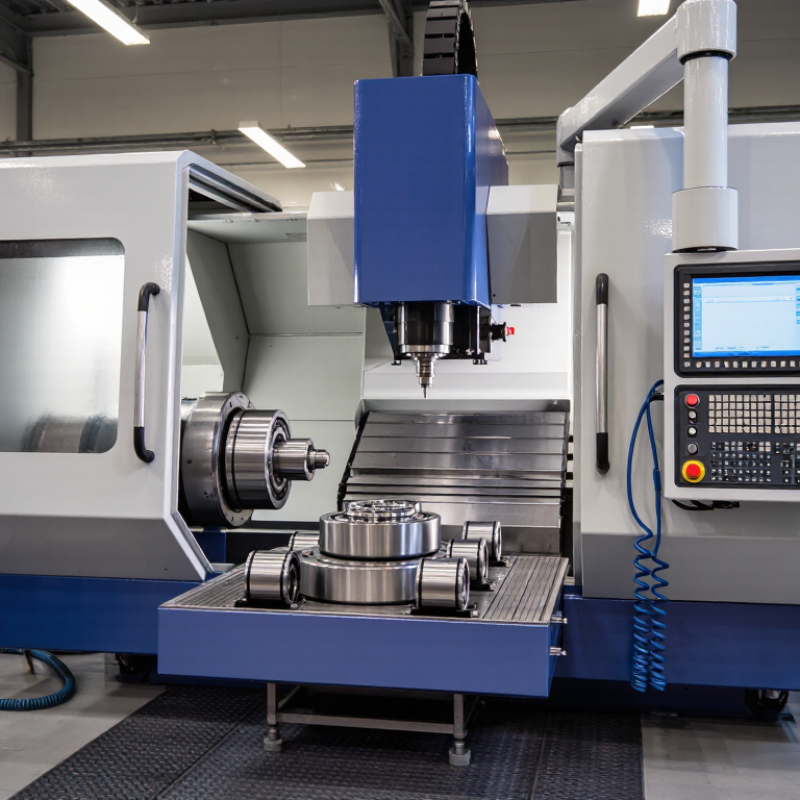
Before comparing models, define what the CNC machine must produce. A ball bearing CNC machine may serve small bearing components, housings, shafts, or general precision parts. Write down the materials, dimensions, tolerances, and monthly production volume. A small aluminum bracket needs different cutting power than a hardened steel raceway. Be honest about materials. Hard steel requires suitable spindle torque, rigid construction, and compatible tooling. Wood and plastic may need better dust control instead. I once focused too heavily on advertised speed. That assumption was wrong.
Measure the largest workpiece and the deepest cut required. Record the material hardness and the smallest feature you need to machine. Then compare spindle power, speed range, axis travel, and tool compatibility. Do not judge capability by spindle speed alone. Rigidity often matters more when cutting narrow grooves or bearing seats. Check the working envelope carefully. A long shaft can exceed the usable travel, even when the machine looks spacious. Tolerance also matters. Decorative parts may accept broad limits, while bearing fits require controlled accuracy and repeatable positioning. Leave room for clamping, tool changes, and chip removal. Verify published specifications through technical documents and practical test results. Run a sample cut. Use the exact stock and tooling planned for production. Inspect edge finish, dimensional variation, and heat marks. These details reveal limits that brochures often hide.
Ball bearing choice affects accuracy, heat, noise, and maintenance. Angular-contact bearings usually suit high-speed spindles because they manage radial and axial loads. Deep-groove bearings cost less, but they may lose stiffness during heavy cutting. Ceramic hybrid bearings reduce thermal growth and can support higher speeds. They also cost more.
A 2024 MarketsandMarkets analysis projects the CNC machine market to grow from about 101 billion dollars in 2024 to nearly 129 billion dollars by 2029. That growth increases equipment choices, but not necessarily quality.
Check the spindle system under real cutting conditions. Belt-driven spindles can reduce motor vibration, while direct-drive systems often improve response and speed stability. Ask for runout measurements, not broad claims.
A practical target is below 0.01 millimeter at the tool holder. Inspect preload adjustment and cooling paths.
Poor heat control can shift the cutting point after an hour. It happens.
Cast iron frames usually provide strong damping, while welded steel frames can offer lower weight and easier modification. However, weak weld relief may create alignment problems later.
The 2023 International Federation of Robotics industry data shows continued automation growth across manufacturing, increasing demand for repeatable machining. That does not make every machine rigid.
Test a sample cut, measure surface finish, and compare results after thermal warm-up.
Leave room for doubt.
A larger bearing is not always better. Oversized parts can add drag, heat, and cost. Choose based on load, speed, duty cycle, and service access.
Consider documented factory tests and independent inspection records before purchase.
Accuracy comes first. ISO 230-2 recommends testing positioning accuracy and repeatability across the machine’s working range. Tip 1: Request measured results, not brochure claims. Tip 2: Check thermal drift after several hours. A spindle can begin precise and finish slightly wrong. Tip 3: Ask for laser-interferometer data taken under realistic cutting conditions. My practical caution: factory accuracy is not shop-floor accuracy.
Load capacity must match the heaviest workpiece, fixture, and cutting force. ISO 281 bearing-life calculations show that small increases in dynamic load can sharply reduce rating life. Tip 4: Compare the stated load with your actual machining force. Tip 5: Examine axial and radial ratings separately. Tip 6: Leave a safety margin, but avoid excessive oversizing. It can reduce responsiveness. Tip 7: Inspect preload adjustment and lubrication access. These details are easy to overlook.
Speed is useful only when the bearings remain stable and cool. Tip 8: Request maximum speed, continuous speed, and runout at operating temperature. Tip 9: Review vibration readings, especially near your planned cutting range. The 2024 Gardner World Machine Tool Survey reported global machine-tool consumption above 80 billion dollars, showing the scale of this investment. Tip 10: Verify serviceable bearing life, sealing, and replacement procedures. Long-term durability depends on maintenance records, coolant protection, and operator habits. A weaker point remains: published life estimates rarely reflect every shop’s dust, heat, or interrupted cuts.
| No. | Buying Evaluation Area | Practical Benchmark or Specification | How to Verify It | Warning Signs | Buying Implication |
|---|---|---|---|---|---|
| 1 | Positioning Accuracy | For general machining, a stated positioning accuracy around ±0.01 mm may be suitable. Precision work generally requires a tighter, independently verified value. | Request a test report using a calibrated laser interferometer, linear scale, or ballbar system under defined conditions. | Only a vague “high precision” claim, no measuring method, or no ambient-temperature information. | Match the accuracy specification to the tolerance of the parts rather than paying for unnecessary precision. |
| 2 | Repeatability | A repeatability value near ±0.005 mm is a useful target for many light and medium-duty CNC applications, subject to machine size and test conditions. | Command the same coordinate several times from different directions and compare measured results. | Large variation after reversing direction, inconsistent homing, or visible backlash. | Prioritize repeatability when producing batches of parts with identical dimensions. |
| 3 | Ball Screw and Bearing Preload | Preloaded ball screws and properly matched angular-contact bearings reduce backlash and improve stiffness; excessive preload can increase heat and friction. | Ask for screw size, lead, preload class, bearing arrangement, and backlash measurements over the full travel. | Unusual vibration, rough movement by hand, excessive motor load, or unexplained temperature rise. | Choose a design that balances low backlash with acceptable operating temperature and service life. |
| 4 | Dynamic Load Capacity | Bearing selection should be based on the calculated dynamic equivalent load and required life, not simply the maximum table weight. | Compare the bearing catalog rating with cutting forces, axis mass, acceleration, and duty cycle. Use the manufacturer’s L10 life calculation. | The seller provides only a maximum workpiece weight without bearing load or service-life calculations. | Select a safety margin for shock loads, interrupted cuts, and frequent acceleration. |
| 5 | Maximum Spindle Speed | A speed range such as 8,000–24,000 rpm can support many small-tool applications, but the correct speed depends on tool diameter, material, and cutting data. | Check the spindle speed range, runout at the tool holder, balancing grade, and continuous power curve. | High peak rpm with low continuous torque, excessive noise, or no runout measurement. | Do not choose speed alone; verify that the spindle can maintain torque at the intended cutting speed. |
| 6 | Spindle Runout | For precision small-tool work, runout near or below 0.01 mm at the tool holder is a reasonable evaluation point; the actual result depends on the taper, collet, and tool. | Measure with a calibrated dial indicator at the taper and at a specified distance from the spindle nose. | Runout is measured only on an empty spindle or without stating the measurement location. | Low runout improves tool life, surface finish, and dimensional consistency. |
| 7 | Maximum Feed Rate and Acceleration | Rapid speeds of approximately 5–15 m/min are common across different machine classes, while acceleration must be evaluated together with axis mass and rigidity. | Run a representative program and record actual feed rate, following error, vibration, and stopping distance. | The advertised rapid rate is available only with an empty table or causes servo faults under load. | Choose stable acceleration and cutting-feed performance over an attractive no-load rapid-speed figure. |
| 8 | Machine Rigidity and Damping | A rigid frame, supported linear guides, short tool overhang, and adequate mass help limit deflection and chatter during cutting. | Inspect frame construction, guide support, bearing spacing, table mounting, and perform a test cut in the intended material. | Visible flexing, ringing sounds, poor surface finish, or chatter at conservative cutting parameters. | Rigidity is essential when cutting harder materials or using larger tools. |
| 9 | Thermal Stability | Ball screws and spindle bearings expand as they heat, so temperature control and warm-up procedures directly affect dimensional accuracy. | Run the machine through a normal duty cycle and compare warm and cold measurements at several axis positions. | Accuracy changes significantly after warm-up, or the machine lacks lubrication and thermal-compensation procedures. | Ask whether the machine uses warm-up cycles, cooling, temperature sensors, or compensation tables. |
| 10 | Lubrication, Sealing, and Service Life | Sealed or protected bearings, regular lubrication, clean coolant management, and correctly adjusted preload help extend bearing and ball-screw life. | Review the maintenance schedule, lubrication points, seal design, replacement procedure, and spare-part availability. | No maintenance interval, inaccessible grease points, exposed guides, or unclear replacement instructions. | A well-documented maintenance plan lowers downtime and protects long-term accuracy. |
Note: Accuracy, load, speed, and service-life values should be compared using the same test method, environmental conditions, duty cycle, and machine configuration.
Buying a ball bearing CNC machine starts with compatibility, not cutting speed. Match the machine’s travel, spindle power, and rigidity to your materials. Aluminum needs different cutting conditions from hardwood or plastic. Ask for documented load limits and test results. A machine that handles thin panels may struggle with dense stock.
Tools matter just as much. Check collet sizes, chuck capacity, tool length, and available cutters. Measure your existing tools before ordering. I once overlooked tool clearance and lost useful working height. That mistake was avoidable. Leave room for clamps, probes, and chip removal around the cutting area. Small details become expensive problems.
Software compatibility deserves equal attention. Confirm file formats, control software, and post-processor support. A design file may open correctly but still produce unusable toolpaths. Run a simulation before cutting valuable material. Keep a simple test file for checking future updates. Your workspace also needs stable power, ventilation, lighting, and a level floor. Measure doorways and bench depth. Allow space behind the machine for cables and maintenance. Noise and dust can affect nearby work, even when the machine itself performs well. Check these conditions in person when possible.
Check compatibility with materials, tools, software, and workspace before you buy.
The chart shows typical starting spindle-speed ranges for common CNC materials. Actual settings depend on tool diameter, flute count, cutting depth, feed rate, machine rigidity, and cooling. Always follow the tooling manufacturer's recommendations.
A ball bearing CNC machine deserves more than a low purchase price. Calculate the full cost, including tooling, software, installation, training, electricity, and spare bearings. Ask for a written quotation. Hidden costs matter. Compare delivery terms, warranty coverage, and payment conditions before signing. I once underestimated installation work, and the delay damaged our production schedule.
Maintenance should be practical, not theoretical. Check how easily operators can reach lubrication points, filters, belts, and bearing housings. Request a maintenance schedule with replacement intervals. Ask whether common parts are stocked locally. Inspect the machine’s service records during a demonstration. Measure the noise and vibration. Small changes can reveal alignment problems early. Still, maintenance estimates are never perfect; dust, workload, and operator habits change them.
Safety features must be visible and testable. Confirm guarded moving parts, a working emergency stop, door interlocks, chip protection, and clear operating instructions. Ask how the machine handles power loss and restart conditions. Supplier support also needs evidence. Request technician response times, remote troubleshooting procedures, training materials, and references from similar users. Speak with those users directly. A confident sales promise is not enough. Test the machine with your actual material and cutting cycle, then record accuracy, surface finish, cycle time, and recovery behavior. Do not ignore uncomfortable findings.
QUICK LINKS
CONTACT US
Office: (+86) 755 23040566
Tel: (+86) 158 9965 5195
E-mail: sale@pcbledmodule.com
Skype: Hans@Rocket-PCB
Whatsapp: 86 1589965 5195
Office Address: 2207,Bid 4,He Gu Shan Hui Cheng,35#,Guang Tian RoYanluo street, Song Gang Town,518105 SHENZHENG, CHINA
Plant ADD.: No 69, Lianfeng North Road, Xianxi Area, ChangAn Town, Dongguan, China.


Copyright © 2025 Rocket PCB Solution Ltd. | All Rights Reserved Sitemap Friendship link: CNC machining heat sink