

A Spray Nozzle may look like a small metal fitting, yet it controls how liquid becomes a useful spray. Inside its narrow passage, pressure accelerates the fluid and shapes its movement. The outlet then divides the liquid into droplets, forming a cone, fan, stream, or hollow pattern. Droplet size matters. It affects coverage, cooling, cleaning, drying, and chemical application.
Spray technology expert Arthur H. Lefebvre described the core process clearly: “Atomization is the process of breaking up bulk liquid into droplets.” This definition explains why nozzle design requires more than choosing an outlet size. Engineers examine pressure, flow rate, liquid viscosity, surface tension, and operating temperature. A stainless-steel nozzle may perform steadily in a hot wash line, while a plastic nozzle may suit a lighter-duty system. Small changes can be significant.
The details are tangible. A partially blocked orifice can create a crooked spray pattern. Excessive pressure may produce unwanted mist. Low pressure can leave dry stripes across a moving surface. Nozzle wear also changes flow over time, even when the equipment appears normal. There is no perfect Spray Nozzle for every task. That limitation deserves attention.
This guide explains what a Spray Nozzle is, how it works, and why its internal geometry matters. It also considers spray patterns, droplet behavior, materials, maintenance, and selection criteria. Real performance depends on testing under actual conditions. A catalogue chart helps, but it cannot replace measurement. Even experienced users sometimes overlook that point.
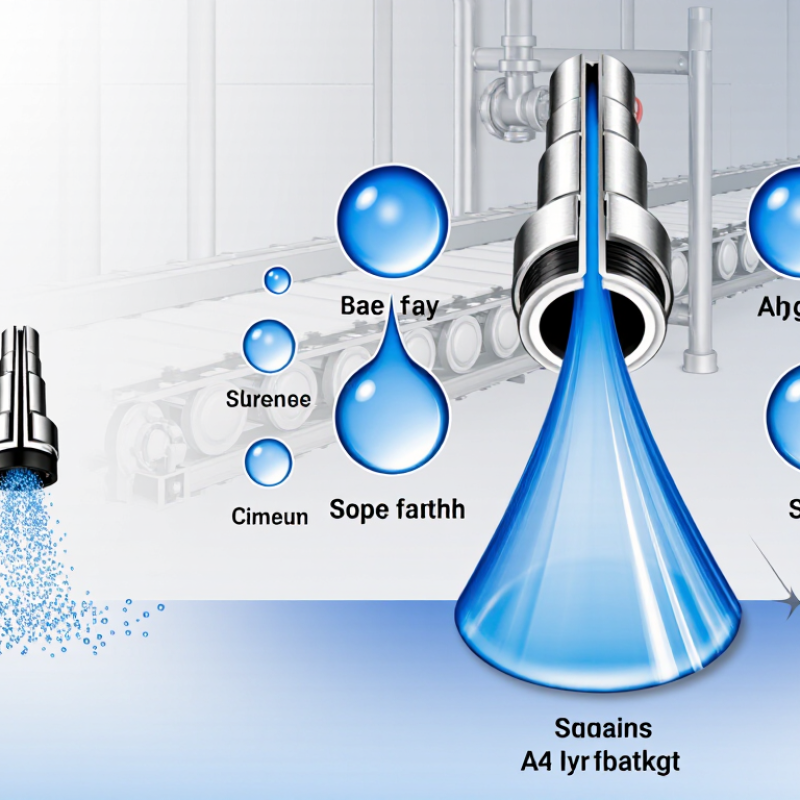
A spray nozzle is a precision device that converts liquid into controlled droplets, sheets, or narrow streams. It usually contains a small orifice, internal passage, and outlet shape. Pressure pushes liquid through these parts, while the outlet determines spray angle, flow rate, and droplet size. In many hydraulic nozzles, flow increases with the square root of pressure. Doubling pressure does not double output.
Droplet size matters greatly. ASABE S572.1 classifies spray droplets from very fine, below 100 micrometers, to ultra-coarse, above 665 micrometers. Small droplets cover surfaces more evenly, but they can drift or evaporate quickly. Larger droplets resist movement and impact surfaces harder. Small droplets travel far. Large droplets land sooner. Neither choice is automatically better.
USDA’s 2022 Census of Agriculture reported 880.1 million acres in U.S. farms. That scale shows why accurate nozzle selection matters in field operations. Technicians also examine liquid viscosity, pressure stability, temperature, and pump capacity. A nozzle designed for water may perform differently with thicker liquids. This detail is often overlooked.
Nozzle performance is not perfectly predictable. Wear can enlarge the orifice and increase flow, sometimes without visible damage. ISO 5682-1 provides methods for evaluating spray distribution and flow behavior. In practical inspections, comparing actual output with the rated value remains essential. A simple collection test may reveal a problem earlier than appearance alone.
A spray nozzle controls liquid flow and converts it into a specific spray pattern. Its design affects coverage, droplet size, pressure, and application consistency. In practical equipment inspections, the nozzle body is the main housing. It connects to the fluid line and protects the internal components.
The inlet guides liquid into the nozzle. Inside, a passage or swirl chamber may rotate the liquid before it exits. This movement can create a cone-shaped spray. The orifice is the small opening that determines flow volume and droplet formation. A spray cap holds the outlet components in position. Seals and gaskets prevent leaks, while a small filter can block particles before they reach the orifice. Each part matters. A worn opening can quietly change the spray pattern.
Tips: Check the gasket for flattening, cracking, or stiffness. Clean the orifice with the correct soft tool, not a sharp metal object. Compare the spray pattern under consistent pressure. Pressure changes can look like nozzle damage. Material compatibility also matters, because unsuitable liquids may weaken seals or corrode internal surfaces. A perfect spray rarely stays perfect. Even careful maintenance can miss tiny wear. When performance becomes uneven, inspect the filter, chamber, and orifice together instead of replacing one part immediately.
A spray nozzle converts pressurized liquid into controlled droplets. The process begins at the pump. Pressure pushes liquid through the nozzle inlet and into a narrow internal passage. As the passage becomes smaller, liquid velocity increases. The orifice then releases a thin sheet or focused jet into the air.
That sheet breaks apart. Surface tension, air resistance, and nozzle geometry create separate droplets. Internal vanes may produce a hollow cone, while a shaped outlet can form a flat-fan pattern. Pressure affects the result, but not in a simple way. Flow usually follows the square-root relationship: doubling pressure increases flow by only about 41 percent. Higher pressure can also create smaller droplets and more drift.
The pattern reaches the target next. Coverage depends on droplet size, spray angle, spacing, height, and travel speed. ASABE S572.1 classifies spray quality by droplet size, helping technicians compare patterns consistently. The 2024 United Nations World Water Development Report states that agriculture accounts for about 70 percent of global freshwater withdrawals, so nozzle calibration matters beyond the equipment room. A worn or partially blocked orifice can change flow and coverage without obvious visual warning. This is easy to miss. Field checks should measure output from each nozzle and inspect the pattern on a clean test surface. Real systems are messier than diagrams. Temperature, liquid viscosity, and pressure fluctuations can quietly alter performance.
What Is a Spray Nozzle and How Does It Work?
A spray nozzle converts liquid pressure into a controlled spray pattern. Its internal orifice, swirl chamber, and outlet shape determine how the liquid breaks apart. Common patterns include flat fan, hollow cone, full cone, and solid stream. A flat-fan pattern forms overlapping sheets, useful for uniform surface coverage. Hollow-cone sprays concentrate droplets around an open center. Full-cone sprays create a denser, round coverage area.
Droplet size is equally important. The ASABE S572.1 classification uses volume median diameter to group droplets from Very Fine, below 145 micrometres, to Ultra Coarse, above 650 micrometres. ISO 25358:2018 also supports standardized droplet-size classification. Fine droplets can improve coverage on smooth surfaces, but they drift more easily. Coarse droplets resist drift and evaporation, although they may leave fewer droplets per square centimetre. The trade-off is real.
Pressure changes the result quickly. Higher pressure often creates smaller droplets, while larger orifices generally produce larger droplets at the same flow rate. Air-induction designs can produce coarse, air-filled droplets with reduced drift potential. In field testing, technicians use laser diffraction systems and patternators to measure droplet distribution and spray uniformity. Practical measurements can still disagree with catalogue values. Temperature, viscosity, nozzle wear, and water quality interfere. I have seen a seemingly correct pattern become uneven after a small filter blockage. That detail is easy to miss.
| Spray Nozzle Type | How It Works | Typical Spray Pattern | Typical Droplet Size (Dv50, approximately) | Common Operating Pressure | Typical Coverage or Impact | Common Applications |
|---|---|---|---|---|---|---|
| Flat-Fan Nozzle | Liquid passes through a shaped orifice and forms a thin, fan-shaped sheet that breaks into droplets. | Elliptical fan with tapered edges; designed for overlapping spray swaths. | 100–400 µm | 1.5–5 bar (22–73 psi) | Uniform surface coverage with moderate impact. | Surface treatment, agricultural coverage, cleaning, coating, and conveyor applications. |
| Hollow-Cone Nozzle | A tangential or swirl flow creates a rotating liquid sheet that atomizes around the outer edge. | Ring-shaped spray with a relatively open center. | 50–250 µm | 1–7 bar (15–102 psi) | Fine droplets and strong radial coverage. | Gas cooling, humidification, dust suppression, and light spray coating. |
| Full-Cone Nozzle | An internal vane or swirl chamber distributes liquid across the complete circular spray area. | Solid circular cone filled with droplets. | 150–600 µm | 1–10 bar (15–145 psi) | Broad coverage with moderate-to-high liquid loading. | Tank washing, cooling, scrubbing, fire protection, and process spraying. |
| Deflector Nozzle | A liquid jet strikes a deflector surface, spreading outward into a wide sheet. | Wide flat fan or umbrella-shaped pattern. | 250–800 µm | 0.5–4 bar (7–58 psi) | Large coverage area with relatively coarse droplets. | Low-pressure irrigation, dust control, cooling, and general wetting. |
| Air-Induction Nozzle | Liquid flow creates a pressure drop that draws air into the spray passage, producing air-filled droplets. | Flat fan or cone, depending on the outlet design. | 300–800+ µm | 2–8 bar (29–116 psi) | Coarse to extremely coarse droplets with reduced drift potential. | Outdoor spraying where wind drift reduction is important. |
| Fine-Mist Nozzle | High pressure, a small orifice, and often internal swirl create rapid liquid-sheet breakup. | Very fine hollow cone or compact mist plume. | 10–100 µm | 5–70 bar (73–1,015 psi) | Very high surface area; droplets can evaporate or drift easily. | Humidification, evaporative cooling, odor control, and precision misting. |
| Air-Atomizing Nozzle | Compressed air supplies energy to break the liquid into very small droplets, either internally or externally. | Round, flat, or adjustable atomized plume. | 10–100 µm | Liquid: 0.2–7 bar Air: 1–7 bar | Very fine atomization with adjustable spray quality. | Paint and coating, lubrication, pharmaceutical processing, and precision application. |
| Solid-Stream Nozzle | A relatively large, unobstructed orifice produces a compact liquid jet rather than a widely dispersed spray. | Solid jet or narrow stream. | Usually not classified by spray droplet size; droplets are comparatively large. | 1–100+ bar (15–1,450+ psi) | High localized impact and long reach. | Descaling, cutting, cleaning, injection, and high-impact washing. |
| Factor | Typical Effect on the Spray |
|---|---|
| Liquid Pressure | Increasing pressure generally increases flow rate and reduces average droplet size, although the exact effect depends on nozzle geometry and liquid properties. |
| Flow Rate | Flow rate is commonly related to the square root of pressure for a fixed nozzle and liquid. Doubling pressure does not normally double flow. |
| Liquid Viscosity | Higher viscosity usually produces larger droplets and may require more pressure or a different nozzle design. |
| Surface Tension | Higher surface tension resists breakup and can result in larger droplets or a less finely atomized spray. |
| Nozzle Orifice and Geometry | Small orifices and swirl features generally promote finer atomization, while large orifices tend to produce higher flow and coarser droplets. |
| Airflow and Wind | Air movement can deform the spray pattern and carry fine droplets away from the intended target. |
Spray nozzles control how liquid becomes droplets, so their condition directly affects coverage, waste, and equipment safety.
In field inspections, uneven spray often begins with a partially blocked or worn orifice. A nozzle may still look clean. It may still perform poorly. The FAO AQUASTAT database reports that agriculture uses about 70% of global freshwater withdrawals. Small flow losses can therefore create serious resource costs across large systems.
Operators should inspect nozzles before each shift. Look for distorted spray patterns, dripping after shutdown, rust, and visible enlargement at the outlet. Compare the measured flow with the manufacturer’s rated flow at the same pressure. A difference above 10% deserves investigation, although the acceptable limit depends on the application and local procedure.
Clean blocked nozzles with approved soft tools. Never force wire through the opening. It can permanently damage the orifice. Replace severely worn parts instead of compensating with higher pressure. That shortcut often produces finer drift-prone droplets and uneven coverage.
Tips:
Keep spare nozzles sealed and labeled by size. Record pressure, flow, cleaning dates, and replacement reasons. The U.S. Environmental Protection Agency’s WaterSense program estimates that household leaks waste nearly one trillion gallons of water annually. Industrial systems differ, but the lesson remains relevant: routine checks prevent invisible losses. A practical weakness is relying only on visual inspection. Use a calibrated flow test when accuracy matters. It takes extra minutes. It can reveal problems before the whole application fails.
QUICK LINKS
CONTACT US
Office: (+86) 755 23040566
Tel: (+86) 158 9965 5195
E-mail: sale@pcbledmodule.com
Skype: Hans@Rocket-PCB
Whatsapp: 86 1589965 5195
Office Address: 2207,Bid 4,He Gu Shan Hui Cheng,35#,Guang Tian RoYanluo street, Song Gang Town,518105 SHENZHENG, CHINA
Plant ADD.: No 69, Lianfeng North Road, Xianxi Area, ChangAn Town, Dongguan, China.


Copyright © 2025 Rocket PCB Solution Ltd. | All Rights Reserved Sitemap Friendship link: CNC machining heat sink


