
English


Sourcing a Salto Hotel Card for global buyers requires more than comparing prices on a supplier website. The card must match the hotel’s SALTO access platform, reader technology, encoding process, and security policy. A visually impressive card can still fail at the front desk.
Market scale makes this decision important. UN Tourism reported approximately 1.4 billion international tourist arrivals in 2024, nearly returning to pre-pandemic levels. WTTC’s 2024 Economic Impact Research valued global travel and tourism at a record US$11.1 trillion. More guests mean more cards, replacements, and pressure on procurement teams. Small compatibility errors can become expensive operational problems.
A reliable sourcing process should verify card frequency, chip technology, memory, encryption support, printing quality, and hotel-system integration. Buyers should request samples before approving bulk production. They should also examine supplier experience, factory controls, export packaging, lead times, and after-sales support. SALTO’s own technical documentation remains the essential reference for approved configurations. General marketplace descriptions are not enough.
Security matters.
Suppliers should provide traceable product information and clear documentation. They should not promise universal compatibility without testing. ISO/IEC 14443 references may help, but they do not prove SALTO compatibility by themselves. That distinction is often missed.
This guide examines practical sourcing routes, supplier verification, customization, compliance, and international logistics. It also questions one common assumption: the lowest unit price is rarely the lowest total cost. A better decision balances authentication, durability, delivery reliability, and long-term hotel operations. That balance deserves careful review.
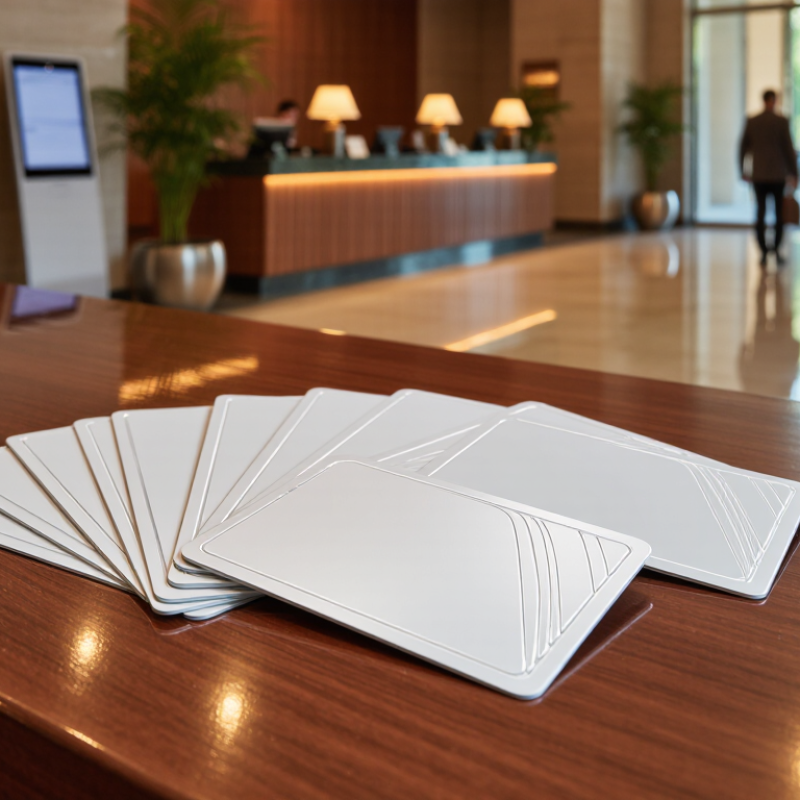
How to Source a Salto Hotel Card for Global Buyers?
SALTO hotel cards typically use SVN data-on-card technology with 13.56 MHz RFID communication. SVN stores access permissions directly on the card, rather than relying on constant network access. A guest may receive a card at reception, enter a room, and use shared facilities without a live connection. The card should support the required ISO/IEC 14443 standards, encryption profile, memory size, and read distance. These details matter more than appearance.
Grand View Research estimated the global RFID market at about USD 14.3 billion in 2023, with an expected 11.9% annual growth through 2030. This growth increases supplier choices, but quality remains uneven. Buyers should request samples, datasheets, encoding tests, and environmental ratings. Test cards beside metal doors, mobile phones, and elevator readers. Small failures become expensive during hotel deployment. They happen.
IDTechEx’s 2024 RFID analysis also identifies contactless identification as a major growth area across access control and hospitality. However, frequency alone does not guarantee compatibility. Confirm chip structure, sector security, writable memory, printing durability, and key-management procedures. Ask for traceable production records and independent test evidence. I would also check ten random cards from each batch. A perfect sample proves little. Raw material variation, weak lamination, or incorrect encoding can still disrupt check-in operations.
| Data Dimension | Reference Specification or Typical Value | Relevance to Global Hotel Buyers | Recommended Verification Point |
|---|---|---|---|
| Card Technology | SALTO hotel cards generally use contactless smart-card technology with data stored on the card for authorized access management. | The card can carry access-related information and support offline locks without requiring every door to be continuously connected to a central server. | Confirm the exact card family, memory configuration, encryption method, and system compatibility before purchasing. |
| Operating Frequency | 13.56 MHz high-frequency RFID. | This frequency is widely used for contactless access cards and is supported by established international smart-card standards. | Do not substitute a low-frequency 125 kHz proximity card unless the installed readers explicitly support it. |
| Contactless Interface | ISO/IEC 14443 proximity-card interface, normally using short-range inductive coupling. | The guest can present the card by tapping or holding it near the reader; physical insertion is not required. | Request confirmation of ISO/IEC 14443 support and the applicable card type used by the hotel access system. |
| Data-on-Card Model | The SVN model uses authorized card data to distribute or update access permissions through the hotel’s operational network. | Cards may be updated at designated points such as reception or other equipped access points, reducing the need for wired connections at every lock. | Verify where card updates occur, how often permissions are refreshed, and what happens when a card is lost or expired. |
| Access Permission Content | Typical records include room or zone permissions, validity dates, validity times, issue information, and security-related control data. | Time-limited permissions support check-in, checkout, staff access, housekeeping schedules, and restricted-area control. | Ask for the supported permission structure and confirm that the card does not expose sensitive personal data in readable form. |
| Security Architecture | Secure authentication and encrypted card communication should be used; the exact cryptographic implementation depends on the approved card and system configuration. | Strong authentication helps reduce unauthorized cloning, replay, and manipulation of access credentials. | Require written confirmation of supported encryption, key-management responsibility, card revocation, and replacement procedures. |
| Read Range | Usually a short range of a few centimetres, depending on the reader, antenna design, card orientation, and installation conditions. | Short-range operation reduces accidental reads and provides a predictable guest experience at the door. | Test the card with the actual lock and reader model rather than relying only on laboratory read-range claims. |
| Card Construction | Common formats include ISO/IEC 7810 ID-1 cards measuring approximately 85.60 × 53.98 mm, with a typical thickness close to 0.76 mm. | Standard dimensions fit common card holders, printers, wallets, and hotel key-card packaging. | Confirm dimensions, material, surface finish, antenna placement, and compatibility with the hotel’s card printer. |
| Printing and Personalization | Cards may support one- or two-sided visual printing, while electronic encoding is performed using compatible card-encoding equipment. | Visual branding, room instructions, emergency information, and event details can be printed without replacing the electronic credential function. | Separate visual-printing requirements from electronic encoding requirements and request a production sample. |
| Memory Capacity | Available memory varies by integrated circuit; common contactless smart-card products provide memory from a few hundred bytes to several kilobytes. | The required capacity depends on the number of access zones, permission records, audit data, and system-specific security fields. | Never approve a card based on memory size alone; confirm the exact chip model and encoding profile. |
| Environmental Durability | PVC, composite, or similar card bodies are commonly used; resistance to bending, abrasion, moisture, and temperature depends on the construction. | Durability is important for repeated handling, humid locations, outdoor facilities, and long staff-use cycles. | Request material specifications, test reports, and operating-temperature information for the intended region. |
| Global Compliance Considerations | Relevant references may include ISO/IEC 14443 for contactless cards, ISO/IEC 7810 for card dimensions, and applicable regional radio-equipment requirements. | Compliance documentation supports customs clearance, procurement approval, and deployment across multiple countries. | Request declarations of conformity, test reports, safety information, and country-specific import documentation where applicable. |
| Supplier Qualification | A qualified supplier should provide traceable chip information, encoding support, quality-control records, samples, and consistent batch production. | Traceability helps international buyers manage counterfeit risk, inconsistent read performance, and cross-border warranty issues. | Check sample approval, minimum order quantity, lead time, packaging, quality tolerance, replacement policy, and pre-shipment testing. |
| Recommended Sourcing Workflow | Identify the installed access platform, confirm the approved card profile, test samples, validate encoding, approve artwork, and release the production order. | A controlled workflow minimizes incompatibility, rejected batches, guest lockouts, and delays during hotel opening or renovation projects. | Obtain written technical approval before mass production and retain approved samples for future batch comparison. |
QUICK LINKS
CONTACT US
Office: (+86) 755 23040566
Tel: (+86) 158 9965 5195
E-mail: sale@pcbledmodule.com
Skype: Hans@Rocket-PCB
Whatsapp: 86 1589965 5195
Office Address: 2207,Bid 4,He Gu Shan Hui Cheng,35#,Guang Tian RoYanluo street, Song Gang Town,518105 SHENZHENG, CHINA
Plant ADD.: No 69, Lianfeng North Road, Xianxi Area, ChangAn Town, Dongguan, China.


Copyright © 2025 Rocket PCB Solution Ltd. | All Rights Reserved Sitemap Friendship link: CNC machining heat sink

