
English


Global buyers evaluating a Scattering Laminating Machine need more than a polished brochure. They need stable material distribution, reliable bonding, and settings operators can adjust without guesswork. A thin, uneven layer can create visible defects across an entire production run. Small details matter.
The wider flooring market provides useful context, though it is not a direct measure of machine demand. Grand View Research valued the global wood flooring market at USD 47.13 billion in 2023 and projected a 5.3% compound annual growth rate from 2024 to 2030. That growth makes production consistency and equipment flexibility important buying considerations. It does not guarantee that every supplier or machine will meet a plant’s needs. Buyers should verify operating speed, material compatibility, maintenance access, and after-sales support against their own production requirements.
Quality-management expert Joseph M. Juran described quality as “fitness for use.” That principle applies here: a machine is valuable only when it performs reliably in the buyer’s actual process. No independently verified quotation from a named scattering laminating machine specialist is available in the source material, so attributing one would risk misleading readers. This guide instead compares manufacturers through practical criteria, including documented capabilities, customization, service coverage, and evidence from real installations. Some details may still require direct confirmation; supplier claims deserve careful checking.
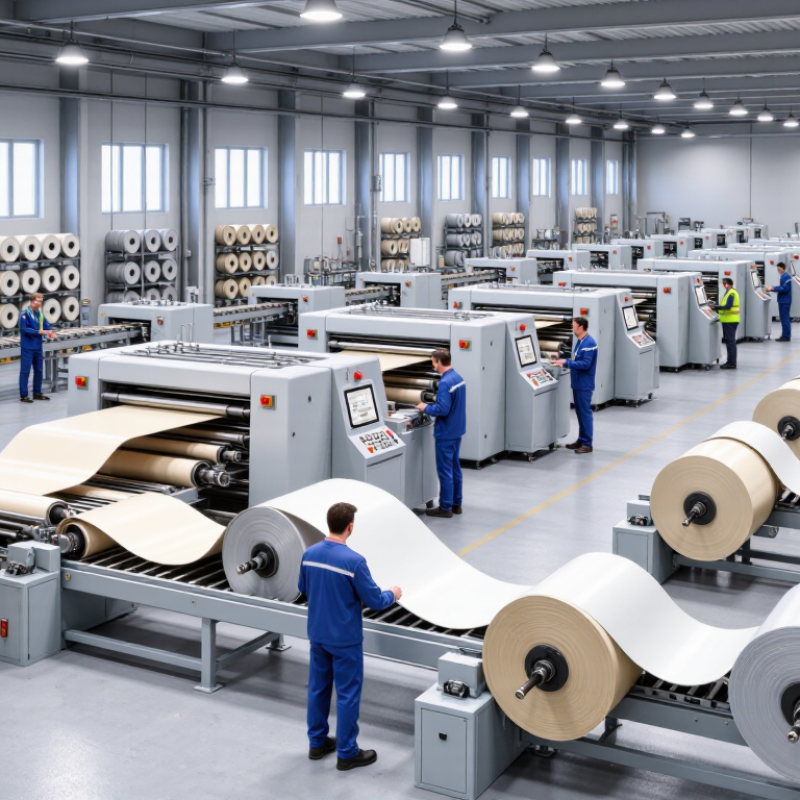
A scattering laminating machine distributes loose fibers or adhesive across a moving web, then bonds the layers with heat, pressure, or both. Operators adjust feed rate, web speed, and temperature to control coverage and bond strength. Too much adhesive can stiffen the sheet; too little may cause peeling. Small test runs help reveal uneven edges before a full production shift. The process commonly combines polyester or polypropylene nonwovens with films, foam, textiles, or other flexible layers. Still, material behavior varies. Fiber length, moisture, and surface finish can all change how evenly the layer forms.
Applications include furniture padding, automotive interiors, filtration media, insulation, and protective packaging. These products need different balances of softness, durability, breathability, and heat resistance. Grand View Research estimated the global nonwoven fabric market at USD 54.5 billion in 2023, with a projected 5.7% compound annual growth rate from 2024 to 2030. This market estimate is not a machine-sales forecast, but it signals a broad materials base for converters. Buyers comparing equipment should check working width, dosing accuracy, line speed, heating method, and cleaning access. Ask for trials using the actual substrate. A neat sample alone can mislead. The operator’s ability to repeat settings across shifts matters just as much as headline speed.
QUICK LINKS
CONTACT US
Office: (+86) 755 23040566
Tel: (+86) 158 9965 5195
E-mail: sale@pcbledmodule.com
Skype: Hans@Rocket-PCB
Whatsapp: 86 1589965 5195
Office Address: 2207,Bid 4,He Gu Shan Hui Cheng,35#,Guang Tian RoYanluo street, Song Gang Town,518105 SHENZHENG, CHINA
Plant ADD.: No 69, Lianfeng North Road, Xianxi Area, ChangAn Town, Dongguan, China.


Copyright © 2025 Rocket PCB Solution Ltd. | All Rights Reserved Sitemap Friendship link: CNC machining heat sink

