
English


China’s 58mm thermal printer sector serves busy checkout counters, compact kiosks, delivery desks, and mobile service teams. These printers use narrow paper rolls, often around 58 millimeters wide, to produce receipts where space and speed matter. Buyers still need to look beyond a low unit price. Print clarity, cutter life, interface options, driver support, and steady paper feeding shape daily performance.
Market context appears in Grand View Research’s Thermal Printing Market analysis and IMARC Group’s Thermal Printer Market report. These reports examine market segments and demand trends, but their broad figures do not describe China’s 58mm segment alone. That distinction matters. No source material was supplied to verify a named 58mm thermal printer specialist’s quotation, so assigning one would risk misrepresenting an expert. A sourced quotation should be added before publication.
This guide compares manufacturers through practical criteria: product range, customization, quality controls, communication, and after-sales support. A printer that works well in a showroom may struggle beside a hot kitchen counter or through a full shift of receipt printing. Small details count. Ask suppliers for interface specifications, sample prints, warranty terms, and evidence of repeatable production. Treat any ranking as a starting point, not a substitute for testing.
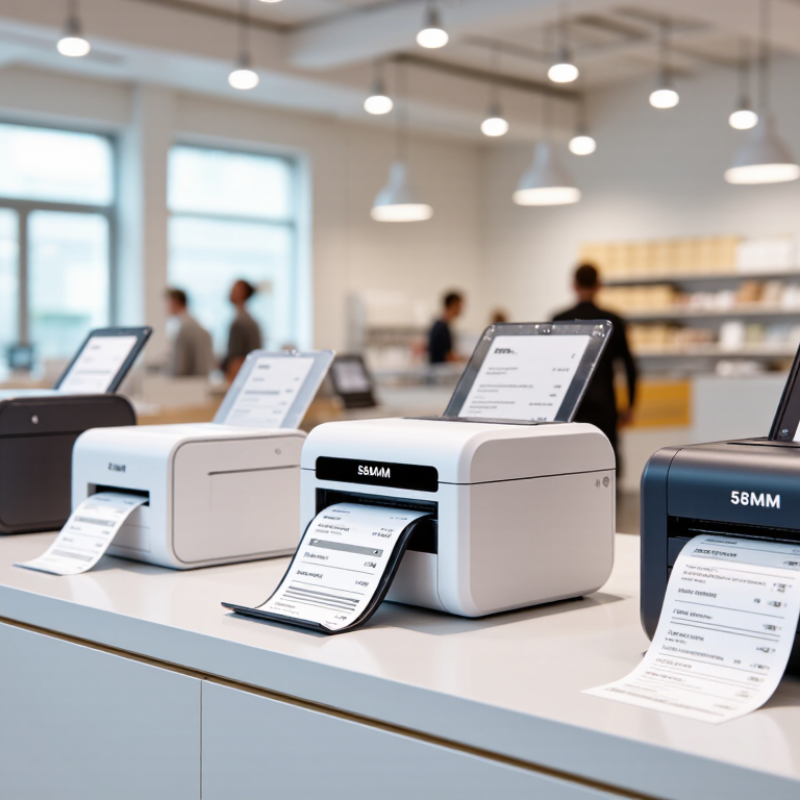
A 58mm thermal printer usually accepts paper close to 58mm wide, but its printable area is narrower. A common print width is about 48mm. At 203 dpi, the print head provides 384 dots across that area, or roughly eight dots per millimeter. That is the useful figure when laying out a receipt. Paper width is not print width.
In practice, test a receipt with the actual font, margins, and paper roll. A logo or long item name can wrap sooner than expected. At 384 dots, a line of text must fit within the available dot columns; even a few extra characters may push a word onto another line. Small barcodes need careful sizing, too. Check both readability and quiet margins before production. It is easy to assume a 58mm roll gives 58mm of usable space. It does not. Thermal paper can also shift slightly during feeding, so designs placed right at the edge may look uneven. I still find that a printed sample catches layout issues that a screen preview misses. Small detail, real difference.
QUICK LINKS
CONTACT US
Office: (+86) 755 23040566
Tel: (+86) 158 9965 5195
E-mail: sale@pcbledmodule.com
Skype: Hans@Rocket-PCB
Whatsapp: 86 1589965 5195
Office Address: 2207,Bid 4,He Gu Shan Hui Cheng,35#,Guang Tian RoYanluo street, Song Gang Town,518105 SHENZHENG, CHINA
Plant ADD.: No 69, Lianfeng North Road, Xianxi Area, ChangAn Town, Dongguan, China.


Copyright © 2025 Rocket PCB Solution Ltd. | All Rights Reserved Sitemap Friendship link: CNC machining heat sink

