
English


Choosing the right Pp Geogrid can determine whether a reinforced soil structure remains stable after years of loading. On a real road project, the drawing may show a simple layer beneath aggregate. The ground underneath may be soft, wet, or uneven. That difference matters. Engineers assess tensile strength, junction efficiency, aperture size, polymer type, and installation conditions before approving a product. They also review laboratory test reports, quality certificates, and the manufacturer’s technical data. A strong headline value alone is not enough. It must match the design load and expected service life. Small details count.
This guide explains how to compare Pp Geogrid for roads, retaining walls, working platforms, and similar applications. It considers polypropylene behavior, construction damage, soil interaction, drainage, temperature, and long-term creep. Field experience shows that placement quality often affects performance as much as product selection. Wrinkles, poor overlaps, sharp aggregate, and inadequate compaction can weaken an otherwise suitable system. Site inspections and documented testing make decisions more reliable. However, every project has limits. A product that performs well on granular subgrade may not suit saturated clay. Designers should confirm calculations with qualified geotechnical professionals and follow applicable local standards. We should admit an uncomfortable point: product labels can simplify complex behavior. Careful verification is still necessary. The right choice is not always the strongest grid. It is the grid that fits the soil, load, installation method, and budget without hiding uncertainty.
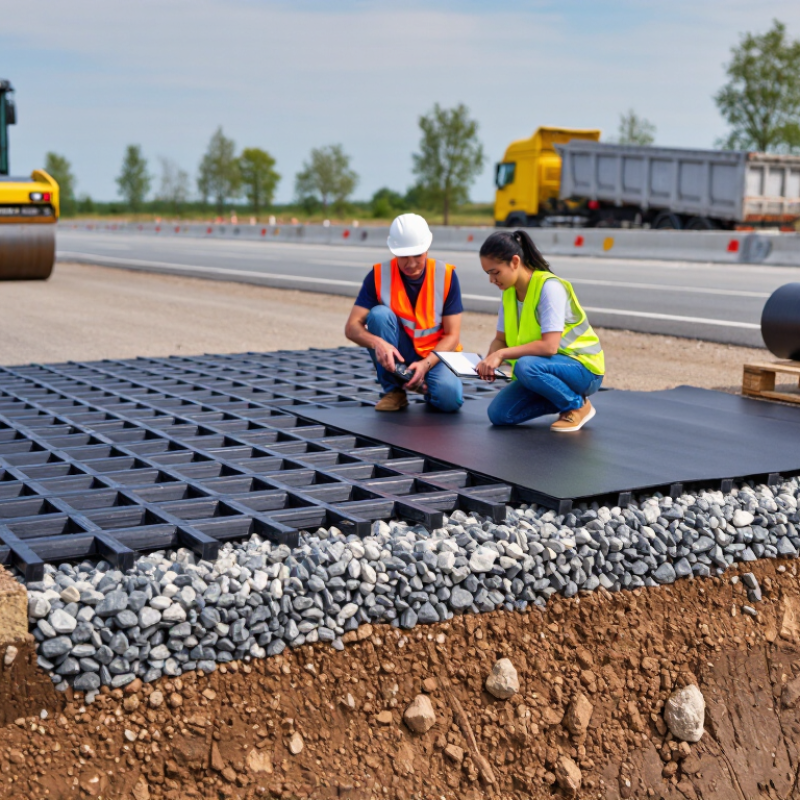
A CBR value between 2% and 8% signals variable subgrade support. Test several locations, not only the easiest access point. A CBR near 2% may require stronger stabilization than a CBR near 8%. Record moisture, soil texture, rut depth, and seasonal changes. Wet ground changes everything. Site loads also matter. Construction traffic, storage areas, haul roads, and permanent vehicles create different stresses. A geotechnical engineer should convert these loads into design requirements for tensile strength, stiffness, and junction performance.
Drainage deserves equal attention. PP geogrid can improve aggregate confinement, but it cannot replace a drainage layer or blocked outlet. Check groundwater, surface runoff, pipe locations, and the planned crossfall. Poor drainage may soften the subgrade after installation. That risk is easy to underestimate. Select the geogrid with the aggregate size and fill quality in mind. Openings should allow effective interlock without losing confinement. Laboratory data helps, but field conditions can be less cooperative.
Installation conditions often decide whether the design performs as intended. Confirm whether equipment can reach the site without damaging weak soil. Remove sharp debris, maintain proper overlaps, and avoid wrinkles or folds. Secure the geogrid before placing aggregate. Use controlled placement heights when the subgrade is fragile. Inspect exposed sections during installation. Measure twice. One practical mistake remains possible: a specification may be technically correct but unsuitable for the crew, weather, or access limits. Revise the method when site evidence disagrees with the original assumption.
QUICK LINKS
CONTACT US
Office: (+86) 755 23040566
Tel: (+86) 158 9965 5195
E-mail: sale@pcbledmodule.com
Skype: Hans@Rocket-PCB
Whatsapp: 86 1589965 5195
Office Address: 2207,Bid 4,He Gu Shan Hui Cheng,35#,Guang Tian RoYanluo street, Song Gang Town,518105 SHENZHENG, CHINA
Plant ADD.: No 69, Lianfeng North Road, Xianxi Area, ChangAn Town, Dongguan, China.


Copyright © 2025 Rocket PCB Solution Ltd. | All Rights Reserved Sitemap Friendship link: CNC machining heat sink

