
English


Choosing the right Trailer Generator can shape your business’s daily performance, operating costs, and customer trust. A unit that looks powerful on paper may struggle when connected to welders, refrigeration systems, lighting, or sensitive electronics. The wrong choice can also consume excessive fuel, create unnecessary noise, or require frequent service during demanding jobs.
Laura Bennett, a mobile-power systems consultant with more than 15 years of field experience, says, “A generator earns its value when it performs reliably under the exact load your trailer carries.” Her view reflects a practical truth. Rated watts matter, but they are not the whole story. You must examine starting watts, continuous output, fuel type, runtime, enclosure design, weather resistance, and available maintenance support. A compact generator may suit a weekend service trailer, while a larger commercial unit may better support construction equipment for twelve-hour shifts.
Think about the real job site. Will the trailer operate beside homes, highways, farms, or crowded events? Every setting changes the requirements. Quiet operation may matter more than maximum output near residential areas. Fuel availability may outweigh efficiency in remote regions. These details are easy to overlook.
There is no perfect specification sheet. Business owners sometimes choose extra capacity for safety, then pay for unused weight and fuel. Others select the cheapest model and regret it after the first heavy workload. This guide examines those trade-offs carefully, helping you choose a Trailer Generator that fits your equipment, working conditions, budget, and long-term service expectations.
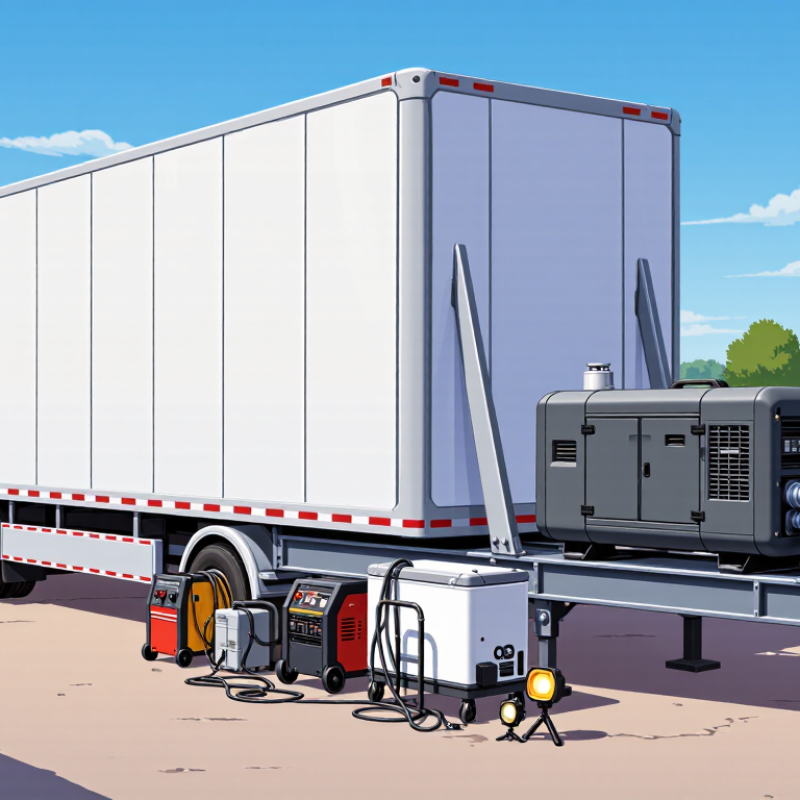
How to Choose the Best Trailer Generator for Your Business?
Define Your Business’s Trailer Power Requirements
Choosing a trailer generator starts with a clear power inventory, not a guess based on trailer size. List every tool, appliance, light, and control system used during a normal workday. Record each item’s running wattage and starting wattage. Motors, compressors, pumps, and cooling units may demand two to three times more power during startup.
For example, a mobile workshop might use a 3,000-watt compressor, 1,200 watts of lighting, battery chargers, and small hand tools. Its running load could reach 5,000 watts, while startup demand may exceed 8,000 watts. A suitable generator should handle both figures without unstable voltage. Add a sensible reserve, usually 20 to 25 percent, for unexpected equipment or future growth.
Think beyond wattage.
Voltage, phase, outlet type, and frequency must match your equipment. Check whether the generator will operate continuously for several hours or only during short tasks. Fuel capacity matters when the trailer works far from refueling points. Noise levels, ventilation, weather protection, and available payload also affect the decision.
A neat spreadsheet can still be wrong. Real tools rarely run at their label rating all day, yet startup surges are easy to overlook. Measure actual equipment where possible, and ask a qualified electrician to verify the load calculation. Recheck the estimate after seasonal changes, added equipment, or longer operating hours.
QUICK LINKS
CONTACT US
Office: (+86) 755 23040566
Tel: (+86) 158 9965 5195
E-mail: sale@pcbledmodule.com
Skype: Hans@Rocket-PCB
Whatsapp: 86 1589965 5195
Office Address: 2207,Bid 4,He Gu Shan Hui Cheng,35#,Guang Tian RoYanluo street, Song Gang Town,518105 SHENZHENG, CHINA
Plant ADD.: No 69, Lianfeng North Road, Xianxi Area, ChangAn Town, Dongguan, China.


Copyright © 2025 Rocket PCB Solution Ltd. | All Rights Reserved Sitemap Friendship link: CNC machining heat sink

