
English


Candy Machine Manufacturers serve very different production needs. Some build compact equipment for small-batch kitchens. Others engineer high-speed lines for large confectionery plants. The distinction matters. A machine suited to chocolate may not handle gummy depositing or hard-candy forming with the same consistency.
Confectionery scientist Richard W. Hartel has published extensively on confectionery processing. The following is an editorial paraphrase of the practical perspective his work supports, not a verified verbatim quotation: “Choose equipment by the product and process it must control, not by output claims alone.” That is a useful test. A chocolate tempering system manages temperature and crystal formation. A gummy line must control depositing, cooling, and release. A hard-candy cooker needs accurate heat management. Small details show up in the finished batch.
This guide introduces the main types of Candy Machine Manufacturers, from specialists in single machines to suppliers of integrated production lines. It also considers custom builders and manufacturers focused on particular products, such as chocolate, gummies, or hard candy. Buyers should compare sanitation access, changeover time, production capacity, and technical support—not just the brochure figures. Ask to see the equipment run with a comparable product. Watch the feed, the controls, and the finished pieces. A neat sample is not the whole story. Even experienced buyers can overlook maintenance access; that deserves a second look. Which manufacturer fits best depends on the recipe, available space, staff skills, and planned growth.
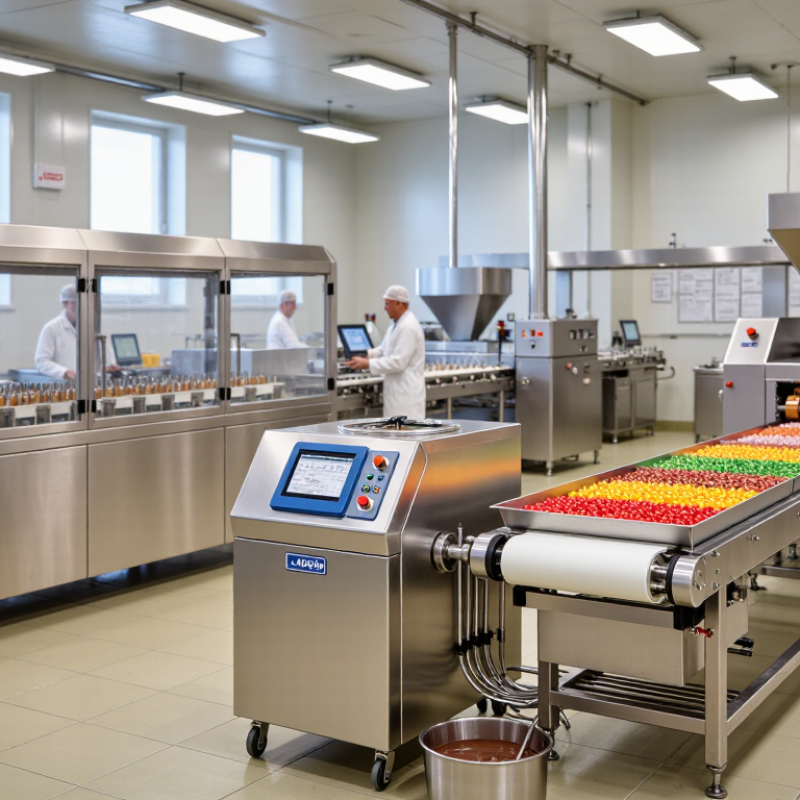
Batch-cooker manufacturers build equipment for heating candy syrup in controlled lots. For hard-crack candy, the finished syrup commonly reaches 149–154°C. At this stage, little water remains, and a cooled drop sets into a brittle, glass-like piece. It should snap cleanly, not bend. That is the target.
A cooker’s heating surface, batch size, and agitation all affect how evenly the syrup warms. Operators often watch a calibrated thermometer and check the syrup’s appearance near the endpoint. A few degrees matter. A probe touching the vessel wall may read hotter than the syrup itself, so its position deserves attention. Humidity and ingredient ratios can also shift the result; the temperature range is a useful guide, not a promise for every formula.
Manufacturers may offer jacketed kettles, controlled heating, scrapers, and discharge systems to help manage thick, hot syrup. These features can reduce scorching and make batches easier to transfer, but they do not replace careful testing. Hot syrup is unforgiving. Even experienced teams can overshoot the endpoint while moving slowly from heating to discharge. That part is easy to underestimate. A small trial batch can reveal whether the cooker’s heat response suits the recipe before production scales up.
QUICK LINKS
CONTACT US
Office: (+86) 755 23040566
Tel: (+86) 158 9965 5195
E-mail: sale@pcbledmodule.com
Skype: Hans@Rocket-PCB
Whatsapp: 86 1589965 5195
Office Address: 2207,Bid 4,He Gu Shan Hui Cheng,35#,Guang Tian RoYanluo street, Song Gang Town,518105 SHENZHENG, CHINA
Plant ADD.: No 69, Lianfeng North Road, Xianxi Area, ChangAn Town, Dongguan, China.


Copyright © 2025 Rocket PCB Solution Ltd. | All Rights Reserved Sitemap Friendship link: CNC machining heat sink