
English


A bolt and a screw can look nearly identical on a workbench, yet their names affect how a joint is designed, installed, and inspected. In common engineering practice, a bolt usually passes through clearance holes and is tightened with a nut. A screw typically engages a threaded hole or forms its own thread in the material. That distinction is useful, but not perfect. Standards and shop terminology sometimes use the words differently.
Technical references help make the comparison more precise. ASME B18.2.1 specifies dimensions for inch-series square and hex bolts and screws, while ISO 4014 and ISO 4017 distinguish common hexagon-head fasteners by thread coverage. For industry context, U.S. Census Bureau trade datasets and USITC DataWeb publish fastener-related shipment classifications and values. Those records describe trade, not the mechanics of a joint. That difference matters. A data table cannot tell you whether a fastener will loosen under vibration or damage a soft aluminum part. In practice, check the drawing, standard, material, thread, and installation method—not just the head shape. Even experienced buyers can inherit inconsistent naming from old catalogs. That is worth questioning. A careful Bolt Screw comparison starts with the joint’s function, then verifies the relevant specification.
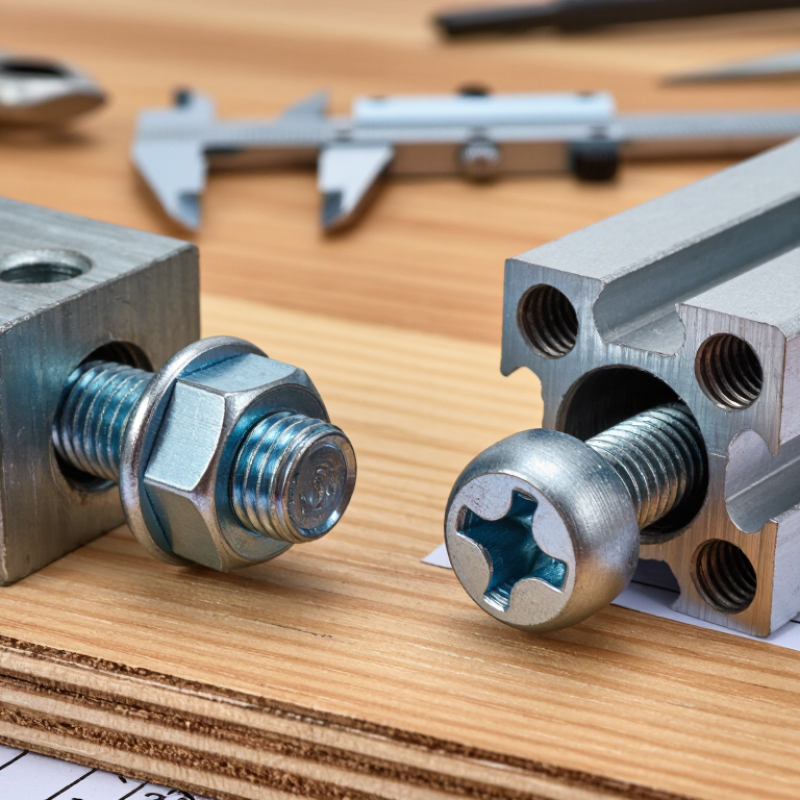
A bolt is a threaded fastener usually passed through aligned holes in two or more parts. A nut turns onto its exposed end and clamps the parts together. The bolt’s threads help create and maintain that clamping force. For example, a bolt can pass through two steel plates, with a washer and nut fitted on the far side. That is the core.
A screw usually fastens parts by turning its threaded shank into a material or a threaded hole. Its head provides a surface for a driver, while the threads resist the force trying to pull the parts apart. Some screws cut their own threads in wood or sheet material; others fit into threads made beforehand. Bolts and screws can look similar, and everyday naming is not always consistent. The connection matters more than appearance: a bolt commonly works with a nut, while a screw commonly engages the part itself. There are exceptions, so check the fastener’s design and installation instructions.
Tips: Match the fastener to the materials and expected load. Check the hole size, thread fit, and required length before tightening. Fit matters. If a joint loosens or the material begins to split, stop and reassess the fastener choice and installation.
QUICK LINKS
CONTACT US
Office: (+86) 755 23040566
Tel: (+86) 158 9965 5195
E-mail: sale@pcbledmodule.com
Skype: Hans@Rocket-PCB
Whatsapp: 86 1589965 5195
Office Address: 2207,Bid 4,He Gu Shan Hui Cheng,35#,Guang Tian RoYanluo street, Song Gang Town,518105 SHENZHENG, CHINA
Plant ADD.: No 69, Lianfeng North Road, Xianxi Area, ChangAn Town, Dongguan, China.


Copyright © 2025 Rocket PCB Solution Ltd. | All Rights Reserved Sitemap Friendship link: CNC machining heat sink

