Why Choose a Hand Manual Coffee Grinder?
Choosing a Hand Manual Coffee Grinder is about more than skipping an electric motor. It is a practical choice for people who want fresh grounds, quiet mornings, and control over each cup. A compact grinder can sit beside a kettle, travel in a bag, or work on a small kitchen counter. Turn the handle, feel the burrs catch the beans, and notice the aroma rise. That ritual matters.
Coffee educator James Hoffmann has emphasized the grinder’s importance, often putting it simply: “The grinder is the most important piece of equipment in your coffee setup.” A manual model can support that principle with adjustable burrs and consistent grinding, though performance depends on its design and build. No motor. No rush. You can adjust the grind for a pour-over, French press, or espresso, then repeat the setting when you find one you like. It takes effort, especially with a dense roast or a fine espresso grind. That part is easy to underestimate.
This guide explores why people choose hand grinders, what features deserve attention, and where manual grinding may fall short. We will look at burr quality, adjustment steps, capacity, comfort, and cleaning. A lower price does not always mean better value, and a beautiful handle cannot fix uneven grinding. The best choice fits your brewing habits, budget, and patience. Some days, the quiet routine feels satisfying. Other days, you may wish the coffee were ready sooner.
What a Hand Manual Coffee Grinder Is and How It Works
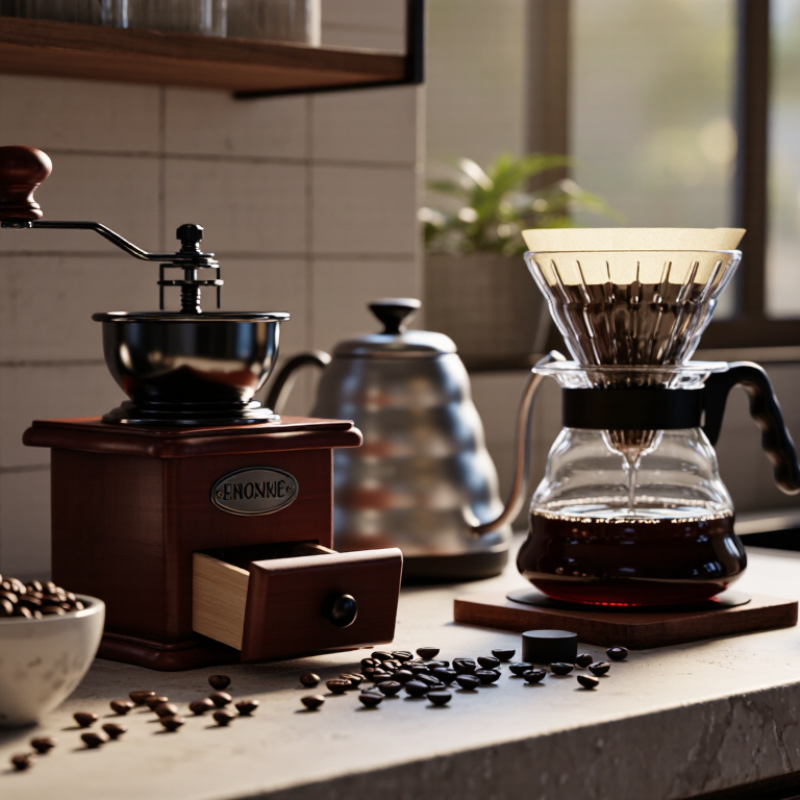
A hand manual coffee grinder is a compact tool that crushes whole coffee beans between two burrs. Beans sit in a small hopper at the top. Turning the side handle moves one burr against the other, breaking the beans into particles that fall into a container below. No motor is involved. Just a crank and a little effort.
Burr spacing controls the grind size. A wider gap makes larger pieces for methods such as a French press; a narrower gap produces finer grounds for espresso-style brewing. The exact settings vary between grinders, so small adjustments and test brews help. This part takes patience.
To use one, add a measured amount of beans, secure the lid, and turn the handle steadily. The crank may feel smooth with a light load, then catch slightly as beans shift between the burrs. It is not effortless. Hand grinding can take a minute or two, and very fine settings require more work. A few stray grounds may cling to the catch cup, especially in dry air. Tap the cup gently before opening it. Cleaning the burr area now and then helps keep old coffee from affecting the next grind.
How Grinding by Hand Affects Coffee Particle Size
A hand grinder does not automatically make coffee particles more uniform. The burr design, alignment, and adjustment mechanism matter more than the handle itself. Still, grinding by hand lets you feel changes in resistance as beans pass through the burrs. That detail can help you notice when a setting is too fine or uneven. Small differences matter.
Particle size affects how quickly water extracts flavor. For pour-over coffee, a fairly even grind can help water flow steadily through the bed. If the bed drains unusually fast, particles may be too coarse; a slow, muddy drawdown can point to excess fines or a grind that is too fine. These signs are useful, not definitive. Bean freshness and pouring technique also affect the result.
For a French press, coarser particles are common, but very fine pieces can still slip through the filter and leave grit in the cup. I’d adjust one step at a time and keep the dose and brewing method steady. Compare the grounds on a pale plate: large flakes mixed with powder suggest a broad particle spread. I still find it easy to blame the grinder too quickly. Water, beans, and my own rushed turning can all be part of the problem.
Why Choose a Hand Manual Coffee Grinder? — How Grinding by Hand Affects Coffee Particle Size | Brewing Method | Practical Particle-Size Starting Range | How Hand Grinding Affects the Grind | Useful Adjustment |
| Espresso | Approximately 200–400 microns; fine | A hand grinder with suitable burrs can produce a fine grind, but particle consistency and adjustment precision depend on its design and condition. | Adjust in small steps. If espresso flows too quickly, try a finer setting; if it flows too slowly, try a coarser setting. |
| Pour-over | Approximately 400–800 microns; medium to medium-coarse | Grinding immediately before brewing can help preserve coffee aroma. A steady, consistent turning pace may make grinding more comfortable, but does not by itself guarantee uniform particles. | Change the setting gradually and keep the dose and pouring routine consistent while comparing results. |
| Automatic drip | Approximately 500–1,000 microns; medium | Manual grinding offers direct control over the setting. The grinder’s burr geometry, alignment, and sharpness have a greater effect on particle distribution than the fact that it is hand-operated. | If the coffee tastes harsh or bitter, try a coarser setting; if it tastes weak or sour, try a finer setting. |
| French press | Approximately 800–1,200 microns; coarse | Coarser settings are usually easy to produce by hand. The amount of fine particles can vary between grinders and may affect sediment in the cup. | If the cup has excess sediment or tastes overly harsh, try a slightly coarser setting or a grinder that produces fewer fines. |
| Cold brew | Approximately 1,000–1,500 microns; coarse to very coarse | Hand grinding allows the setting to be changed for different steeping recipes. A uniform grind can help make extraction more predictable, though steep time and coffee-to-water ratio also matter. | Keep the grind, steep time, and ratio consistent when adjusting the recipe. |
Note: Particle-size ranges are approximate starting points, not universal standards. Grinder settings and actual particle sizes vary by burr design, coffee, and measurement method. Hand grinding provides manual control and can reduce noise or improve portability, but it does not inherently produce a more uniform grind than an electric grinder.
Key Advantages of Manual Grinding for Home Brewing
A hand manual coffee grinder gives home brewers direct control over grind size without needing a power outlet. Adjusting the burr setting can help match the grounds to a pour-over, French press, or espresso-style brew. The difference is tangible: coarser grounds feel gritty between your fingers, while finer grounds resemble soft sand. No motor noise, either.
Consistency matters because grind size affects how water extracts flavor. The Specialty Coffee Association’s Golden Cup Standard sets brewed-coffee targets of 1.15–1.35% total dissolved solids and 18–22% extraction yield. These are brewing benchmarks, not proof that manual grinders outperform electric ones. Still, changing one grind setting at a time makes it easier to notice how a slower drawdown or a sharper cup relates to your adjustment. A small kitchen scale helps, too.
Manual grinding is not effortless. Grinding enough coffee for several cups can tire your wrist, and cheaper mechanisms may produce uneven particles. That can make a brew taste both weak and bitter. A steady pace helps. For a single morning cup, however, the quiet routine can be useful: measure the beans, turn the handle, and brew while the grounds are fresh. The ritual is pleasant, but it is not a substitute for a well-made grinder.
How Manual Grinders Compare with Electric Grinders
A hand manual coffee grinder turns grinding into a slower, more involved part of brewing. You add beans to the small hopper, steady the body, and turn the handle until the grounds fall into the cup below. The process is quiet. That can matter in a shared home or during an early morning. Manual models also need no outlet, so they are easy to pack for travel or use in a small kitchen.
Electric grinders are usually faster and require less effort, especially when preparing coffee for several people. Their motors can make more noise, and the machine takes up counter space, but pressing a button is convenient on busy mornings. Grind consistency depends on the burrs, alignment, and adjustment system, not simply on whether a grinder is manual or electric. A well-made manual grinder can produce even grounds, though turning it finely for espresso may tire your wrist. I’ve found that the practical difference is often the batch size: one cup feels manageable, while repeated batches can become tedious. That trade-off is easy to overlook. Consider how often you brew, how much coffee you make at once, and whether quiet handling matters more than speed.
Why Choose a Hand Manual Coffee Grinder?
A feature-by-feature look at manual and plug-in electric grinders
Manual grinders work without electricity and require hand cranking. Plug-in electric grinders use a motor and need an electrical outlet. The chart compares basic features; grinding speed, noise, and grind consistency vary by model.
Factors to Consider When Choosing a Manual Coffee Grinder
Why Choose a Hand Manual Coffee Grinder?
When choosing a manual coffee grinder, start with grind consistency and adjustment range. Burrs should produce a reasonably even grind, from coarse particles for immersion brewing to finer grounds for espresso. Many grinders use stepped settings, which are easy to repeat. Stepless adjustment offers finer control, but it can take longer to dial in. Check whether the settings are clear enough to use before your morning coffee.
Comfort matters more than it may seem. A long handle can reduce effort, while a stable body helps keep the grinder steady on the counter. Consider capacity, too: a small chamber suits one cup, but may require several rounds for a larger pot. Metal parts can feel sturdy, though they may add weight in a travel bag. Cleaning access is worth checking; trapped grounds can affect freshness and make adjustment feel gritty. No single design is perfect. Even clear markings may not match your preferred recipe exactly.
Tips: If possible, test the handle’s grip and turning resistance. Choose a model with accessible burrs and simple adjustment. A quick brush after grinding helps. Keep the first few brews experimental; small setting changes can noticeably alter flavor.






