
English


Choosing a Cascade Retort is not just a question of capacity. It means matching the heating process to the product, container, and production line. A thick stew in a deep tray heats differently from soup in a pouch. That difference affects process time, product quality, and throughput.
The FAO’s 2024 State of Food Security and Nutrition in the World report estimated that 2.33 billion people experienced moderate or severe food insecurity in 2023. Safe, shelf-stable foods matter. For processors, the choice of retort must support a validated thermal process, not simply promise faster cycles. U.S. FDA regulations in 21 CFR Part 113 also require scheduled processes for relevant low-acid canned foods. Requirements vary by market, so verify them with qualified process authorities.
Food engineering expert Dennis R. Heldman’s work emphasizes the importance of applying engineering principles to food processing. A concise paraphrase of that principle—not a verbatim quotation—is: “Choose around the process, not the machine.” Keep that distinction in mind. Compare cascade water distribution, temperature uniformity, load configuration, controls, and cleaning access. Ask suppliers for data from comparable products and packages, then review it with a qualified thermal-process specialist. A glossy specification sheet is not enough. This guide explores how to assess those details and select a Cascade Retort suited to your actual line.
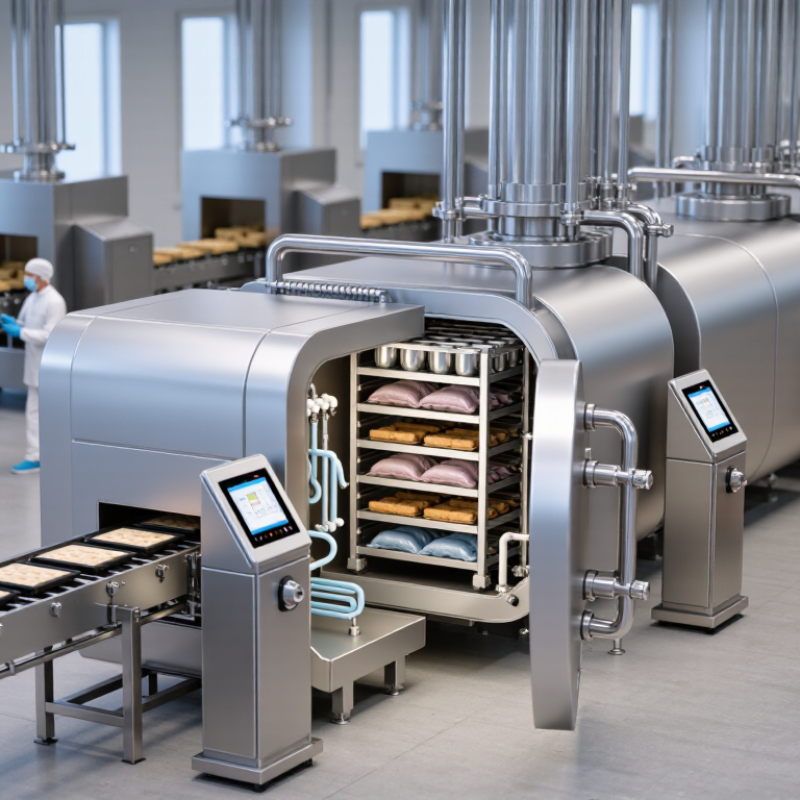
Before choosing a cascade retort, describe the product as it will enter the package. Record its thickness, viscosity, particle size, and starting temperature. A thin soup heats differently from a dense sauce with large vegetable pieces. Note whether solids settle, float, or change position during processing. Small details matter.
Heat transfer also depends on the package. Glass jars, metal cans, and flexible pouches respond differently to heating and cooling. Measure the package dimensions and fill weight, and identify the headspace and closure. Then define the required processing outcome and expected batch size. A qualified process authority should establish and validate the schedule for the specific product, package, and retort conditions. Do not assume one recipe or container size can use the same schedule. That is not enough.
Consider how a cascade retort distributes heated water across the load. Ask whether packages need agitation, and check that the proposed loading pattern allows consistent water contact. A crowded basket may behave differently from a partially filled one. Include cooling needs, available utilities, and cleaning routines in the assessment. I would also keep a written record of product and package variations; they are easy to overlook during equipment selection.
QUICK LINKS
CONTACT US
Office: (+86) 755 23040566
Tel: (+86) 158 9965 5195
E-mail: sale@pcbledmodule.com
Skype: Hans@Rocket-PCB
Whatsapp: 86 1589965 5195
Office Address: 2207,Bid 4,He Gu Shan Hui Cheng,35#,Guang Tian RoYanluo street, Song Gang Town,518105 SHENZHENG, CHINA
Plant ADD.: No 69, Lianfeng North Road, Xianxi Area, ChangAn Town, Dongguan, China.


Copyright © 2025 Rocket PCB Solution Ltd. | All Rights Reserved Sitemap Friendship link: CNC machining heat sink

