
English


China’s optical-sorting industry is changing quickly. More recycling plants now seek accurate identification, stable throughput, and lower operating costs. This article introduces China’s Top 10 Green Machine Optical Sorter suppliers and examines their practical strengths. The phrase “green machine” should not remain a marketing label. It must describe measurable resource savings, dependable recovery, and safer plant operation.
Dr. Volker Rehrmann, a recognized recycling-technology specialist, has often emphasized, “Sorting is the key to a circular economy.” His view reflects the central role of optical sorting. A modern Green Machine Optical Sorter may combine RGB cameras, near-infrared sensors, artificial intelligence, and high-speed air jets. On a factory floor, this means plastic flakes moving rapidly beneath bright sensor lights. Contaminants are detected within milliseconds. Precise air pulses then separate them into different collection streams.
This ranking considers sorting accuracy, material compatibility, processing capacity, energy use, software capability, maintenance support, and customer experience. It also considers supplier transparency. A strong brochure cannot replace stable performance during dusty, humid, and uneven operating conditions. Some suppliers may publish limited field data. That is a weakness worth noting. Buyers should request test results using their actual materials before making a final decision. No machine performs perfectly in every application. A sorter designed for clear PET may require different settings for mixed plastics, glass, textiles, or food-grade recovery. The following suppliers deserve attention, but independent verification remains essential.
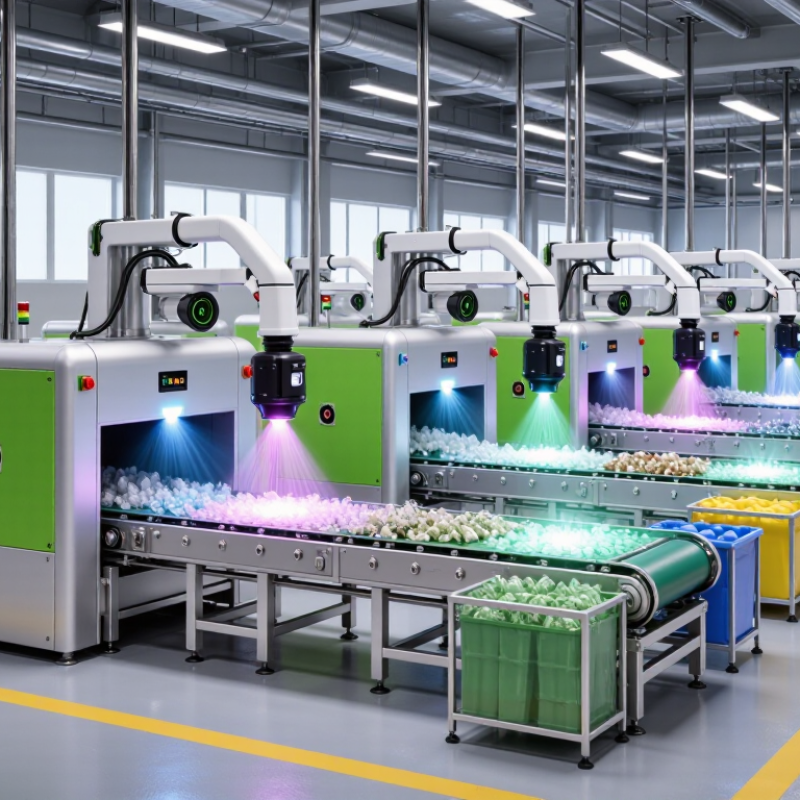
Selecting a green machine optical sorter requires more than comparing conveyor speed. NIR sensors identify material by molecular response, especially plastics, paper, and organic residues. RGB cameras read visible color, shape, and surface defects. Used together, they improve separation when materials overlap in appearance.
AI adds another layer. Trained models can recognize irregular objects, dark fragments, and mixed items that fixed rules often miss. However, AI depends on representative training images and stable lighting. A model trained on clean samples may perform poorly when dust, moisture, or labels cover the target. No sensor is perfect.
Detection range matters. Systems designed for 1–5 mm particles need precise illumination, narrow belt spacing, and low vibration. At this scale, a small nozzle error can send valuable material into the wrong stream.
During a supplier evaluation, request sample-based tests, hourly accuracy records, reject rates, and maintenance procedures. Check calibration with real feedstock, not showroom samples. I would also repeat tests after several hours of operation; heat and dust can change performance. That extra trial may expose weaknesses, but it builds more reliable purchasing decisions.
QUICK LINKS
CONTACT US
Office: (+86) 755 23040566
Tel: (+86) 158 9965 5195
E-mail: sale@pcbledmodule.com
Skype: Hans@Rocket-PCB
Whatsapp: 86 1589965 5195
Office Address: 2207,Bid 4,He Gu Shan Hui Cheng,35#,Guang Tian RoYanluo street, Song Gang Town,518105 SHENZHENG, CHINA
Plant ADD.: No 69, Lianfeng North Road, Xianxi Area, ChangAn Town, Dongguan, China.


Copyright © 2025 Rocket PCB Solution Ltd. | All Rights Reserved Sitemap Friendship link: CNC machining heat sink

