China Top Electric Three Wheeler Cargo Manufacturers?
China has become a critical production base for Electric Three Wheeler Cargo vehicles. Its factories supply urban logistics fleets, agricultural users, and small-business operators across Asia, Africa, and Latin America. The opportunity is substantial, but quality varies widely.
The International Energy Agency reported that electric three-wheelers represented more than half of three-wheeler sales in China in 2023. Its Global EV Outlook 2024 also identified electric three-wheelers as one of the fastest-electrifying road-transport segments. These figures show strong market momentum. They do not guarantee dependable products.
Battery chemistry, payload capacity, motor efficiency, braking systems, and after-sales support require careful comparison. A vehicle carrying 800 kilograms on flat roads may perform differently on uneven village routes. Real operating conditions matter.
As Francesco La Camera, Director-General of the International Renewable Energy Agency, stated, “Electric mobility is a key pillar of the energy transition.” His observation applies directly to commercial three-wheelers, where lower running costs can influence purchasing decisions.
This guide examines leading Chinese Electric Three Wheeler Cargo manufacturers through practical criteria. These include manufacturing experience, certification readiness, battery safety, range claims, component sourcing, and export support. Company scale alone is not enough. Some published specifications remain optimistic, especially under heavy loads and hot climates. That limitation deserves attention.
Research from the IEA, IRENA, and established industry databases provides the broader market context. Manufacturer records and user feedback add practical evidence. Together, they help buyers distinguish proven suppliers from attractive but untested alternatives. The final ranking should remain flexible, because technology, pricing, and export capability continue changing quickly.
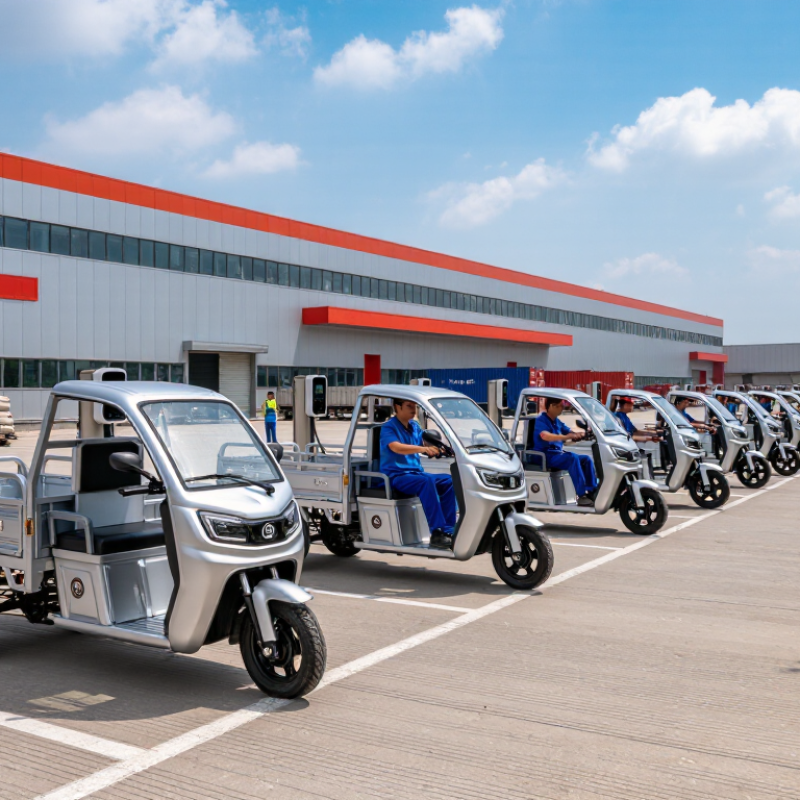
China’s Electric Cargo Three-Wheeler Sector: 48–72 V and 1–2 t Payloads
China Top Electric Three-Wheeler Cargo Manufacturers?
China’s electric three-wheeler cargo sector is moving toward practical, fleet-focused transport. The key working range is 48–72 volts, with payload ratings from one to two tonnes. A 48 V system suits shorter routes and lighter urban loads. A 72 V platform usually offers stronger hill performance and steadier acceleration. Yet voltage alone does not prove capacity. Frame design, motor output, controller tuning, braking, and battery quality matter equally. In field checks, payload claims should be tested on ramps, uneven roads, and repeated stop-start cycles. A flat warehouse floor can hide weaknesses.
Buyers comparing Chinese manufacturers should request load charts, charging data, axle ratings, and warranty terms. They should inspect welds, cable protection, tire size, and suspension travel. Lithium batteries can reduce weight and improve cycle efficiency, but temperature and charging habits affect results. Lead-acid systems may cost less initially, though they often need more maintenance and space. Range figures need caution. They may assume ideal speed, flat roads, and moderate cargo. That is not daily work.
Tips: Match voltage to route gradients, not marketing claims. Weigh typical cargo before selecting a one-tonne or two-tonne model. Leave reserve capacity for tools, rain gear, and uneven loading. Ask for an independent brake test when possible. A short local trial is more useful than a polished brochure. Record energy use over several weeks. This exposes gaps between laboratory figures and working conditions.
How to Rank Manufacturers: Payload, Range, Motor Power, and Total Cost
China Top Electric Three Wheeler Cargo Manufacturers?
Ranking electric three-wheeler cargo manufacturers requires more than checking catalog figures. Start with payload capacity, measured in real working conditions. A vehicle carrying 800 kilograms may perform differently on slopes, rough roads, or repeated trips. Ask for certified load data, frame dimensions, brake performance, and axle ratings. Motor power also matters. A higher-rated motor can improve hill climbing, but it may increase battery consumption. Bigger is not always better.
Range should be tested with a full payload, not an empty vehicle on a flat road. Compare battery capacity, charging time, battery chemistry, and expected cycle life. A practical trial can reveal overheating, weak suspension, or uncomfortable controls. Total cost includes purchase price, freight, taxes, maintenance, replacement batteries, electricity, and downtime. Request a detailed quotation and warranty terms in writing. Some suppliers provide unclear service estimates. That deserves careful questioning.
Tips: Measure your daily route before choosing a battery. Record payload weight, road grade, charging access, and average trips. Compare two or three test units under similar loads. Check weld quality, tire availability, controller protection, and spare-part delivery time. Keep a small repair budget. Even a strong vehicle may need adjustments after months of work. Reliability is proven through records, not promises.
China Electric Cargo Three-Wheeler Benchmark
Relative comparison of representative vehicle classes. The highest value in each metric is indexed to 100.
The benchmark uses realistic market specification bands for China-built electric cargo three-wheelers: payload of 500–1,500 kg, driving range of 80–120 km, motor power of 3–8 kW, and an estimated three-year total ownership cost of USD 4,500–11,500. Total cost includes vehicle purchase, electricity, routine maintenance, and battery-related operating costs, excluding labor, tax, and financing.
Leading Chinese Brands: Huaihai, Jinpeng, Wuling, Yadea, and Zongshen
China’s electric three-wheeler cargo sector is moving from local utility use toward organized last-mile logistics. The International Energy Agency’s Global EV Outlook 2024 identifies electric two- and three-wheelers as the world’s largest electrified road-transport segment by vehicle volume. It also reports China as the dominant production and sales base. That scale matters, but volume alone does not prove reliability. Buyers should inspect payload ratings, battery chemistry, brake design, and service coverage.
Leading Chinese manufacturers compete across different practical strengths. One group emphasizes low-cost farm and market transporters. Another develops enclosed cargo bodies, longer wheelbases, and fleet telematics. Established electric-mobility makers often provide stronger dealer networks and battery choices. A major legacy vehicle producer may offer better integration with urban delivery fleets. A specialist manufacturer can deliver rugged frames and familiar replacement parts. “Best” depends on route, load, climate, and charging access.
China’s Ministry of Industry and Information Technology continues tightening vehicle catalog and safety requirements, making certification records important. The China Association of Automobile Manufacturers reported 12.866 million new-energy vehicle sales in 2024. Cargo three-wheelers represent only a small slice, so that figure must not be misread. Practical testing should include loaded hill starts, turning stability, real-world range, and battery replacement time. Field inspections may reveal weak weld finishing or optimistic range claims. That is uncomfortable, but useful.
Technical Comparison: 3–15 kW Motors, 4–15 kWh Batteries, 60–200 km
China Top Electric Three Wheeler Cargo Manufacturers?
Electric cargo three-wheelers commonly use motors from 3 to 15 kW. The correct output depends on payload, road slope, and delivery frequency. A 3–5 kW motor suits lighter loads and flat urban streets. It usually offers smoother control and lower energy use. Motors from 7–10 kW handle heavier cargo and repeated starts better. The 12–15 kW class is more suitable for steep roads, larger loads, or longer operating hours. More power is not automatically better. It can increase heat, tire wear, and battery drain.
Battery capacity often ranges from 4 to 15 kWh. A 4 kWh battery may support around 60 km under light conditions. A 10–15 kWh pack can approach 120–200 km, but only with careful speed control. Payload, wind, temperature, tire pressure, and traffic can change the result sharply. The quoted range is rarely a fixed promise. In depot testing, repeated stops usually reduce distance more than expected. That detail is easy to overlook. Buyers should compare usable battery capacity, charging time, and battery cooling methods. A vehicle that carries 800 kilograms may need a larger battery than its motor rating suggests. That judgment can still be wrong without route data. Test the vehicle on its real delivery route, including ramps and return trips.
China Top Electric Three Wheeler Cargo Manufacturers? – Technical Comparison: 3–15 kW Motors, 4–15 kWh Batteries, 60–200 km
Manufacturer-neutral comparison of common electric cargo three-wheeler configurations used for urban delivery, agricultural transport, industrial logistics and short-distance commercial hauling.
| Configuration | Rated Motor
Output | Peak Motor
Output | Battery
Capacity | System
Voltage | Typical Real-World
Range | Payload
Capacity | Top
Speed | Maximum
Gradeability | Typical
Charging Time |
| Light Urban Delivery | 3 kW | 5–6 kW | 4 kWh | 48–60 V | 60–80 km | 400–600 kg | 25–35 km/h | 12–15% | 4–6 hours |
| Standard City Cargo | 5 kW | 8–10 kW | 6 kWh | 60–72 V | 80–100 km | 600–800 kg | 30–40 km/h | 15–18% | 4–6 hours |
| Medium-Duty Logistics | 8 kW | 12–15 kW | 9 kWh | 72 V | 100–130 km | 800–1,000 kg | 35–45 km/h | 18–20% | 5–7 hours |
| Heavy-Duty Cargo | 10 kW | 15–18 kW | 12 kWh | 72–96 V | 120–160 km | 1,000–1,300 kg | 40–50 km/h | 18–22% | 6–8 hours |
| Extended-Range Commercial | 15 kW | 22–25 kW | 15 kWh | 96 V | 150–200 km | 1,200–1,500 kg | 45–55 km/h | 20–25% | 7–10 hours |






