

China’s commercial refrigeration sector serves supermarkets, convenience stores, cafés, and food retailers worldwide. A Commercial Display Fridge must do more than keep products cold. It also needs clear visibility, reliable temperature control, and practical access for staff and customers. Small details matter: door seals, shelf spacing, lighting, and airflow can affect daily operation.
MarketsandMarkets’ 2023 Commercial Refrigeration Market report estimated the global market at US$39.4 billion in 2023. It forecast growth to US$53.7 billion by 2028, representing a 6.4% compound annual growth rate. This broad category includes multiple equipment types, so the figures should not be mistaken for display-fridge sales alone. Still, they signal sustained investment in commercial cooling and retail presentation. That matters.
This guide examines leading commercial display fridge manufacturers in China through practical buying considerations. We look at product range, manufacturing capability, customization, energy performance, and after-sales support. Buyers should also check temperature consistency, noise levels, warranty terms, and the availability of replacement parts. A glossy product photo cannot confirm those details. Not every cabinet suits every store, and supplier claims deserve careful verification. The right choice depends on the merchandise, floor plan, local service access, and expected operating hours.
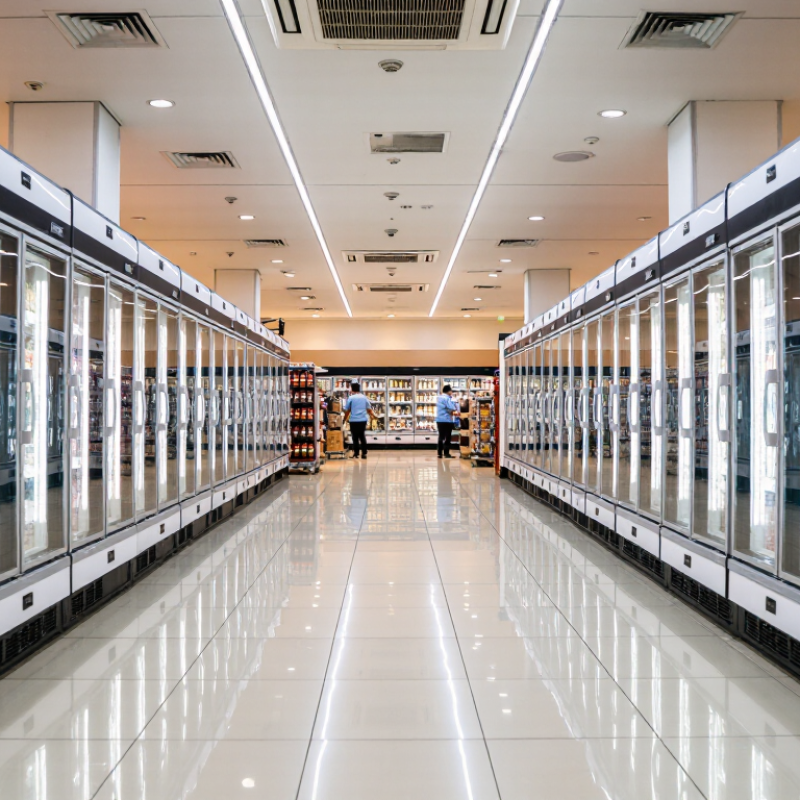
Commercial display fridges are refrigerated cabinets designed to keep food or drinks visible while maintaining a suitable temperature. Glass doors or open fronts let customers see products without handling them. Shelves, interior lighting, and fans help present items clearly and distribute cool air. They are different from back-room storage units.
Visibility is part of their job.
You will often find them in supermarkets, convenience stores, cafés, bakeries, and takeaway counters. A supermarket may use upright cabinets for bottled drinks, while a bakery might choose a counter-height case for cakes and sandwiches. In a café, a compact unit near the till can make chilled desserts easier to notice.
Placement matters.
A fridge beside a sunny window or a hot oven may struggle to keep conditions steady. Operators should check the cabinet’s temperature, clean its glass and shelves, and avoid blocking air vents with tightly packed stock. Product labels and clear shelf spacing also help customers make quick choices.
Small details matter.
A display fridge is not a substitute for careful food handling, and attractive lighting cannot correct poor temperature control. Even a well-designed cabinet may need adjustment as room conditions and customer traffic change.
China’s commercial display fridge industry has developed alongside supermarket expansion, food-service growth, and stronger cold-chain infrastructure. Earlier cabinets often prioritized basic cooling and clear product visibility. Newer designs increasingly address energy use, temperature stability, and condensation on glass doors. The shift is visible. LED lighting, variable-speed compressors, and digital temperature controls help operators manage daily use, though results depend on installation and maintenance.
Infrastructure growth provides useful context, but it is not a direct measure of fridge sales. The China Federation of Logistics and Purchasing’s Cold Chain Logistics Committee reported 228.1 million cubic meters of cold-storage capacity in 2023, up 8.3% year on year. Its 2023 China Cold Chain Logistics Operation Report also estimated the sector’s market at 517 billion yuan. These figures show a broader cold-chain build-out that can support demand for reliable retail refrigeration. Yet progress is not tidy. Smaller shops may still choose lower-cost units, and poor airflow around a cabinet can undermine even sound equipment. Manufacturers therefore face a practical challenge: balancing efficient cooling, easy servicing, and attractive product presentation across very different store formats.
Chinese commercial display-fridge manufacturers commonly produce upright glass-door merchandisers, island freezers, countertop cases, and refrigerated prep counters. Their capabilities extend beyond cabinet assembly: sheet-metal forming, foam insulation, refrigeration-loop assembly, and temperature-control integration all affect performance. Buyers should request test records for cooling capacity and temperature uniformity, alongside compressor and refrigerant specifications. Details matter. A polished showroom does not prove stable operation.
Grand View Research valued the global commercial refrigeration equipment market at USD 39.41 billion in 2022 and projected 5.3% annual growth through 2030. The International Institute of Refrigeration’s 2023 Informatory Note estimates refrigeration uses about 20% of global electricity, making equipment efficiency a practical concern. Manufacturers may offer variable-speed compressors, LED lighting, and digital controllers, but real-world savings depend on ambient heat, door openings, and maintenance. Not just output. Compare measured energy use and temperature recovery, not feature lists alone. Test conditions can be missing from specification sheets, so ask for protocols, material thickness, warranty scope, and spare-parts lead times before comparing claims.
The product types and temperature ranges below reflect common commercial refrigeration configurations. Actual specifications, materials, testing procedures, and production capabilities vary by manufacturer and model and should be confirmed against product documentation.
| Product category | Common operating range | Typical format and use | Relevant manufacturing capabilities | Checks to request when sourcing |
|---|---|---|---|---|
| Upright glass-door merchandiser | Typically around +2°C to +8°C; model and application dependent | Single- or multi-door cabinet for packaged drinks and chilled foods | Cabinet forming, insulated-panel assembly, door and gasket fitting, lighting and shelving installation, refrigeration-system integration | Temperature uniformity, door sealing, condensation control, energy-use data, and operation under the stated ambient conditions |
| Open multideck display cabinet | Often designed for chilled display, commonly about +2°C to +8°C | Open-front, multi-shelf cabinet for supermarkets and food retail | Long-cabinet assembly, air-curtain design, shelf and lighting installation, and provision for remote or self-contained refrigeration | Airflow performance, product temperature at specified loading, defrost behavior, and compatibility with the intended refrigeration system |
| Serve-over counter | Commonly configured for chilled display, approximately +2°C to +8°C | Front-service counter for deli foods, meat, seafood, or prepared items | Countertop and display-glass fabrication, refrigerated deck assembly, drainage design, and custom length or layout options | Product-zone temperatures, cleaning access, drainage, glass visibility, and the specified food-display application |
| Bakery or cake display cabinet | Chilled models are commonly set around +2°C to +8°C; ambient models also exist | Countertop or floor-standing glass display for cakes and pastries | Curved or flat glass fitting, shelf and LED-light installation, finish customization, and chilled or non-refrigerated model assembly | Whether the unit is chilled or ambient, humidity considerations, lighting heat, glass condensation, and usable display dimensions |
| Upright freezer merchandiser | Commonly designed for frozen storage near -18°C; exact set point varies by model | Glass-door cabinet for packaged frozen foods and ice cream | Thicker insulated cabinet construction, heated or anti-condensation glass options, refrigeration-system assembly, and frost-management design | Pull-down and recovery performance, frost and defrost behavior, door sealing, and temperature stability at the rated ambient temperature |
| Island or chest freezer | Usually intended for frozen products, often around -18°C or colder depending on design | Horizontal cabinet with sliding or hinged glass lids for retail floor display | Foamed cabinet production, lid and track fitting, basket installation, and static or fan-assisted system integration | Temperature recovery after lid opening, lid movement, insulation performance, drainage, and defrost requirements |
| Refrigeration and cabinet production capabilities | Not a product temperature specification | Capabilities may cover product design, sheet-metal work, foaming, assembly, and system integration | Factory scope can include cabinet fabrication, insulation foaming, refrigeration piping, electrical assembly, configurable dimensions, and private-label or OEM production | Verify in-house versus outsourced processes, sample approval, production traceability, applicable market certifications, and final inspection records |
| Quality and compliance verification | Depends on model, refrigerant, destination market, and test conditions | Applies across refrigerated display products | Potential checks include electrical safety inspection, refrigerant-circuit leak testing, temperature testing, and visual or functional inspection | Request valid certificates for the exact model and destination market; confirm test standards, refrigerant details, electrical ratings, and warranty terms |
Sourcing note: temperature ranges are indicative, not guaranteed performance figures. Compare products using the manufacturer’s stated test conditions, rated ambient temperature, loading method, and applicable safety and energy requirements.
China Top Commercial Display Fridge Manufacturers
Chinese manufacturers serve different retail needs, so specialization matters more than a single ranking. Grand View Research valued the global commercial refrigeration equipment market at USD 39.3 billion in 2023 and forecast a 5.6% compound annual growth rate from 2024 to 2030. This figure covers equipment beyond display fridges, so it should not be treated as a cabinet-sales estimate. Still, it signals sustained demand for reliable commercial cooling.
Suppliers focused on supermarkets commonly make multideck open cases, glass-door merchandisers, and remote refrigeration systems. Their strengths often lie in cabinet layouts, airflow control, and adapting cases to store plans. Beverage-focused producers tend to prioritize upright coolers, clear product visibility, and compact footprints for convenience stores. Smaller specialists may offer undercounter units for cafés and food-service counters. Small details matter. Door seals, shelf spacing, and lighting affect daily use, not just showroom appeal. Buyers should compare temperature consistency, energy use, service access, and spare-part availability under real operating conditions. A weakness in many comparisons is the assumption that one design fits every shop. It does not always. A cabinet that looks efficient in a catalogue may be awkward to clean or restock during a busy shift.
Chinese manufacturers serve a range of commercial refrigeration specializations, from beverage and fresh-food displays to frozen-food cases. The chart shows illustrative operating temperature bands for these product categories, not a ranking of manufacturers.
Temperature bands are typical examples in degrees Celsius; actual operating ranges vary by model, application, and manufacturer specifications.
A reliable Chinese display fridge manufacturer should explain how each cabinet performs in real shop conditions. Ask for usable capacity, temperature recovery time, daily energy consumption, and test conditions—not just a glossy specification sheet. Small details matter. Check door seals, shelf adjustment, lighting glare, and whether condensate drains cleanly after repeated opening.
Energy data can sharpen the comparison. ENERGY STAR reports that certified commercial refrigerators use about 20% less energy than standard models. UNEP’s 2023 Global Cooling Watch report projects cooling capacity could more than triple by 2050. These figures make efficiency testing relevant, but they do not prove that any single factory’s model meets your needs. Request independent test reports for the exact model and configuration, then compare measured results under the same conditions.
Inspect production controls as well as the sample unit. Ask how the factory checks cabinet insulation, refrigerant charge, electrical safety, and temperature uniformity before shipment. Confirm that certificates and reports match the model number, components, and intended destination market. A tidy showroom is not proof of consistent production. One judgment can be imperfect: a strong sample may conceal weak batch control. Request recent inspection records, spare-parts lead times, and a written warranty response process before placing an order.
QUICK LINKS
CONTACT US
Office: (+86) 755 23040566
Tel: (+86) 158 9965 5195
E-mail: sale@pcbledmodule.com
Skype: Hans@Rocket-PCB
Whatsapp: 86 1589965 5195
Office Address: 2207,Bid 4,He Gu Shan Hui Cheng,35#,Guang Tian RoYanluo street, Song Gang Town,518105 SHENZHENG, CHINA
Plant ADD.: No 69, Lianfeng North Road, Xianxi Area, ChangAn Town, Dongguan, China.


Copyright © 2025 Rocket PCB Solution Ltd. | All Rights Reserved Sitemap Friendship link: CNC machining heat sink


