
English


China’s position in Electronic Board Assembly is built on more than low production costs. It depends on engineering depth, component access, process discipline, and dependable quality control. IPC’s 2024 Electronics Industry Business Outlook identifies continuing demand for electronics across automotive, industrial, medical, and communications markets. These sectors expect stable supply, traceable production, and consistent performance.
Market research reports from Fortune Business Insights and Grand View Research also forecast continued growth in global printed circuit board assembly. Their findings point to rising demand for miniaturization, surface-mount technology, automated optical inspection, and high-mix manufacturing. The numbers differ between reports. That is worth noting. Forecasts are useful, but factory capability must be verified on the production floor.
John W. Mitchell, former IPC President and CEO, described electronics manufacturing as “the backbone of nearly every modern industry.” His observation explains why supplier selection requires more than a polished website. A capable Chinese manufacturer should demonstrate controlled solder paste printing, component placement accuracy, reflow profiling, and final functional testing. Ask for process records. Inspect sample boards under real operating conditions.
A reliable partner can show certifications, engineering feedback, material traceability, and corrective-action reports. Small details matter, such as clean connector pins, readable labels, and secure solder joints. China has many strong assembly providers, but not every factory suits every project. Price alone can hide weak process control. This guide examines how to identify a top Electronic Board Assembly manufacturer in China through evidence, technical fit, and practical due diligence.
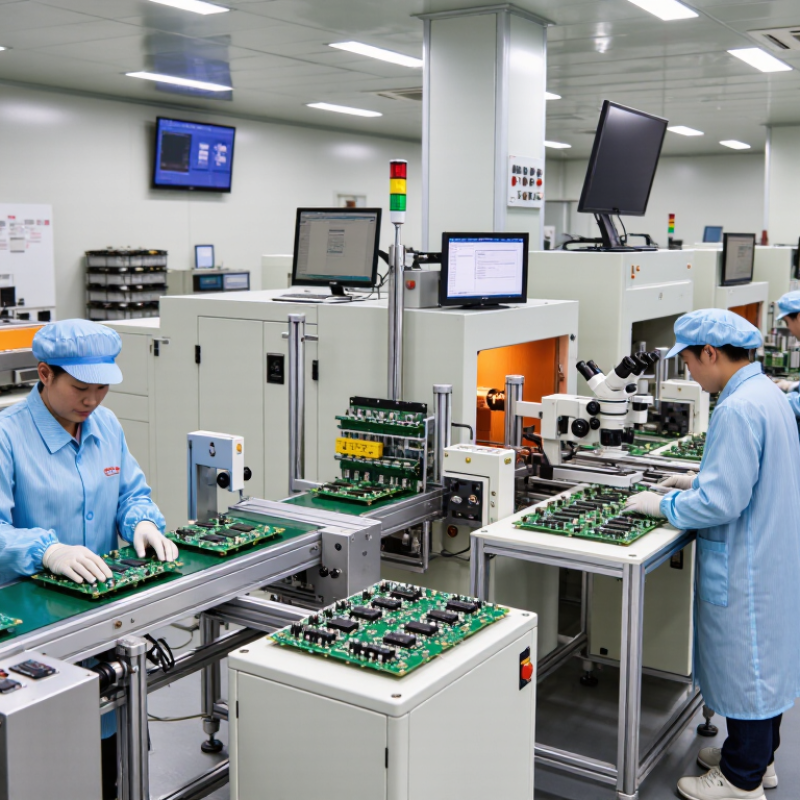
Definition and Role of Electronic Board Assembly Manufacturers
An electronic board assembly manufacturer places components onto printed circuit boards. It also controls soldering, inspection, testing, and traceability. The work is more than attaching chips. It turns an engineered layout into a functioning product.
A capable factory receives bare boards, components, drawings, and testing requirements. Automated placement machines handle tiny resistors, while operators inspect connectors and cables. Reflow ovens must maintain stable temperature profiles. Optical inspection can detect shifted parts, solder bridges, and missing components. According to Fortune Business Insights, the global printed circuit board market was valued at about USD 89.7 billion in 2023. This scale increases pressure on assembly partners to deliver speed without weakening process control.
Quality evidence matters. Manufacturers should provide lot records, inspection results, equipment calibration data, and corrective-action reports. IPC industry research continues to identify supply-chain resilience, workforce capability, and quality as major electronics concerns. Certification helps, but it does not replace careful audits. A factory may hold a valid certificate and still struggle with material storage or unclear work instructions. That point deserves reflection.
For China-based production, buyers often compare labor capacity, engineering support, export experience, and response time. The best choice depends on product complexity, volume, and risk. A small medical controller needs different controls from a high-volume consumer board. Ask how failed boards are quarantined. Ask who approves substitutions. Ask for real production samples, not only polished presentations. Reliability begins with visible process discipline.
| Data Dimension | Key Information | Definition, Role, or Manufacturing Relevance |
|---|---|---|
| Industry Definition | Electronic Board Assembly Manufacturer | A manufacturer that mounts electronic components onto printed circuit boards (PCBs), completes soldering and inspection, and supplies tested or partially tested board assemblies for electronic products. |
| Primary Product | Printed Circuit Board Assembly (PCBA) | A PCBA combines a bare PCB with electronic components such as integrated circuits, resistors, capacitors, connectors, sensors, and electromechanical parts. |
| Core Manufacturing Process | Surface Mount Technology (SMT) | SMT places components directly onto the surface of a PCB. It supports compact designs, high component density, automated placement, and repeatable production quality. |
| Supporting Assembly Process | Through-Hole Technology (THT) | THT inserts component leads through drilled holes in the PCB. It is commonly used for parts requiring strong mechanical attachment, including certain connectors, transformers, and power components. |
| Soldering Methods | Reflow Soldering and Wave or Selective Soldering | Reflow soldering is mainly used for surface-mounted components, while wave or selective soldering is used for suitable through-hole components. Hand soldering may be applied for rework or low-volume operations. |
| Engineering Input | Gerber Files, BOM, Pick-and-Place Files, and Assembly Drawings | These documents define the PCB design, component list, component locations, polarity, orientation, approved alternatives, and assembly requirements needed for accurate production. |
| Design Review | Design for Manufacturability (DFM) | DFM checks help identify manufacturing risks such as insufficient spacing, unsuitable footprints, difficult-to-solder pads, component availability issues, and assembly access limitations before production begins. |
| Production Planning | Prototype, Low-Volume, and Mass Production | Electronic board assembly manufacturers may support prototype validation, pilot builds, repeat production, and volume manufacturing, with process controls adjusted to order size and product complexity. |
| Component Management | Procurement, Incoming Inspection, and Traceability | Component management includes supplier qualification, part-number verification, moisture control where required, date-code tracking, counterfeit-risk reduction, and lot traceability. |
| Automated Equipment | Stencil Printers, Pick-and-Place Machines, and Reflow Ovens | These machines automate solder-paste printing, component placement, and soldering. Automation improves repeatability and reduces manual placement errors in suitable production volumes. |
| Inspection Technology | SPI, AOI, and X-Ray Inspection | Solder Paste Inspection evaluates paste deposition, Automated Optical Inspection checks visible assembly features, and X-ray inspection can examine hidden solder joints such as certain bottom-terminated or array packages. |
| Electrical Testing | In-Circuit Test, Flying-Probe Test, and Functional Test | Electrical tests identify assembly faults, open or short circuits, component-related issues, and product-level functional problems. The appropriate method depends on design, quantity, and test-access requirements. |
| Quality Standard | IPC-A-610 Acceptance Criteria | IPC-A-610 provides widely used visual acceptance criteria for electronic assemblies, including solder joints, component placement, cleanliness, and workmanship conditions. |
| Quality Management | Process Control and Corrective Action | A controlled production system uses work instructions, process parameters, inspection records, nonconformance handling, root-cause analysis, and corrective actions to maintain consistent assembly quality. |
| Regulatory Consideration | RoHS and REACH Requirements | Products supplied to applicable markets may need to address restricted substances and chemical-substance obligations. Compliance depends on product type, destination market, and customer requirements. |
| Lead-Free Manufacturing | Lead-Free Soldering Capability | Lead-free assembly generally uses solder alloys based on tin with elements such as silver or copper. It requires compatible materials, thermal profiles, component finishes, and process controls. |
| Supply Chain Role | From Bare PCB and Components to Tested PCBA | The manufacturer coordinates materials, assembly operations, inspection, testing, packaging, and shipment, helping convert electronic design data into a usable board-level product. |
| Value-Added Services | Box Build, Cable Assembly, Programming, and Conformal Coating | Some manufacturers extend services beyond PCBA to include enclosure assembly, wire harnesses, firmware loading, labeling, protective coatings, and final product integration. |
| Supplier Evaluation Factor | Process Capability and Equipment Fit | Evaluation should consider component package capability, minimum component size, board dimensions, layer and material requirements, soldering methods, inspection coverage, and testing resources. |
| Supplier Evaluation Factor | Quality, Traceability, and Communication | A reliable supplier should provide clear documentation, production status updates, traceability records, engineering feedback, change control, and defined procedures for handling defects or material substitutions. |
| Cost Drivers | Materials, Board Complexity, Labor, Testing, and Order Quantity | Assembly cost is influenced by component prices, PCB specifications, component count, package types, soldering requirements, inspection depth, test fixtures, setup time, and production volume. |
| Delivery Considerations | Component Availability and Production Lead Time | Delivery timing depends on material readiness, component lead times, PCB fabrication, programming, inspection requirements, test-fixture preparation, production scheduling, and shipping arrangements. |
| Typical Application Areas | Industrial Controls, Consumer Electronics, Medical Devices, Automotive Electronics, and Communications Equipment | Electronic board assembly is used across many sectors. Each application may require different levels of reliability, environmental protection, documentation, testing, and regulatory compliance. |


QUICK LINKS
CONTACT US
Office: (+86) 755 23040566
Tel: (+86) 158 9965 5195
E-mail: sale@pcbledmodule.com
Skype: Hans@Rocket-PCB
Whatsapp: 86 1589965 5195
Office Address: 2207,Bid 4,He Gu Shan Hui Cheng,35#,Guang Tian RoYanluo street, Song Gang Town,518105 SHENZHENG, CHINA
Plant ADD.: No 69, Lianfeng North Road, Xianxi Area, ChangAn Town, Dongguan, China.


Copyright © 2025 Rocket PCB Solution Ltd. | All Rights Reserved Sitemap Friendship link: CNC machining heat sink

