

loading

BLOG

Best Lead Apron Manufacturer in China for Global Buyers

Choosing the best lead apron manufacturer in China requires more than comparing catalog prices. Global buyers need dependable protection, consistent quality, and clear communication. A trusted supplier should understand hospital workflows, dental imaging rooms, veterinary clinics, and mobile radiography teams. Each setting creates different demands for weight, flexibility, storage, and cleaning.

Dr. John W. Boice Jr., a respected radiation-protection expert and former NCRP president, emphasized the established principle of keeping exposure “as low as reasonably achievable.” This principle should guide every lead apron decision. Buyers should examine the apron’s lead-equivalent rating, protective coverage, stitching, closures, and internal shielding material. They should also request batch testing, inspection records, and practical wearing instructions. A strong manufacturer can explain these details without hiding behind vague technical language.

Small details matter. The shoulders should not feel overloaded after a long procedure. The front panels should overlap properly. Hooks and fasteners should remain secure after repeated use. Storage instructions should prevent sharp folds and avoid unnecessary damage. Yet no supplier is perfect. Samples may feel different from bulk production, and attractive product photos can conceal uncomfortable weight. Buyers must test representative samples and review quality controls before placing a large order. Honest factories should accept reasonable questions, document corrective actions, and improve when weaknesses appear. For global buyers, the best lead apron manufacturer is not simply the lowest-cost exporter. It is a responsive partner that combines measurable protection, careful production, transparent documentation, and practical experience.
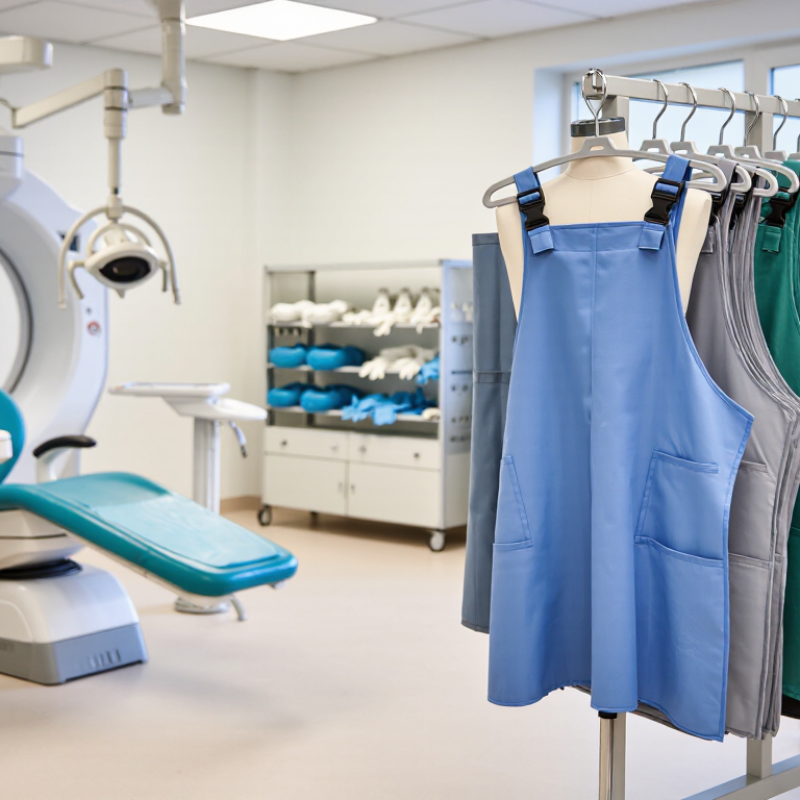
Best Lead Apron Manufacturer in China for Global Buyers

Defining Lead Apron Protection: 0.25–0.50 mm Pb Equivalence per IEC 61331-3

Best Lead Apron Manufacturer in China for Global Buyers

Defining lead apron protection starts with Pb equivalence, not apron weight. Under IEC 61331-3, common ratings include 0.25, 0.35, and 0.50 mm Pb equivalence. These values indicate shielding performance under defined test conditions. They do not describe ordinary fabric thickness.

A 0.50 mm rating is not automatically twice as useful as 0.25 mm. Protection depends on radiation energy, exposure direction, garment coverage, and correct fitting. In practical inspections, experienced buyers check the front panel, overlap areas, seams, and closures. Small gaps can reduce confidence during repeated clinical movement. Fit matters.

Reliable manufacturers should provide current test documentation, material specifications, size charts, and care instructions. Ask whether testing covers the finished garment, rather than only a raw sheet. Review batch identification and visual inspection records when possible. Hang aprons flat or on approved supports to reduce cracking. Never fold them casually.

Some purchasing decisions still focus too heavily on price. That is understandable, but incomplete. A lighter apron may improve comfort, while a higher rating may increase fatigue. The right choice needs workplace assessment and professional guidance. Even careful processes can miss hidden damage, so regular inspection remains necessary. Verify applicable requirements in the destination market before ordering.

Lead Apron Protection Classes Under IEC 61331-3

Lead-equivalent thickness expresses the radiation attenuation provided by protective material compared with the same thickness of pure lead. Common protective apron classes are 0.25 mm Pb, 0.35 mm Pb, and 0.50 mm Pb. A higher lead-equivalence value generally provides greater attenuation, while the appropriate level depends on the procedure, operating voltage, workload, and local radiation-safety requirements. IEC 61331-3 specifies methods for determining and communicating the lead-equivalence performance of protective clothing and devices.

Reference range shown: 0.25–0.50 mm Pb equivalence. Actual product performance should be verified through the manufacturer’s test documentation and applicable regulatory requirements.

Comparing Chinese Manufacturers Against NCRP Report 147 Shielding Principles

For global buyers, comparing Chinese lead apron manufacturers requires more than checking thickness or price. NCRP Report No. 147 offers a practical design framework for diagnostic X-ray shielding. It considers tube voltage, workload, distance, and room occupancy. These principles describe facility barriers, not a complete apron specification. That distinction matters.

A capable manufacturer should state measured lead equivalence, material composition, and test conditions. Ask for reports linked to recognized laboratory methods, batch records, and traceable quality checks. An apron should cover the torso without restricting movement. Its overlap should remain secure during standing and bending. Stitching, closures, labels, and surface integrity deserve inspection. Small defects can become uncomfortable quickly. In real purchasing work, photographs rarely reveal internal cracking or uneven protective material.

Chinese suppliers can be competitive when engineering evidence matches production consistency. Compare samples, not catalog promises. Check whether protection remains stable after repeated folding, hanging, and cleaning. Storage instructions also matter because careless compression may damage the apron. NCRP 147 cannot replace product-specific testing or a site shielding assessment. Independent verification may be necessary before approving a large order. That step feels slow, but it exposes assumptions. Even experienced teams can overlook fit, weight, or worker comfort. Reliable documentation should identify model, size, lead equivalence, test date, and applicable standard. Ask difficult questions. Vague answers are useful warning signs.

Auditing Material Uniformity, Seams, and 0.5 mm Pb Performance

Best Lead Apron Manufacturer in China for Global Buyers

Auditing Material Uniformity, Seams, and 0.5 mm Pb Performance

A reliable lead apron begins with uniform shielding material. Buyers should request batch records, density checks, and the declared lead-equivalence test method. IEC 61331-1 and IEC 61331-3 define test principles for protective clothing, but 0.5 mm Pb is not one universal attenuation value. Performance changes with tube voltage, beam quality, and test geometry.

Inspect the apron like a working technician. Measure several points, including the chest, lower abdomen, shoulder area, and edges. Look for thin zones, trapped folds, or visible gaps near seams. Seams should remain flat and fully covered. Overlap matters, especially when the front panels move during fluoroscopy. A small weakness can become a practical exposure concern.

The IAEA General Safety Requirements, Part 3, uses 20 mSv per year averaged over five years as the occupational effective dose limit. An apron supports this protection strategy, but it cannot replace distance, exposure-time control, or equipment optimization. Many clinical programs use annual fluoroscopic inspection, although local procedures differ. That difference deserves attention. A supplier’s certificate is useful, yet independent sampling is stronger evidence. Ask for raw test results, thickness maps, seam photographs, and traceable production records before approving a large shipment.

Verifying Global Compliance with EN 61331-3 and EU PPE Regulation 2016/425

For global buyers, lead apron compliance starts with evidence, not appearance.

EN 61331-3 evaluates protective clothing against diagnostic X-radiation, including attenuation, design, labeling, and test conditions. Buyers should request reports showing lead equivalence at relevant tube voltages, not only a marketing value such as 0.5 mm Pb.

The UNSCEAR 2020/2021 report identifies medical exposure as the largest source of artificial ionizing radiation exposure, representing about 95% of the total. That figure makes routine protection important.

During factory audits, check apron seams, overlap zones, hook-and-loop closures, and stored samples. Damage often begins near shoulder folds. It is easy to miss.

EU market access also requires alignment with Regulation (EU) 2016/425.

A responsible manufacturer should provide an EU Declaration of Conformity, technical documentation, user instructions, traceability, and valid conformity assessment records. The European Commission’s PPE framework places strong emphasis on risk assessment and ongoing product control, not one-time testing alone. EN 61331-3 supports technical verification, but it does not replace the regulation.

A certificate alone is not enough.

Ask whether the tested construction matches the delivered apron, including fabric layers and protective inserts. This is where some purchasing decisions become weak. Weight, flexibility, and coverage may conflict with radiation protection. Buyers should record acceptance criteria before ordering, then inspect random units after delivery.

Selecting Suppliers by Quality Systems, MOQ, Lead Time, and Export Capacity

Choosing the best lead apron manufacturer in China requires more than comparing prices. A reliable supplier should operate a documented quality system, such as ISO 9001, with clear inspection records. Ask how raw materials are checked before production. Consistent protective material, strong stitching, and accurate sizing matter in daily clinical use. Request recent test reports, batch records, and product specifications. Do not rely on photographs alone.

MOQ should match your purchasing plan, storage space, and market testing needs. A low MOQ can reduce initial risk, but it may increase unit costs or limit customization. A higher MOQ may improve pricing, yet unsold inventory becomes a real concern. Discuss sample approval before mass production. Keep the details in writing. Small misunderstandings can become expensive.

Lead time should include production, inspection, packaging, and shipping preparation. Ask for a realistic schedule, not an optimistic promise. Export capacity is equally important. The supplier should handle commercial invoices, packing lists, shipping marks, and secure protective packaging. Check whether the factory has experience serving different destinations and can communicate clearly with freight partners. In practice, even a capable manufacturer may face delays during peak seasons. Build a reasonable buffer. That is not wasted time. It is practical risk control.

Chat Online
Chat Online
Leave Your Message inputting...
Thank you for your attention. Please kindly describe your question first, or please send your inquiry to our email sale@pcbledmodule.com, and we will reply to you ASAP. Welcome, what can I help you?
Sign in with:



