

loading

BLOG

What Is the Best Ultrasonic Cell Disruptor in 2026?

Choosing the best Ultrasonic Cell Disruptor in 2026 is not simply a matter of selecting the highest wattage. Sample volume, vessel shape, probe diameter, and heat sensitivity all affect performance. A unit that handles a dense bacterial pellet may be poorly suited to a small, temperature-sensitive sample. The details matter.

The physics explains why. In his peer-reviewed review in Science, sonochemistry expert Kenneth S. Suslick wrote, “The chemical effects of ultrasound do not come from a direct interaction with molecular species; rather, they arise from acoustic cavitation.” Suslick’s review describes bubble collapse producing extreme local conditions, including temperatures near 5,000 K and pressures around 1,000 atmospheres. These are microscopic, short-lived conditions—not the bulk temperature of a sample. That distinction matters when evaluating cooling and pulse controls.

A reliable comparison should look beyond advertised power. Check whether the instrument offers adjustable amplitude, pulsed operation, temperature monitoring, and probes suited to your sample volume. Also consider noise, replacement-probe costs, and access to service support. Small practical details count.

This guide compares those features and explains which users may benefit from different configurations. It will not pretend one model fits every laboratory. Real samples are less tidy than product charts.
What Is the Best Ultrasonic Cell Disruptor in 2026?

How Ultrasonic Cell Disruptors Break Open Cells

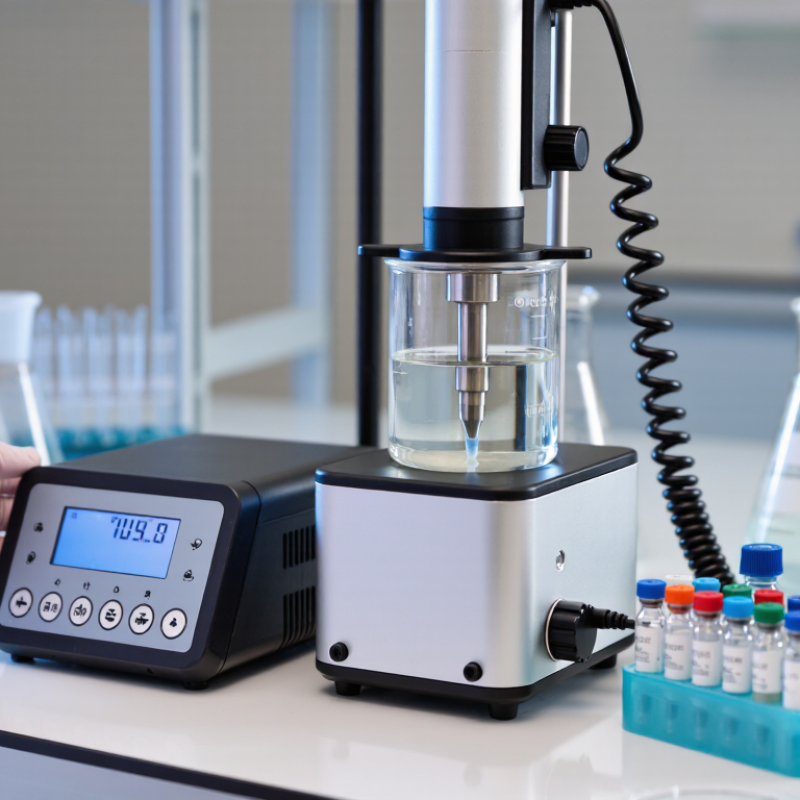
An ultrasonic cell disruptor converts electrical energy into rapid mechanical vibration. A probe, often called a horn, transfers that vibration into the liquid sample. At its tip, alternating pressure creates tiny bubbles. When these bubbles collapse, they generate localized forces that can rupture cell membranes and release intracellular material. That process is cavitation. Small bubbles matter.

Disruption depends on more than the instrument’s power setting. Probe depth, sample volume, vessel shape, and pulse duration all affect how energy moves through the liquid. Excessive sonication can warm a sample, damage sensitive proteins, or create uneven results. Short pulses with pauses can limit heat buildup; a chilled vessel may help with heat-sensitive material. Still, cooling does not fix every problem. A temperature check is useful, not optional guesswork.

Different cells respond differently, so there is no universal setting that guarantees effective disruption. A dense pellet may need a different approach from a dilute suspension. Start with a small test, keep the sample volume and probe position consistent, and record pulse times and temperature. The “best” disruptor in 2026 is not simply the most powerful one; practical control and reproducible results matter. Even then, complete disruption can be hard to judge by appearance alone.

Key Components and Performance Specifications

A capable ultrasonic cell disruptor is a system, not just a wattage rating. Its core parts are a generator, piezoelectric transducer, probe, and sample vessel. The generator sets frequency and amplitude; the transducer converts electrical energy into vibration. A probe transfers that vibration into the liquid. For many laboratory units, the operating frequency is around 20 kHz, but probe diameter and sample volume affect how energy is distributed. Numbers can mislead.

Check whether the instrument provides adjustable amplitude, pulse timing, and overload protection. These controls help limit heating and give cells repeatable exposure. A temperature probe or an external cooling bath is useful for heat-sensitive samples. Keep samples cool. The calorimetric method described by Margulis and Margulis in Ultrasonics Sonochemistry (2003) estimates acoustic power from a liquid’s temperature rise over time. It is a practical check on delivered energy, rather than relying only on the generator’s rated electrical power.

Compare performance using the same sample volume, probe depth, and treatment time. Record temperature before and after each run. A 3 mm probe may suit small tubes, while larger probes generally couple energy into larger volumes. Confirm the stated amplitude range and replaceable probe options before purchase. IEC 61010-2-051 addresses safety requirements for laboratory mixing and stirring equipment, including ultrasonic devices. Specifications still cannot predict every result; vessel shape and sample viscosity can change disruption. That part deserves a test run.

Types of Ultrasonic Disruptors and Their Applications

Ultrasonic disruptors differ mainly in how they deliver acoustic energy. Probe systems place a vibrating tip directly into the sample, making them useful for tough cells and small, concentrated batches. Heat builds fast. An indirect bath sonicator suits several sealed tubes or delicate samples, but energy may vary across the tank. Flow-through units process larger volumes continuously, while multiwell systems support parallel screening. A technical review by Chemat et al. in Ultrasonics Sonochemistry (2011) describes high-power processing ultrasound in the 20–100 kHz range, a useful reference when comparing equipment specifications.

Application matters more than a headline power rating. A probe can break dense bacterial pellets, but short pulses and cooling help protect heat-sensitive proteins. Baths reduce direct probe contact and simplify handling, though they may need longer treatment. Flow-through designs fit repeated processing, but require attention to residence time and sample temperature. There is no universal winner. Even the same cell type can respond differently when concentration or vessel geometry changes.

Tips: Start with a small aliquot. Keep the vessel chilled, use consistent probe depth, and record pulse time, amplitude, and temperature. Compare disruption under a microscope or with a suitable protein assay. Don’t assume a clearer lysate means better recovery.

What Is the Best Ultrasonic Cell Disruptor in 2026?

Typical operating frequencies by disruptor type

How to choose: Probe-type disruptors deliver energy directly into a sample and are commonly used for intensive processing of individual samples. Bath-type disruptors provide indirect sonication and can process multiple vessels at once. Cup horns sonicate sealed vessels, helping reduce contamination and aerosol exposure. Frequencies shown are representative, not universal specifications; the best choice depends on sample volume, throughput, and containment needs.

How to Compare Ultrasonic Cell Disruptors in 2026

Comparing ultrasonic cell disruptors means testing delivered energy, not trusting the wattage printed on a housing. Chisti and Moo-Young’s review in Enzyme and Microbial Technology (1989) describes acoustic cavitation as the disruption mechanism and heat as a key process concern. Many probe systems operate near 20 kHz. Treat that as a starting point, not a universal winner.

Run the same sample volume, cell concentration, and pulse schedule on each unit. For example, test 10 mL aliquots with five seconds on and five seconds off, while keeping samples in an ice bath. Record temperature before and after treatment. Then compare soluble protein yield or another assay matched to your target. Use at least three replicates; one good-looking tube proves little. Also check whether the probe tip fits your vessel without touching its walls.

Ask suppliers for measured acoustic output, amplitude range, duty-cycle control, and compatible probe sizes. Rated electrical power is not the same as energy reaching the sample, a distinction emphasized in sonochemistry measurement literature. Small batches may need gentle, repeatable pulses; viscous samples can behave differently. No setting wins every time. Even careful comparisons leave some uncertainty, so retain your own sample-specific results.

Choosing a Disruptor for Your Sample and Laboratory Needs

What Is the Best Ultrasonic Cell Disruptor in 2026?
Choosing a Disruptor for Your Sample and Laboratory Needs

The best ultrasonic cell disruptor is the one that suits your sample, workload, and lab setup. Start with sample type and volume. A small tube of delicate cells may need a different probe and power range than a larger, tougher sample. Too much energy can heat samples quickly or damage sensitive material. That matters.

Match the probe size to the vessel and working volume. A probe that is too large may cause splashing; one that is too small can make processing slow. Look for adjustable amplitude and pulse settings, plus a timer you can set precisely. Pulsed operation gives samples brief cooling intervals. Check that replacement probes are available and that the unit is straightforward to clean. Specifications help, but settings from one device may not translate directly to another. It is easy to overvalue maximum power.

Tips: Begin with a small test volume and short pulses. Keep the vessel cool, and note the probe depth, settings, and processing time. Compare sample appearance or measured results between runs. Adjust gradually; the ideal setting may take a few attempts.

What Is the Best Ultrasonic Cell Disruptor in 2026? — Choosing a Disruptor for Your Sample and Laboratory Needs

Disruptor Type Typical Working Scale Disruption Capability Best Suited For Key Limitations Practical Selection Notes
Probe sonicator with a microtip Small samples, commonly about 0.1–10 mL; the usable range depends on the probe and vessel. High-intensity, direct energy delivery can efficiently disrupt many microbial and tissue samples. Small-volume work, difficult-to-lyse cells, and protocols requiring relatively concentrated samples. Direct probe contact can introduce metal particles through tip wear. Small volumes can heat quickly, and open vessels can generate aerosols. Choose a tip sized for the sample volume. Use short pulses, cooling, and an appropriate sound enclosure; inspect the tip regularly.
Probe sonicator with a standard probe Often used for roughly 5–500 mL, with the actual range depending on probe diameter, vessel geometry, and instrument configuration. High-intensity direct sonication; suitable for many routine cell-lysis and homogenization procedures. Routine laboratory batches where adjustable amplitude, pulse timing, and direct processing are useful. Energy distribution can vary with immersion depth and vessel shape. Heating, foaming, and aerosol formation may affect sensitive samples. Match probe diameter to batch size and keep immersion depth consistent. Validate the process for each sample type and vessel.
Cup-horn sonicator Multiple sealed tubes or vessels; capacity depends on the cup, holder, and vessel arrangement. Indirect ultrasonic energy reaches samples through the vessel wall; intensity and uniformity depend on setup. Parallel processing, sealed samples, and workflows where avoiding direct probe contact is important. Energy transfer may be less direct than with a probe. Positioning, vessel type, and water level can influence results. Useful for reducing probe-to-sample contact and cross-contamination risk. Standardize tube placement and verify disruption efficiency.
Ultrasonic bath Several tubes or vessels can be processed together; practical capacity depends on bath size and sample holders. Generally lower and less localized energy at the sample than direct probe sonication; cell disruption may be slow or inconsistent. Gentle treatment, small-scale preliminary work, or applications where a bath is already part of the workflow. Results can vary with vessel position, bath loading, and coupling. It is not usually the first choice for demanding or reproducible cell lysis. Do not assume bath settings equal delivered sample energy. Use a validated protocol and compare results with a direct probe method when needed.

How to choose: For efficient disruption of small or difficult samples, a probe sonicator is often the most practical starting point. For sealed, parallel samples, consider a cup horn. A bath is generally better suited to gentler or less demanding applications. Working-volume ranges are indicative, not universal specifications; confirm compatibility with the instrument, probe, vessel, and sample. Control heat with pulsed operation and cooling, and use suitable shielding and aerosol precautions.

Chat Online
Chat Online
Leave Your Message inputting...
Thank you for your attention. Please kindly describe your question first, or please send your inquiry to our email sale@pcbledmodule.com, and we will reply to you ASAP. Welcome, what can I help you?
Sign in with: