
English


Choosing a steel light pole manufacturer is about more than comparing prices. The right supplier can affect installation time, maintenance needs, and long-term performance. For global buyers, details such as pole height, base-plate dimensions, coating thickness, and wind-load requirements deserve careful review. A drawing may look complete, yet a small mismatch in anchor-bolt spacing can delay work on site.
This guide introduces seven manufacturers serving buyers in different markets and project types. It considers product range, engineering support, manufacturing capabilities, quality documentation, and export experience. These factors help buyers ask more useful questions before requesting a quotation. A supplier’s published specifications are a starting point, not a guarantee that every project need is covered. Details matter.
The best choice depends on where and how the poles will be used. Coastal exposure, transport limits, local installation practices, and replacement-part availability can change the decision. Some buyers may value custom engineering; others may need standard models with predictable lead times. No ranking can replace a technical review of drawings, finishes, and project requirements. Comparisons also have limits: public information may not reveal a factory’s current capacity or service quality. Use this overview to shortlist candidates, then verify important claims directly with each manufacturer.
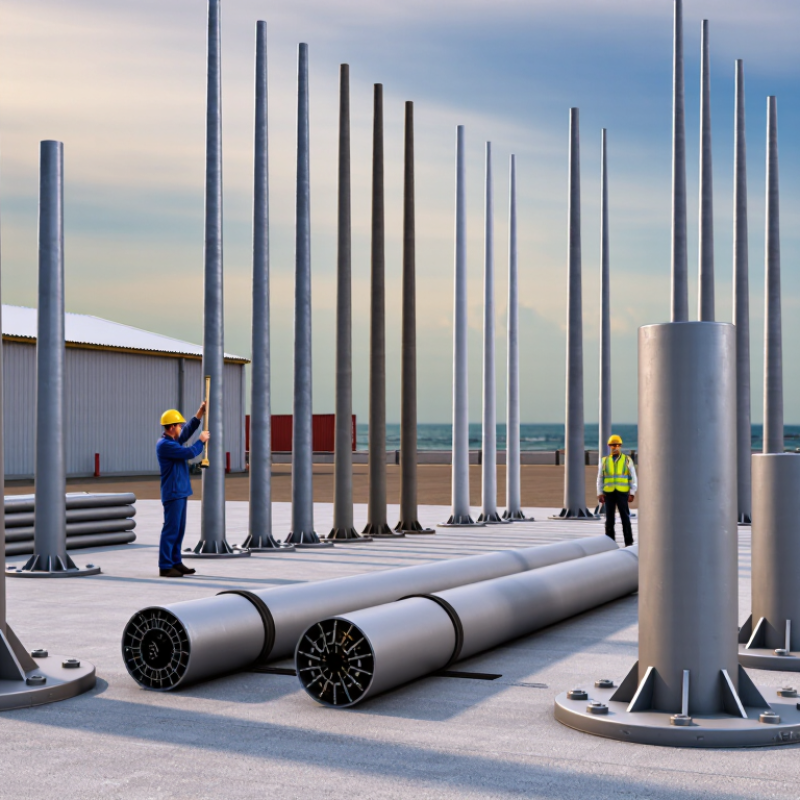
Steel light poles support roadway lights, parking-lot fixtures, pedestrian paths, and industrial yards. Their shape affects strength, appearance, and installation. Round tapered poles offer a clean profile and can reduce wind exposure. Octagonal shafts provide flat faces for mounting brackets and access doors. High-mast poles serve broad areas, while shorter poles suit walkways and small lots.
Grade 50 steel is commonly associated with a minimum yield strength of 345 MPa, subject to the applicable material specification and product thickness. This strength can help designers balance structural capacity and wall thickness. But the steel grade alone does not determine performance. Pole height, fixture weight, wind loading, anchor-bolt layout, and soil conditions all matter. One detail is easy to overlook: weld quality and corrosion protection affect service life, too. Hot-dip galvanizing is widely used outdoors, though coating condition still needs inspection.
Buyers should request material certificates and drawings that show dimensions, base plates, and connection details. Check whether the design accounts for local wind exposure and the number of fixtures. Small differences matter. A pole that looks robust in a catalog may not fit a site’s foundation or maintenance equipment. Specifications deserve a second look.
QUICK LINKS
CONTACT US
Office: (+86) 755 23040566
Tel: (+86) 158 9965 5195
E-mail: sale@pcbledmodule.com
Skype: Hans@Rocket-PCB
Whatsapp: 86 1589965 5195
Office Address: 2207,Bid 4,He Gu Shan Hui Cheng,35#,Guang Tian RoYanluo street, Song Gang Town,518105 SHENZHENG, CHINA
Plant ADD.: No 69, Lianfeng North Road, Xianxi Area, ChangAn Town, Dongguan, China.


Copyright © 2025 Rocket PCB Solution Ltd. | All Rights Reserved Sitemap Friendship link: CNC machining heat sink

