
English


Choosing the best Smart Street Light in 2026 means looking beyond the fixture’s headline brightness. A streetlight must help people see sidewalks, crossings, and road edges without creating harsh glare. It should also dim reliably when streets grow quiet. Small details matter.
Mark Rea, a lighting researcher and former director of the Lighting Research Center, offers a useful principle: judge lighting by visual performance, not brightness alone. This is a paraphrase of the approach reflected in his research, not a direct quotation. It matters when comparing products that advertise high lumen output but provide little information about light distribution, controls, or maintenance.
This guide examines the practical differences between leading smart street-light systems. It considers LED efficiency, adaptive dimming, sensors, network connectivity, cybersecurity practices, and compatibility with existing infrastructure. It also looks at warranty terms and how easily crews can replace components from a bucket truck. A well-lit intersection can still have dark patches. Specifications do not always reveal them.
There is no single fixture that suits every street. A coastal road, a residential lane, and a busy junction have different needs. The best choice depends on local conditions, measured performance, and long-term operating costs—not a product’s marketing label. Even careful comparisons have limits; real-world trials can reveal issues that a datasheet misses.
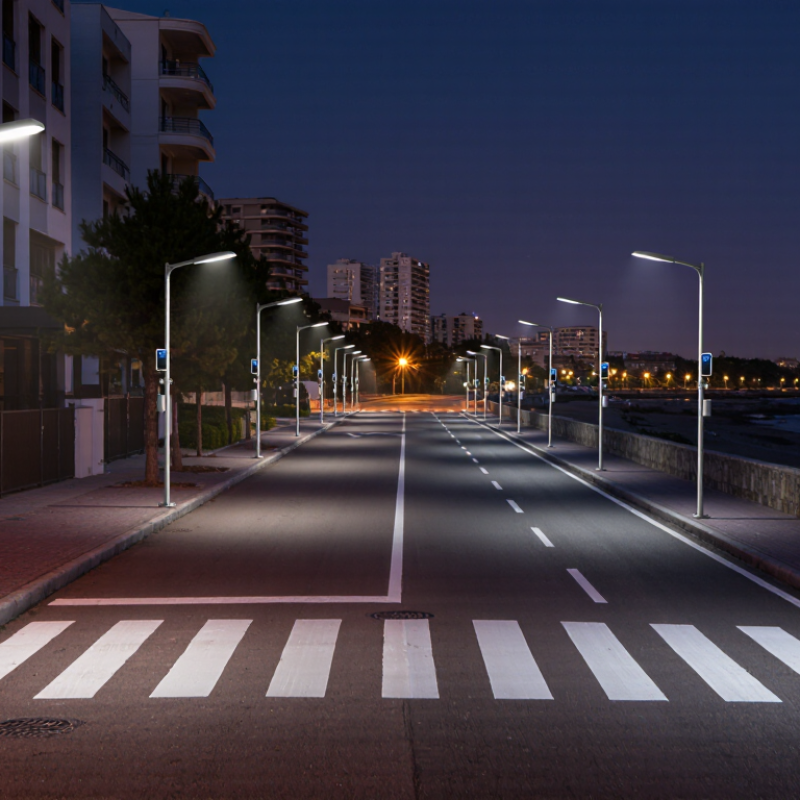
A smart street light is more than an LED lamp on a pole. It combines efficient lighting with remote controls, network communication, and useful operating data. Operators can dim lamps at quiet hours, raise output when pedestrians or vehicles approach, and receive outage alerts without driving street by street. That distinction matters. A connected lamp is not automatically smart.
The International Energy Agency reports that lighting accounts for about 15% of global electricity use and roughly 5% of greenhouse-gas emissions. The U.S. Department of Energy says LED streetlights can use at least 50% less energy than conventional streetlights. These figures describe lighting efficiency, not guaranteed savings from smart controls. Actual results depend on schedules, local conditions, and whether dimming is properly commissioned.
A practical system also needs reliable sensors, secure communications, and controls that work with equipment from different suppliers. On a rainy road, for example, a sensor should not leave a crossing dim when people are waiting. Maintenance teams need clear fault reports, not another dashboard full of noise. Still, gaps remain: networks fail, sensors misread scenes, and savings can disappoint. A careful pilot should measure light levels, energy use, and outage response before a city expands the system.
QUICK LINKS
CONTACT US
Office: (+86) 755 23040566
Tel: (+86) 158 9965 5195
E-mail: sale@pcbledmodule.com
Skype: Hans@Rocket-PCB
Whatsapp: 86 1589965 5195
Office Address: 2207,Bid 4,He Gu Shan Hui Cheng,35#,Guang Tian RoYanluo street, Song Gang Town,518105 SHENZHENG, CHINA
Plant ADD.: No 69, Lianfeng North Road, Xianxi Area, ChangAn Town, Dongguan, China.


Copyright © 2025 Rocket PCB Solution Ltd. | All Rights Reserved Sitemap Friendship link: CNC machining heat sink

