

Electricity is becoming more distributed, measurable, and demanding. Solar panels, heat pumps, electric vehicles, and home batteries are changing how protection devices operate. A traditional breaker may interrupt a fault, but a Smart Circuit Breaker can also report energy use, detect abnormal loads, and support remote control.
The International Energy Agency’s Electricity 2024 report expects global electricity demand to grow by about 4% in 2024, with strong growth continuing through 2026. That pressure makes safer and more visible distribution systems increasingly important. MarketsandMarkets also identifies digital monitoring and connected power equipment as major trends across low-voltage electrical infrastructure. These reports do not make every connected breaker a wise investment. Context matters.
Jean-Pascal Tricoire, former Schneider Electric chairman and a leading voice in digital energy management, said, “Digital is not about technology. It’s about people.” His point applies directly here. A breaker with an attractive mobile app can still disappoint if installation is difficult, cloud access is unreliable, or local support is weak.
This guide compares seven Smart Circuit Breaker options for global buyers. It considers interrupting capacity, voltage compatibility, DIN-rail installation, metering accuracy, communication protocols, cybersecurity, certification, and after-sales service. Look closely.
No shortlist is perfect. A compact device may suit an apartment, while a commercial panel needs higher fault ratings and stronger coordination. Buyers should verify IEC or relevant national compliance before purchase. Product availability also changes by region. A cheaper breaker may create hidden costs through adapters, subscriptions, or unavailable replacement parts. The best choice is not always the most advanced model. It is the one that matches the electrical system, installation environment, and people responsible for maintaining it.
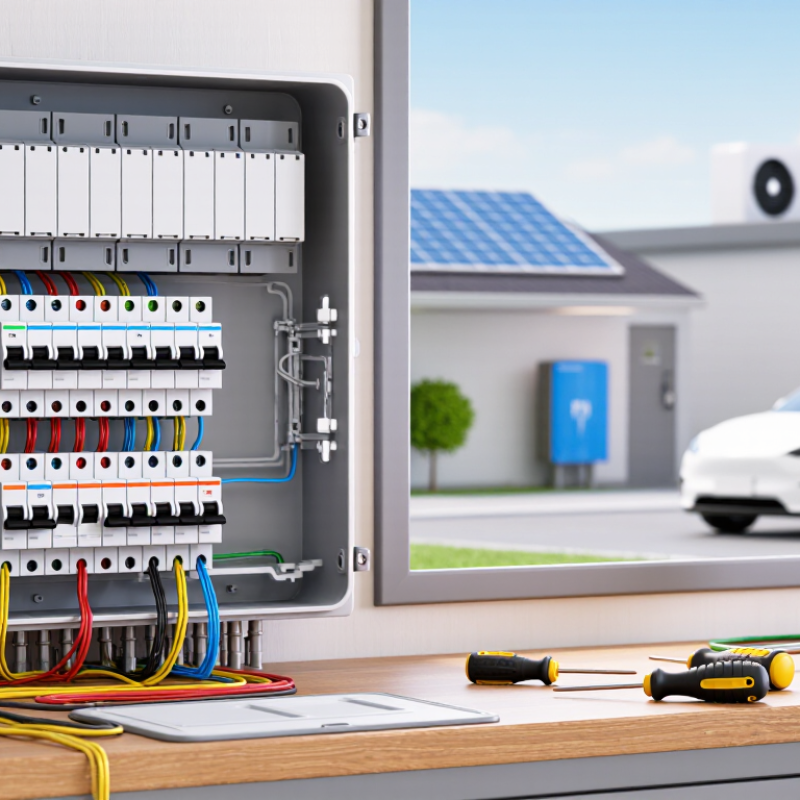
A smart circuit breaker combines electrical protection with sensing and communication. Inside, current and voltage sensors monitor a circuit continuously. When overload, short circuit, or abnormal temperature appears, its trip mechanism disconnects power. Many models also measure energy use and send alerts through a local network or cloud platform. The basic protection remains automatic. It should not depend on an internet connection.
The International Energy Agency’s Electricity 2024 report forecasts global electricity demand to grow by about 3.4% annually from 2024 to 2026. This growth increases interest in load monitoring, peak control, and safer distribution panels. A smart breaker can switch selected loads, such as water heaters or workshop equipment, during high-demand periods. It can also record unusual consumption, helping technicians find a failing appliance.
Small detail. Important difference.
Global buyers should check rated voltage, frequency, pole configuration, interrupting capacity, and installation space. Compliance with relevant requirements, including IEC 60898-1 or IEC 60947-2 where applicable, needs verification. Communication security matters too; encrypted access and strong authentication reduce avoidable risks.
Remote switching sounds convenient, but poor settings may interrupt essential equipment. I would also test manual operation and local tripping before trusting an app. Performance claims can be attractive, yet wiring quality, enclosure temperature, and installation practice still influence real safety.
Global buyers should compare smart circuit breakers by safety, compatibility, and evidence, not app appearance. The International Energy Agency’s Electricity 2024 report projects global electricity demand to grow by 3.3% in 2025. More connected loads will increase the value of accurate energy monitoring. Look for voltage, current, power, and temperature readings, with clear time intervals. Accuracy matters.
Check compliance with recognized standards, such as IEC 60898-1 for household circuit protection or IEC 60947-2 for industrial applications. Confirm rated current, breaking capacity, trip curves, and operating temperature. A breaker installed in a hot panel needs more than attractive specifications. Ask for independent test reports and certificates. Marketing language is not verification.
Communication features deserve equal attention. Wi-Fi is convenient, but local control and stable alternatives can be more dependable during outages. Secure authentication, encrypted communication, firmware updates, and access logs should be available. The NIST Cybersecurity Framework remains a useful reference for evaluating connected-device risks. Compatibility with regional voltage, frequency, neutral wiring, and installation space is essential. A compact design may still be awkward in a crowded distribution board. The International Renewable Energy Agency reported 473 gigawatts of renewable capacity additions in 2023, showing why flexible load monitoring is becoming more relevant. Still, forecasts are not guarantees. Buyers should test real switching response, notification delays, and manual operation before large-scale deployment.
| Rank / Product Profile | Typical Application | Poles & Rated Current | Voltage & Frequency | Connectivity | Protection & Monitoring | Installation & Standards | Best For |
|---|---|---|---|---|---|---|---|
| 1. Single-Phase Wi-Fi MCB | Apartments, lighting circuits, sockets, and small appliances | 1P+N; typically 16–63 A | 220–240 V AC; 50/60 Hz | 2.4 GHz Wi-Fi; mobile app and voice-platform integration may be available | Overload and short-circuit protection; remote ON/OFF; energy monitoring on selected models | DIN rail; commonly aligned with IEC 60898-1; verify local certification | Cost-conscious residential automation |
| 2. Zigbee Smart MCB | Multi-room homes and buildings using a central smart-home hub | 1P+N or 2P; typically 16–63 A | 220–240 V AC; 50/60 Hz | Zigbee 3.0; requires a compatible gateway or hub | Remote switching, schedules, overload alerts, and optional current or power data | DIN rail; check compliance with IEC 60898-1 and regional radio requirements | Reliable low-power mesh networks |
| 3. Energy-Monitoring Smart MCB | Home energy management and load-reduction programs | 1P+N or 2P; typically 20–63 A | 220–240 V AC; 50/60 Hz | Wi-Fi, Bluetooth commissioning, or gateway-based communication | Voltage, current, power, power factor, cumulative energy, and overload protection | DIN rail; measurement accuracy is commonly specified as Class 1 or better, depending on design | Users who need consumption data rather than switching only |
| 4. Smart RCBO with Residual-Current Protection | Bathrooms, kitchens, outdoor circuits, and other higher-risk areas | 1P+N; typically 6–40 A | 220–240 V AC; 50/60 Hz | Wi-Fi or Zigbee, depending on the model | Overload, short circuit, and residual-current protection; common trip sensitivity is 30 mA | DIN rail; typically evaluated against IEC 61009-1; local RCD requirements must be checked | Personal protection combined with remote control |
| 5. Two-Pole Smart MCB | Single-phase feeders, water heaters, HVAC, and dedicated equipment | 2P; typically 40–100 A | 220–240 V AC; 50/60 Hz | Wi-Fi, Ethernet gateway, or RS-485-based system integration | Simultaneous switching of line and neutral; remote trip status and optional energy metering | DIN rail; interrupting capacity and coordination must match the installation design | High-load single-phase circuits |
| 6. Three-Phase Smart Breaker | Small commercial sites, pumps, workshops, and three-phase equipment | 3P or 4P; typically 16–63 A | 380–415 V AC between phases; 50/60 Hz | Ethernet, RS-485/Modbus, Wi-Fi, or cellular gateway | Phase voltage, current, power, energy, phase imbalance, and remote trip monitoring | DIN rail or panel installation; verify IEC 60947-2 suitability and local approval | Commercial and light-industrial distribution |
| 7. Matter- or Cloud-Connected Smart Breaker | New smart-home installations requiring broader platform compatibility | 1P+N or 2P; typically 16–63 A | 220–240 V AC; 50/60 Hz | Matter over Wi-Fi or Thread, or proprietary cloud connectivity; verify ecosystem support | Remote switching, schedules, fault alerts, and optional real-time energy data | DIN rail; confirm electrical safety certification, cybersecurity policy, and regional radio approval | Cross-platform smart-home projects and future expansion |
Comparison note: Ratings and communication options shown are typical market ranges for these product profiles. Buyers should confirm interrupting capacity, trip curve, residual-current type, enclosure temperature limits, local certification, and compatibility with the intended electrical system before purchase.
For global buyers, the seven best smart circuit breakers depend on the job, not just the app. For apartment protection, choose compact models with overload alerts and clear status lights. For electric vehicle charging, select a breaker with accurate current monitoring and strong thermal performance. Solar systems need models that handle bidirectional energy flow and frequent load changes. Workshops benefit from higher interruption ratings and simple manual controls. Remote cabins need dependable offline operation, because mobile signals can disappear. Rental properties suit breakers with shared access and event history. Small commercial panels require expandable communication and easy maintenance records. These use cases matter more than attractive software screens.
Tips: Check voltage, frequency, pole count, and enclosure size before ordering. Confirm local certification requirements with a qualified electrician. Test manual operation, network recovery, and trip response during commissioning. Do not assume every smart breaker fits an older panel. Compatibility is often the weak point.
A reliable selection should also consider heat, humidity, and installation space. A breaker installed beside a hot inverter may need extra clearance. Look for encrypted communication, role-based access, and visible fault records. Local controls remain important when cloud services fail. Some products promise precise energy data, yet readings can drift under unbalanced loads. That limitation deserves attention. A careful buyer compares technical documents, warranty terms, replacement access, and professional support in the destination market.
The chart compares representative nominal current ratings commonly used for smart circuit-breaker applications. Actual selection depends on local electrical codes, system voltage, conductor capacity, load calculation, and installation conditions.
Values are representative circuit ratings: lighting circuits typically use 6–10 A, general socket circuits around 16 A, EV charging commonly uses 32 A, HVAC circuits often range from 32–40 A, residential solar protection may use up to 63 A, small commercial distribution commonly uses 100 A, and industrial feeders can use 250 A or more.
7 Best Smart Circuit Breakers for Global Buyers?
Safety begins with accurate electrical matching, not a mobile application. Check the system voltage, frequency, breaking capacity, pole arrangement, and neutral requirements. A breaker rated for 120 volts may be unsuitable for a 230-volt installation. The enclosure also needs enough space for heat dissipation and wiring bends. One detail is easy to miss. Smart functions cannot compensate for incorrect circuit sizing.
Certification requirements differ by market and application. Industrial products may follow IEC 60947-2, while household breakers can use IEC 60898-1. North American projects often require standards such as UL 489 or CSA C22.2 No. 5. A CE mark indicates regulatory conformity in relevant markets, but it is not always an independent safety certification. Request the declaration of conformity, test reports, rated current, short-circuit rating, and certification scope. Check the actual model, not only the product family.
Installation should be completed by a qualified electrician who understands local wiring rules. Confirm DIN-rail dimensions, terminal capacity, surge protection, and compatibility with existing distribution boards. Remote switching also introduces communication risks, so use strong passwords, secure firmware updates, and limited user access. In field inspections, loose terminals and overloaded neutrals appear more often than expected. I once treated app compatibility as a minor issue; it caused delayed commissioning. That assumption was risky. Buyers should also verify local utility approval, inspection procedures, warranty support, and whether cloud services remain available in their region.
Choosing among the 7 best smart circuit breakers requires more than comparing app features. Market conditions matter. A 120-volt system differs from a 230-volt system. Frequency, pole configuration, neutral wiring, and enclosure size also vary. Check local certification requirements before purchasing. IEC 60898-1 may apply to household protection, while IEC 60947-2 often covers industrial equipment.
Energy visibility is becoming more valuable. The International Energy Agency’s Electricity 2024 report expects global electricity demand to grow by about 3.4% annually through 2026. The 2024 Global Status Report for Buildings and Construction states that buildings consume 32% of global energy. Therefore, choose a breaker that records current, voltage, load, and abnormal events. Local data storage can help where cloud services are unreliable. Cybersecurity matters too. A cheap device can become an expensive maintenance problem.
Tips: Confirm the rated voltage, interrupting capacity, and temperature range. Test manual operation before installation. Ask whether the device supports the required communication protocol. For commercial markets, verify installation space on the DIN rail and compatibility with existing distribution boards. Do not treat remote switching as a replacement for proper overcurrent protection. Pilot one small installation first. That step often exposes weak Wi-Fi, confusing software, or inaccurate energy readings. No checklist is perfect, and market assumptions can be wrong. Measure actual site conditions before choosing a model.
QUICK LINKS
CONTACT US
Office: (+86) 755 23040566
Tel: (+86) 158 9965 5195
E-mail: sale@pcbledmodule.com
Skype: Hans@Rocket-PCB
Whatsapp: 86 1589965 5195
Office Address: 2207,Bid 4,He Gu Shan Hui Cheng,35#,Guang Tian RoYanluo street, Song Gang Town,518105 SHENZHENG, CHINA
Plant ADD.: No 69, Lianfeng North Road, Xianxi Area, ChangAn Town, Dongguan, China.


Copyright © 2025 Rocket PCB Solution Ltd. | All Rights Reserved Sitemap Friendship link: CNC machining heat sink


