

loading

BLOG

What Is the Best Heat Recovery Ventilator in 2026?

A Heat Recovery Ventilator can bring in outdoor air while transferring warmth from outgoing air, helping homes stay fresher without discarding as much heat. But choosing the best model for 2026 is not just a matter of comparing efficiency claims. Climate, home size, duct layout, filter access, and installation quality all shape real-world performance. A quiet unit that is easy to maintain may serve a household better than a higher-rated model that is poorly fitted.

Indoor-environment researcher Dr. Pawel Wargocki’s work points to a useful principle: ventilation should support healthy indoor air, not merely move air around. This is a paraphrase, not a direct quotation. It frames the comparison that follows: airflow, heat-recovery efficiency, sound levels, controls, filtration, and service needs deserve attention together. A product label alone cannot tell the whole story.

Small details count. A filter that slides out easily matters on a cold morning. So does a control panel that makes airflow settings clear. No unit wins everywhere. The comparison is not perfectly neat, because manufacturers test products under different conditions, and local installation can change results. That deserves a closer look. This guide will assess leading options using practical criteria, explain which homes may suit each type, and flag trade-offs buyers should verify with current specifications and a qualified installer. The aim is not to crown a universal winner, but to help identify the right Heat Recovery Ventilator for a particular home.
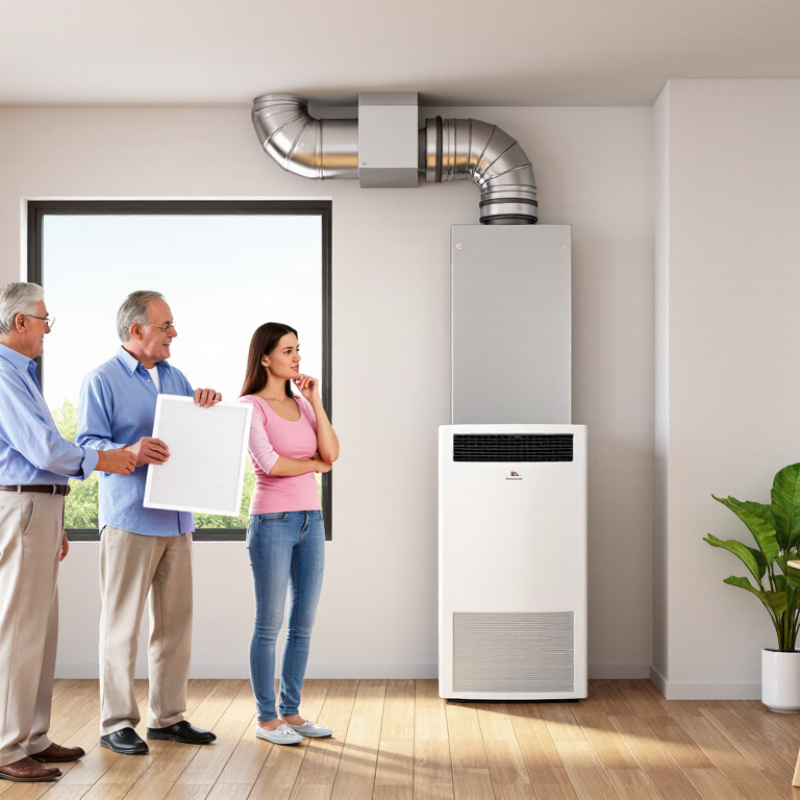
What Is the Best Heat Recovery Ventilator in 2026?

How HRVs Recover Heat: Sensible Effectiveness, SRE, and Frost Control

An HRV transfers sensible heat from outgoing indoor air to incoming outdoor air, without intentionally mixing the streams. Sensible effectiveness describes how much of that temperature difference the core recovers under stated test conditions. A 75% result does not mean every room stays 75% warmer; airflow, installation, and weather matter. Numbers need context. Uneven duct runs or a dirty filter can reduce real-world performance. Compare units at similar airflow and temperature conditions, not by headline percentages alone. That distinction is easy to miss.

Sensible Recovery Efficiency, or SRE, also accounts for the electricity used by the fans under a defined test method. It can help compare net performance, but only when ratings use comparable conditions. Frost control matters in cold weather. Moisture from exhaust air can freeze inside the core, restricting airflow. Some systems use preheating; others temporarily adjust or interrupt supply airflow to clear frost. Each approach affects energy use and ventilation balance. A useful specification should explain its frost-control method and operating limits. I would not treat one catalog number as a verdict: check the test conditions, expected winter temperatures, and airflow needs for the actual home. A quiet unit with suitable capacity may serve better than a higher-rated model that is poorly matched or installed.

How an HRV Recovers Heat: A Sensible Effectiveness Example

Illustrative model, not product test data: with indoor air at 21°C and an assumed 75% sensible effectiveness, the chart shows outdoor air temperature and the calculated supply-air temperature after heat exchange. Actual performance depends on the unit, airflow balance, test conditions, and frost-control operation.

Sensible effectiveness describes heat transfer inferred from air temperatures: (supply temperature after the core − outdoor temperature) ÷ (indoor temperature − outdoor temperature). SRE is a separate, test-method-dependent measure and should not be read as the same value. Frost control can change airflow or temporarily reduce heat recovery to limit ice buildup.

ASHRAE 62.2: 0.03 CFM/ft² + 7.5 × (Bedrooms + 1)

ASHRAE 62.2’s common whole-building ventilation calculation is 0.03 CFM per square foot plus 7.5 CFM multiplied by the number of bedrooms plus one. For a 2,000-square-foot home with three bedrooms, that equals 60 + 30, or 90 CFM. This is a starting point, not automatically the required HRV setting. The applicable standard edition and permitted adjustments can affect the final rate. Measure conditioned floor area carefully; including an unheated garage can distort the estimate. Small details matter.

Once you have a target, compare HRVs by airflow at the expected duct pressure, not just their largest advertised number. A unit rated for 90 CFM under no-resistance conditions may deliver less through real ducts and filters. Ask for performance data, balanced supply and exhaust, frost protection, and accessible filters. Quiet operation matters. A noisy bedroom vent may get closed, defeating the design. After installation, have airflow measured and adjusted at the grilles. Estimates can miss how a particular home behaves, so recheck ventilation after major changes to occupancy or the building envelope.

How to Compare 2026 HRVs Using HVI-Certified Airflow, SRE, and Noise Ratings

When comparing heat recovery ventilators in 2026, start with HVI-certified data, not the largest airflow number on a product page. Check the Home Ventilating Institute directory for the exact model and operating speed. Airflow ratings matter only when compared at similar external static pressure, because restrictive ducts can reduce real delivery. A unit rated at 150 cubic feet per minute may provide less once connected to long, narrow runs.

Then compare sensible recovery efficiency, or SRE, at the airflow your home actually needs. SRE indicates how well the unit transfers heat between outgoing and incoming air under specified test conditions. Higher can mean less heat lost in winter, but test conditions and airflow affect the figure. Look for comparable ratings, not a single impressive percentage. Cold-climate performance deserves attention.

Noise ratings help distinguish quiet operation from a loud mechanical-room surprise. Compare HVI-listed sound levels at matching airflow settings; lower values generally indicate quieter operation. Still, a rating cannot predict every installation. Duct vibration, mounting, and nearby bedrooms change what you hear. Check the low and high settings, then ask whether the required ventilation rate can be met without running the unit noisily. I’d also verify that the listed configuration matches the controls and accessories being installed. It is easy to overlook that detail. A careful comparison is useful, but real duct design may still humble the spreadsheet.

What AHRI 1060 Ratings Reveal About HRV Efficiency and Performance

What Is the Best Heat Recovery Ventilator in 2026?

AHRI 1060 ratings make HRV comparisons more meaningful because they report performance under standardized test conditions. Look beyond a single efficiency number. Sensible recovery efficiency (SRE) estimates how much heat the unit transfers between outgoing and incoming air. Fan efficacy shows the electricity needed to move air, while net airflow helps confirm the unit can meet a home’s ventilation needs. Check that ratings use similar airflow and pressure conditions before comparing models. Otherwise, the numbers may not describe a fair, like-for-like test.

Tips: Match rated airflow to your home’s ventilation plan, then compare SRE and fan efficacy at that airflow. Also check exhaust air transfer ratio and outdoor air correction factor; these can reveal how much exhaust air carries over or how delivered airflow differs from the test setting. Quietness, duct design, and filter condition matter in daily use, too. Ratings cannot predict every installation. A well-rated unit may still disappoint if its ducts are restrictive or its airflow is poorly balanced. That detail is easy to overlook.

How Climate, Home Size, and Duct Design Determine the Best HRV

The best HRV is not simply the unit with the highest heat-recovery rating. Climate changes what “best” means.

In cold, dry regions, an HRV recovers heat but does not return much indoor moisture, so winter air may feel even drier. In humid climates, an HRV does not remove incoming moisture; an energy recovery ventilator may suit some homes better.

The U.S. Department of Energy’s Energy Saver guidance reports that HRVs can recover about 70–80% of exhaust-air energy under suitable conditions. Treat that as a potential range, not a guarantee for every installation.

Home size helps determine the required airflow, but floor area alone is not enough. ASHRAE Standard 62.2-2022 sets a baseline of 0.03 cubic feet per minute per square foot, plus 7.5 cfm per person, with occupancy estimated as bedrooms plus one.

Actual design must also account for infiltration and local requirements. That matters.

A larger home with few occupants may need a different ventilation rate than a compact, crowded one.

Duct design can make a correctly sized HRV perform poorly. Long runs, sharp bends, undersized ducts, and restrictive filters increase resistance and can reduce delivered airflow.

A practical design keeps supply and exhaust paths balanced, gives bedrooms quiet, direct supply air, and allows filter access without moving stored boxes.

Ask for measured airflow at the grilles after installation; the equipment’s rated capacity is not proof. I would still question any design that skips balancing.

Chat Online
Chat Online
Leave Your Message inputting...
Thank you for your attention. Please kindly describe your question first, or please send your inquiry to our email sale@pcbledmodule.com, and we will reply to you ASAP. Welcome, what can I help you?
Sign in with: