
English


Choosing the right chandelier is not only a style decision; it also affects how comfortable and useful a room feels. A Chandelier Led Lamp can provide focused illumination, soften shadows, and become a strong visual feature. Yet a beautiful fixture may disappoint if it overwhelms a small room or leaves a dining table dim. The details matter.
Begin with the room’s dimensions, ceiling height, and existing light sources. Measure the space and the table or island below the fixture. A chandelier should feel proportionate, with enough clearance for people to move safely underneath. In a dining room, consider whether its light reaches the table evenly. In an entryway, check that it does not crowd the doorway. Small details matter.
Next, compare the fixture’s brightness, color temperature, and build quality. Lumens indicate light output, while color temperature helps describe whether the light appears warm or cool. Check the manufacturer’s specifications rather than relying on appearance alone. Also confirm that the fixture works with your preferred dimmer; not every LED lamp is compatible. That part is easy to miss. If installation requires changes to existing wiring or mounting, consult a qualified electrician. I would not choose a chandelier by its product photo alone. Finish, scale, and light quality can look different in your own room. The best choice balances practical measurements with a design you will enjoy seeing every day. Take your time.
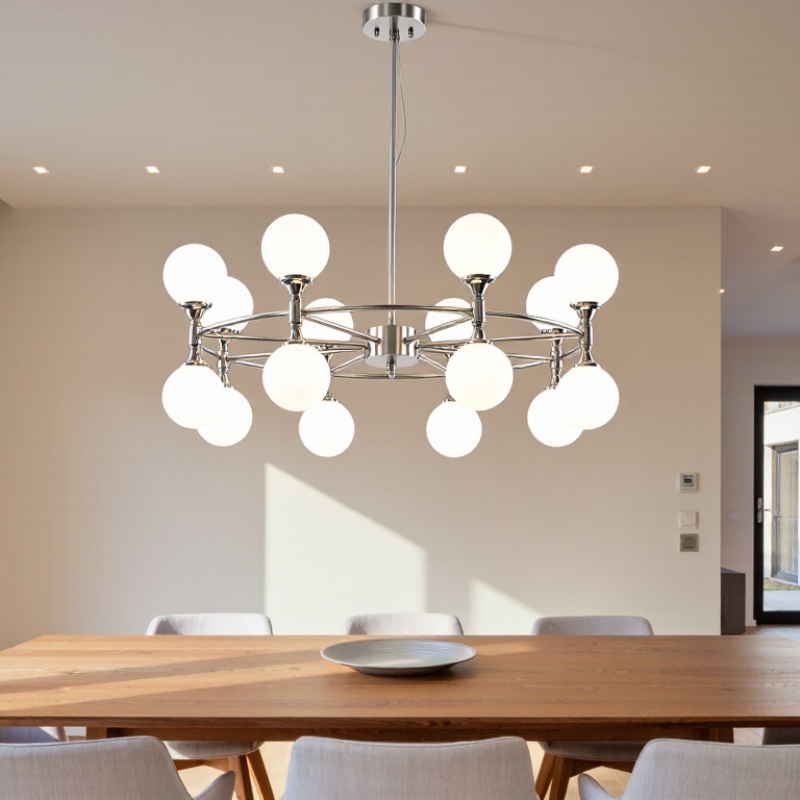
Before choosing a chandelier LED lamp, spend time in the room at different hours. A dining area with broad windows may need less daytime light than a hallway with no natural light. Notice where shadows fall, especially over a table, kitchen island, or reading chair. Take measurements, too. Record the room’s length, width, and ceiling height; a fixture that looks balanced in a shop can feel oversized at home.
Consider what the room is used for. A dining room needs comfortable, even light across the tabletop, while an entryway may benefit from a brighter pool near the door. Check the lamp’s lumen output rather than judging brightness by wattage alone. If the chandelier will serve several purposes, dimmable LED lamps can help shift from focused tasks to softer evening light. Warm-toned light often feels inviting in living spaces, but personal preference matters. Test it if possible.
Look at existing light sources before adding another one. A chandelier may leave dark corners, and recessed lights or a floor lamp might be needed to fill them. I have found that ceiling height is easy to underestimate; a low-hanging fixture can interrupt sightlines or feel awkward above a table. Leave enough clearance for people to move comfortably, and compare the fixture’s dimensions with the furniture below it. Measurements can still mislead. The room’s proportions and daily habits deserve a final look.
| How to Choose the Best Chandelier LED Lamp for Your Home - Assess the Room and Its Lighting Needs | ||||||
|---|---|---|---|---|---|---|
| Room | Typical Room Size | Suggested Ambient Illuminance | Approximate Total Room Light Output | Chandelier Size Guide | Suggested LED Color Temperature | Room-Specific Considerations |
| Dining Room | 10–18 m² | 150–250 lux | 1,500–4,500 lumens | About 45–70 cm diameter for many rooms of this size | 2,700–3,000 K | Center the chandelier over the dining table. For a comfortable view, the fixture’s bottom is commonly positioned about 75–90 cm above the tabletop. |
| Living Room | 15–25 m² | 100–200 lux | 1,500–5,000 lumens | About 50–80 cm diameter, depending on room dimensions and ceiling height | 2,700–3,000 K | Use the chandelier as part of layered lighting. Floor lamps, table lamps, or wall lights can provide comfortable reading and task light. |
| Bedroom | 10–18 m² | 100–150 lux | 1,000–2,700 lumens | About 40–65 cm diameter; choose a compact fixture for lower ceilings | 2,700–3,000 K | Choose a dimmable light for winding down at night. Add bedside lighting so the chandelier does not need to provide every type of light. |
| Kitchen | 10–18 m² | 300–500 lux for work areas | 3,000–9,000 lumens for the room, usually from several light sources | About 40–65 cm diameter for a central fixture; keep island lights proportional to the island | 3,000–4,000 K | A chandelier alone may not light countertops evenly. Combine general lighting with focused task lighting over counters or an island. |
| Entryway or Hall | 4–8 m² | 100–200 lux | 400–1,600 lumens | About 30–50 cm diameter, adjusted for the available clearance | 2,700–3,500 K | Check the fixture’s lowest point against the ceiling height and walking path. A flush or semi-flush design may suit a low ceiling. |
| Planning note: Approximate total lumens are calculated from room area multiplied by the suggested illuminance range. They represent a general target from all light sources, not necessarily the chandelier alone. A useful initial sizing check is to add the room’s length and width in metres, then multiply the result by about 8.3 to estimate a chandelier diameter in centimetres. Adjust for furniture, ceiling height, fixture shape, and personal preference. | ||||||
QUICK LINKS
CONTACT US
Office: (+86) 755 23040566
Tel: (+86) 158 9965 5195
E-mail: sale@pcbledmodule.com
Skype: Hans@Rocket-PCB
Whatsapp: 86 1589965 5195
Office Address: 2207,Bid 4,He Gu Shan Hui Cheng,35#,Guang Tian RoYanluo street, Song Gang Town,518105 SHENZHENG, CHINA
Plant ADD.: No 69, Lianfeng North Road, Xianxi Area, ChangAn Town, Dongguan, China.


Copyright © 2025 Rocket PCB Solution Ltd. | All Rights Reserved Sitemap Friendship link: CNC machining heat sink

