

Choosing a supplier for a curling iron straightener is not just a matter of comparing catalog prices. Buyers also need to assess heating performance, material consistency, safety controls, and support after shipment. China offers a broad manufacturing base, but supplier capabilities vary considerably from one factory to another. Some specialize in compact travel tools, while others handle salon-focused models, private-label programs, or larger production runs. Those differences matter when a product must balance fast heat-up, steady temperature, a comfortable grip, and durable coating. Small details count.
Ask how each company checks temperature accuracy, cord flexibility, surface finish, and unit-to-unit performance. Request samples and clear specifications before discussing a large order. Reviewing factory experience, communication, lead times, packaging options, and quality documentation can reveal practical strengths. Yet a polished website alone is weak evidence. Buyers should confirm claims directly and compare sample results under consistent conditions. That sounds obvious. It is easy to overlook. This guide introduces seven curling iron straightener suppliers in China and explains what buyers can examine when shortlisting them. It also considers how to approach curling iron straightener service from china with realistic expectations, from product development to after-sales communication. Supplier fit depends on order size, target market, customization needs, and the level of technical support required. Not every factory will suit every brief. Use the comparisons as a starting point, then verify current capabilities, terms, and product evidence with each supplier.
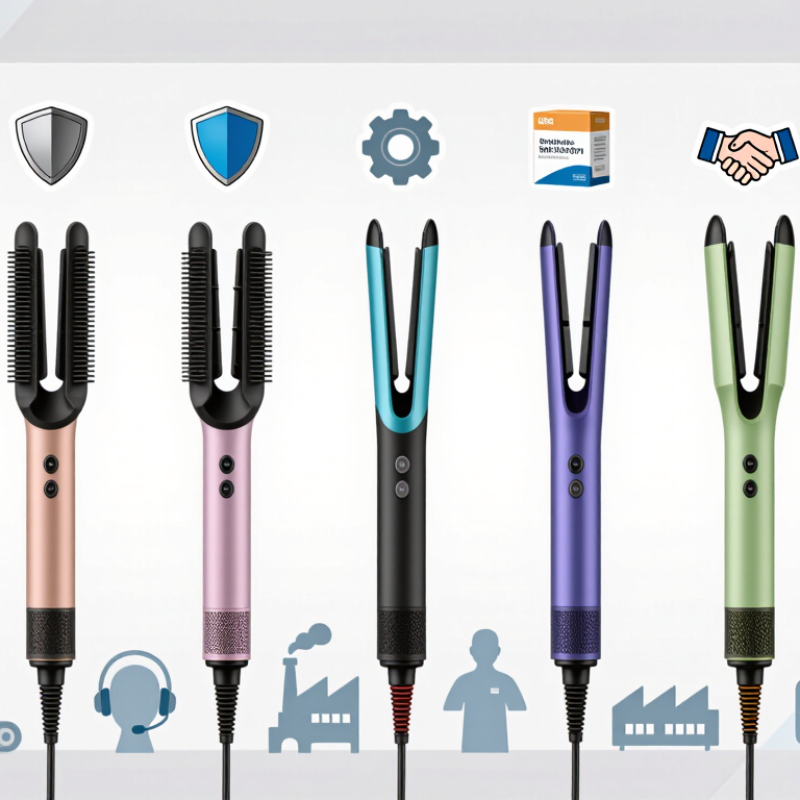
China-based curling iron straightener suppliers manufacture two-in-one heated tools that create curls with a rounded barrel and smooth hair with flat plates. Common production options include ceramic-coated plates, temperature controls, PTC or MCH heating elements, swivel cords, and automatic shutoff features. Some factories offer OEM or ODM work, adjusting barrel diameter, plate width, housing color, and packaging to a buyer’s specifications.
The market is growing, but demand figures do not prove that every supplier has the same capabilities. Grand View Research estimated the global hair styling tools market at about USD 30.09 billion in 2023 and forecast a 5.8% compound annual growth rate from 2024 to 2030. When assessing a Chinese manufacturer, request temperature-consistency test results and inspect samples at several heat settings. Look for even plate contact and a barrel that holds heat during repeated use. Small details matter. A polished sample can still hide uneven heating, and I would treat supplier claims as a starting point, not proof. Ask how each production batch is checked before shipment.
When evaluating Chinese hair styling tool suppliers, inspect the factory, not just the catalogue. Ask to see production records, incoming-material checks, and how failed units are handled. Grand View Research estimated the global hair styling tools market at USD 30.44 billion in 2023 and forecast a 5.7% annual growth rate through 2030. This broad market estimate signals demand, but it does not verify any supplier’s quality. Ask for proof.
For curling iron straighteners, request sample units from a normal production run. Check whether the plates close evenly, the temperature stays stable, and the handle remains comfortable after repeated use. Ask for test reports covering electrical safety, heat performance, and product durability. Confirm that the tested model matches the one offered for production. Paperwork can look tidy; the production line may tell a less tidy story.
Review material traceability, quality-control procedures, lead times, and the supplier’s response to defects. A useful audit checks records against actual stock, such as ceramic plate batches and power-cord specifications. Clarify minimum order quantities and replacement terms in writing. Test real hair. A short sample trial cannot predict every failure, so request repeat samples or a small pilot order before scaling up. That extra step may feel slow, but it can reveal inconsistent heating or loose switches early.
Comparing seven leading curling iron straightener suppliers in China means looking beyond catalog photos. Check whether each supplier explains barrel materials, temperature settings, heating consistency, and safety features clearly. Ask for a sample and test it on different hair sections. Does the heat recover after several passes? Is the grip comfortable after ten minutes? Small details matter. A polished brochure cannot answer these questions.
Reliable suppliers should provide clear product specifications, inspection procedures, and realistic production timelines. Request documentation for materials and electrical testing, then confirm that the supplied model matches the approved sample. Communication is another useful signal. A capable contact should answer technical questions directly, not just promise fast delivery. Still, one sample is not proof of consistent production; repeat checks may be needed. That takes time, but skipping them can create bigger problems.
Tips: Compare the same details across all seven suppliers: sample performance, minimum order quantity, customization options, packaging, and after-sales support. Keep notes during testing. If temperature readings vary or the cord feels awkward, record it rather than relying on memory. Supplier rankings can change, so verify current capabilities before making a purchasing decision.
When comparing curling iron straightener suppliers in China, look beyond catalog size. Some factories focus on a few dual-function tools, offering more room to adjust barrel diameter, plate width, and temperature settings. Others list dryers, brushes, and styling irons together, which may suit buyers building a wider range. A large catalog is not proof of deeper engineering. Details matter.
Manufacturing capability shows up in practical questions: Can the supplier provide samples with consistent heat-up times? Are temperature readings checked across multiple units? Ask about heating-element sourcing, plate materials, assembly steps, and final inspection records. For private-label projects, confirm whether the factory can adapt controls, housing colors, packaging, and plug configurations without disrupting production. Ask for evidence. A polished sample may not match a later batch.
Supplier comparisons should also include tooling ownership, minimum order quantities, lead times, and how defects are handled. Request a small pilot run when possible, then inspect finish quality, button placement, cord flexibility, and temperature stability. One detail is easy to miss: glossy coatings can show scratches under bright retail lighting. I would not judge a factory from its presentation alone; clear specifications and repeatable production matter more, though even good documentation needs checking against actual samples.
Illustrative styling-tool temperature settings and their Fahrenheit conversions. These are reference values, not supplier-specific specifications.
Temperature ranges and available controls vary by model. When comparing suppliers, confirm each product’s adjustable range, heating performance, customization options, and applicable safety certifications directly with the manufacturer.
For a curling iron-straightener supplier, assess the production process, not just a polished sample. Ask how ceramic or coated plates are checked for surface defects and how temperature accuracy is verified. Request batch-level inspection records, traceable component lists, and test reports matching the exact model. A sample can look flawless; later batches may still vary.
Safety evidence matters. The European Commission’s Safety Gate 2023 report recorded 3,412 alerts across product categories; electrical appliances and equipment accounted for 11%. This is not a defect rate for hair tools, but it shows why independent testing and clear records matter. Check protection against overheating, insulation performance, cord durability, and plug and voltage options for the destination market. Confirm that manuals, labels, invoices, and packing lists match the goods. Export-ready paperwork cannot fix weak quality control.
Tips: Compare report model numbers with the product and ask who performed each test. Request photos of carton labels and a sample packing list before shipment. Ask how failed units are handled. Small gaps in documentation are easy to overlook—and worth a second check.
Supplier-specific audit results are not included. Use this evidence-based scorecard to compare shortlisted factories without relying on unverified rankings or claims.
| Assessment area | What to assess | Evidence to request | Practical acceptance check |
|---|---|---|---|
| 1. Factory and product scope | Confirm the legal entity, manufacturing location, and whether the supplier makes the appliance or outsources production. | Business licence, factory address, production-line photos or live video, and a written list of outsourced processes. | Names and addresses on business and export documents are consistent; production arrangements are disclosed in writing. |
| 2. Product performance and consistency | Check temperature control, heat-up behavior, plate or barrel finish, clamp operation, cord rotation, and performance across production samples. | Approved sample, product specification, temperature test records, and inspection results from a production batch. | Sample and batch units meet the agreed written specifications; temperature readings are checked with a calibrated instrument. |
| 3. Electrical and thermal safety | Verify that applicable electrical-safety requirements are assessed for the target market and the exact model being purchased. | Full test reports identifying the model, laboratory, test dates, and applicable standards. IEC 60335-1 and IEC 60335-2-23 are relevant safety standards for many hair-care appliances; the destination market determines applicable requirements. | Reports cover the offered model and configuration. A certificate or summary page alone is not treated as proof of all required compliance. |
| 4. Materials and market compliance | Check materials and components against requirements that apply in the destination market, including restricted-substance obligations where relevant. | Bill of materials, supplier declarations, and relevant test documentation for the finished product or applicable components. For EU sales, verify applicable RoHS obligations and supporting technical documentation. | Documentation matches the exact model and current bill of materials; changes to components are subject to approval and reassessment where needed. |
| 5. Quality management and inspection | Assess incoming-material checks, in-process controls, final inspection, defect handling, and whether quality records are maintained. | Quality procedures, sample inspection records, corrective-action reports, and any current quality-management certificates the supplier claims to hold. | Records are traceable to the product and batch. An ISO 9001 certificate, if presented, is checked for issuer, scope, site, and validity; it does not by itself certify product safety. |
| 6. Export and market documentation | Confirm the supplier can support the shipment terms and provide documents required for the destination and sale arrangement. | Draft commercial invoice and packing list, proposed shipping details, and any destination-specific conformity documents. A certificate of origin is provided when required or agreed. | Product descriptions, quantities, model references, and consignee details are consistent across documents; requirements are confirmed with the importer or customs broker. |
| 7. Traceability and after-sales support | Review batch identification, spare-parts availability, warranty handling, complaint response, and the process for product changes or recalls. | Sample lot or date-code information, written warranty terms, spare-parts list, complaint procedure, and change-control policy. | The supplier can link finished units to production records and explain how defects, component changes, and customer complaints are recorded and addressed. |
QUICK LINKS
CONTACT US
Office: (+86) 755 23040566
Tel: (+86) 158 9965 5195
E-mail: sale@pcbledmodule.com
Skype: Hans@Rocket-PCB
Whatsapp: 86 1589965 5195
Office Address: 2207,Bid 4,He Gu Shan Hui Cheng,35#,Guang Tian RoYanluo street, Song Gang Town,518105 SHENZHENG, CHINA
Plant ADD.: No 69, Lianfeng North Road, Xianxi Area, ChangAn Town, Dongguan, China.


Copyright © 2025 Rocket PCB Solution Ltd. | All Rights Reserved Sitemap Friendship link: CNC machining heat sink