
English


Choosing the right Surface Mounted LED Lights in 2026 requires more than comparing wattage and price. Global buyers must examine efficiency, glare control, heat management, certifications, warranty terms, and supply reliability. A bright fitting is not automatically a good fitting.
The International Energy Agency reports that lighting uses roughly 15% of global electricity consumption. This figure explains why efficient commercial and residential luminaires remain important for energy planning. The U.S. Department of Energy’s Solid-State Lighting reports also show that LED technology continues to improve in efficacy, color quality, and lifetime performance. However, laboratory results do not always represent real installations. Dust, high ceilings, poor ventilation, and unstable voltage can reduce practical performance.
Real projects reveal the difference.
This guide evaluates the 2026 best Surface Mounted LED Lights for global buyers through measurable criteria. These include delivered lumens, system efficacy, color rendering, beam distribution, flicker performance, ingress protection, and thermal design. It also considers regional voltage ranges, installation methods, replacement access, and documented safety compliance. ENERGY STAR, IEC standards, and regional conformity requirements can support purchasing decisions, but buyers should verify current certificates with manufacturers.
Market claims still need careful checking. Some product pages promise 50,000 hours, yet provide limited information about operating temperature or lumen maintenance. That gap deserves attention. Experienced buyers should request test reports, LM-80 or equivalent LED data, photometric files, and clear warranty conditions before placing large orders. The following overview compares practical options for offices, retail spaces, hotels, warehouses, and homes, while recognizing that the cheapest fixture may create higher costs later.
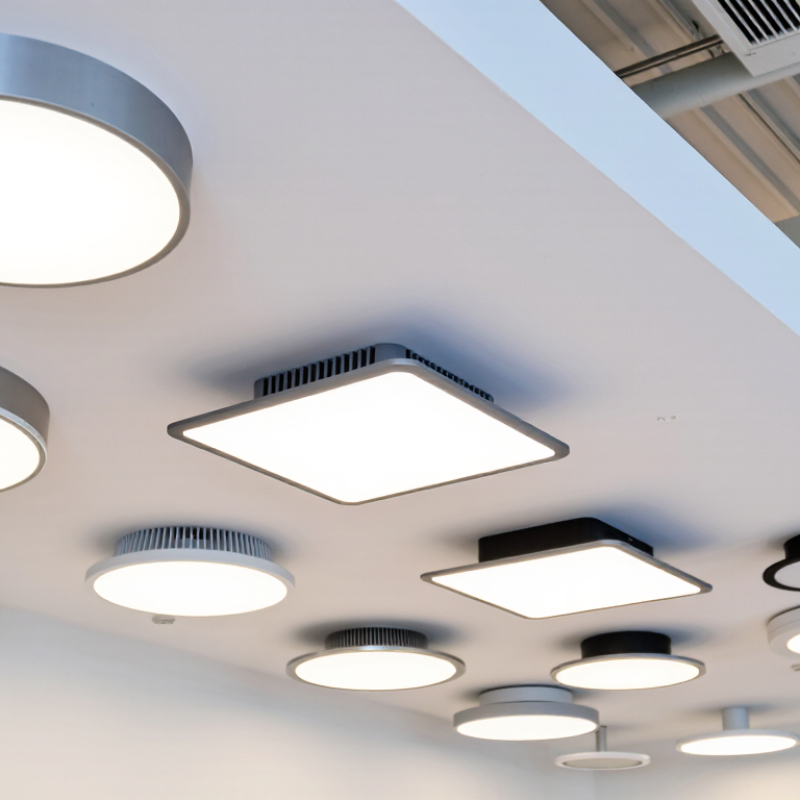
Surface mounted LED lights are fixtures installed directly onto a ceiling or wall. They do not need a deep recessed cavity. A typical unit includes an LED board, heat sink, driver, housing, and diffuser. This structure suits concrete ceilings, shallow spaces, corridors, offices, kitchens, and retail areas.
Installation is practical. Technicians usually secure a mounting plate, connect the wiring, and attach the fixture. The diffuser spreads light across the room, reducing harsh shadows when designed well. According to the U.S. Department of Energy, LED lighting can use at least 75% less energy and last up to 25 times longer than incandescent lighting. The International Energy Agency has also reported that lighting uses roughly 15% of global electricity demand. These figures explain why efficient surface fixtures attract global buyers.
Performance still depends on details. A 24-watt fixture is not automatically efficient. Check delivered lumens, efficacy, color rendering, beam distribution, and driver quality. A crowded diffuser can create glare. A weak heat path may shorten service life. In my experience, installers often focus on wattage first, which is a mistake. The room may look bright but feel uncomfortable. Buyers should review test reports, rated lifetime, operating temperature, and electrical compliance for the target market. Certification labels help, but they are not perfect. Real projects need measured results.
QUICK LINKS
CONTACT US
Office: (+86) 755 23040566
Tel: (+86) 158 9965 5195
E-mail: sale@pcbledmodule.com
Skype: Hans@Rocket-PCB
Whatsapp: 86 1589965 5195
Office Address: 2207,Bid 4,He Gu Shan Hui Cheng,35#,Guang Tian RoYanluo street, Song Gang Town,518105 SHENZHENG, CHINA
Plant ADD.: No 69, Lianfeng North Road, Xianxi Area, ChangAn Town, Dongguan, China.


Copyright © 2025 Rocket PCB Solution Ltd. | All Rights Reserved Sitemap Friendship link: CNC machining heat sink

