

A rotary desiccant dehumidifier can keep a warehouse, production line, or archive dry when ordinary cooling struggles. Its slowly turning rotor carries desiccant through two air streams: one captures moisture, while heated regeneration air removes it. The details matter. Rotor material, airflow, inlet humidity, and regeneration heat all shape performance.
ASHRAE’s Handbook—HVAC Applications provides technical guidance on desiccant dehumidification, while the U.S. Energy Information Administration’s Commercial Buildings Energy Consumption Survey offers broader context on building energy use. Neither source is a product ranking; treat them as engineering references, not proof that one model fits every site. William C. Worek is a recognized researcher in desiccant cooling and dehumidification. A practical takeaway from his published work is: “Choose the rotor for the moisture load, not the catalogue headline.” This is a paraphrase, not a verbatim quotation.
This 2026 buying guide turns those principles into checks you can use on a specification sheet: required dew point, process-air volume, regeneration temperature, heat source, controls, and maintenance access. Picture a damp intake filter, a warm regeneration duct, or a rotor edge coated with dust. Small details can change results. Compare stated capacity at your actual operating conditions, and ask suppliers for test data—not just peak figures. One caution: rated performance can look precise while real inlet conditions keep shifting. That deserves a closer look.
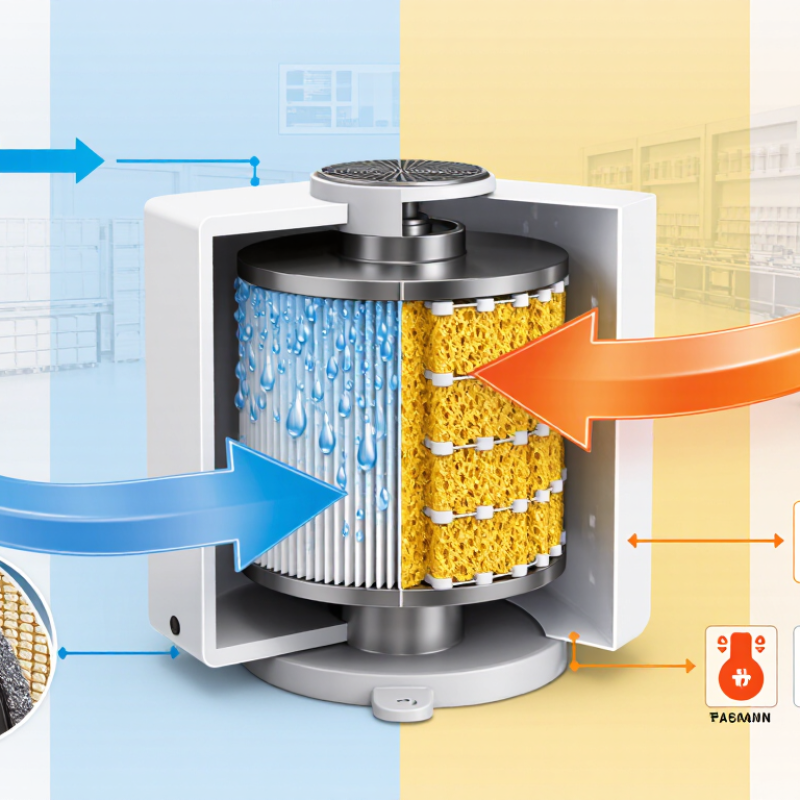
A rotary desiccant dehumidifier controls moisture without relying on a cold evaporator coil. Its central component is a honeycomb rotor coated with a moisture-attracting desiccant. Damp room air passes through one section of the wheel, where water vapor adheres to the material. Dried air then returns to the space as the rotor turns continuously. The principle is simple, but airflow balance matters.
When the rotor moves into a separate regeneration zone, heated air passes through it and releases the captured moisture. That warm, humid exhaust is vented away, while the regenerated section returns to the drying zone. The two air streams stay separate; only the rotor carries moisture between them. That matters. In practice, a blocked filter or poorly sealed duct can weaken performance. Small details count.
Because drying depends on adsorption rather than condensation, these units can work well in cool environments where refrigerant dehumidifiers may lose capacity. They are used in storage rooms, construction drying, and process areas that need low humidity. The trade-off is heat: regeneration consumes energy, and the exhaust needs a suitable route. A wheel cannot eliminate every moisture source. I would check the room’s moisture load, target humidity, and service access before selecting capacity; that estimate is easy to get wrong.
For a rotary desiccant dehumidifier, compare moisture-removal capacity at the same inlet temperature and relative humidity. A rating without test conditions can mislead. Conditions matter. Check the airflow rate and the outlet dew point too; these show whether the unit can treat the room or process air as required. A low outlet dew point may matter more than a large headline capacity in a cold storage area.
Review regeneration energy alongside drying performance. The heater’s power demand, regeneration airflow, and heat recovery options affect operating costs. Ask for pressure-drop data, since restrictive ductwork can reduce delivered airflow. Controls should allow practical adjustment of humidity targets and operating schedules. Some published ratings may not match your installation. That is worth questioning.
Inspect the rotor seal, filter access, and maintenance instructions before comparing prices. Dust buildup or air leakage can undermine performance, even when a unit’s specifications look strong. Check sound levels if equipment will operate near occupied spaces. Also confirm how the manufacturer defines continuous-duty capacity and what service intervals are expected. These details are less impressive than a big capacity figure, but often matter more after installation.
A rotary desiccant dehumidifier should be sized for the moisture entering and generated in the space, not floor area alone. Estimate ventilation, infiltration, people, wet products, and process moisture over a typical operating hour. Then match the required moisture removal rate to the unit’s stated rating conditions. ASHRAE’s Handbook—HVAC Systems and Equipment explains that desiccant performance changes with process-air temperature and humidity, so a catalogue capacity is not universal. Check the test conditions carefully. A cool, damp warehouse and a warm production room can need different airflow and regeneration heat, even at the same size.
Use a target humidity that suits the materials and process. The U.S. Environmental Protection Agency advises keeping indoor relative humidity below 60%, ideally between 30% and 50%; this is useful guidance, not a substitute for process requirements. Compare that target with seasonal outdoor air and the room’s moisture load. A practical example: doors opening repeatedly can add humid air faster than a quiet-room estimate suggests. Small details matter. Allow for peak shifts, not just daily averages, and verify the expected inlet conditions with measurements where possible. The estimate will still be imperfect; revisit it after installation using humidity trends and actual operating hours.
Use these preliminary ranges to compare rotary desiccant dehumidifier sizes. They are planning guides, not guaranteed equipment ratings: actual moisture removal depends on process-air temperature and humidity, regeneration-air conditions, airflow, and the moisture load entering the space.
| Typical application | Indicative space volume | Common design conditions | Preliminary moisture-removal target | Capacity-matching guidance |
|---|---|---|---|---|
| Small controlled room, cabinet area, or laboratory | Up to 150 m³ | Low moisture load; often selected for a stable low-RH setpoint or cool operating conditions | 5–15 kg per 24 hours (0.2–0.6 kg/h) | Estimate moisture entering through door openings, ventilation, and stored materials. Do not size from floor area alone. |
| Small production room or dry-storage room | 150–500 m³ | Moderate air exchange; process-air temperature may be below 15°C or the target RH may be low | 15–60 kg per 24 hours (0.6–2.5 kg/h) | Check door-opening frequency and outdoor-air supply. A tighter room generally needs less capacity than a leaky room of the same volume. |
| Warehouse zone, packaging room, or medium-sized process area | 500–2,000 m³ | Variable occupancy and air leakage; humidity control may be needed during cold or humid weather | 60–240 kg per 24 hours (2.5–10 kg/h) | Include moisture from incoming goods, wet processes, people, and ventilation in the load estimate. Consider separate zones if conditions differ. |
| Large warehouse, industrial drying area, or multi-zone facility | 2,000–10,000 m³ | Higher ventilation or infiltration load; continuous operation may be required to maintain a low humidity setpoint | 240–1,200 kg per 24 hours (10–50 kg/h) | Use a room-by-room or process-load calculation. Confirm the unit’s stated capacity at the actual inlet and regeneration-air conditions. |
| Heavy industrial or continuous-process installation | Over 10,000 m³, or a concentrated process load | Large outdoor-air load, frequent material handling, or a tightly controlled production process | Over 1,200 kg per 24 hours (over 50 kg/h) | Request a project-specific selection using a psychrometric assessment, airflow requirements, operating schedule, and peak-load allowance. |
Selection check: Convert the estimated moisture load to the same units used in equipment data (1 kg/h = 24 kg/day), then compare it with the manufacturer’s performance at your design conditions. Room volume is only a screening factor; leakage, ventilation, target humidity, temperature, and moisture released by products or processes determine the required capacity.
Rotary desiccant dehumidifiers suit spaces that need dry air at lower temperatures, such as storage rooms or production areas. They use a rotating desiccant wheel and heat to remove moisture, so energy use includes both fan power and wheel regeneration. Compare published capacity and energy figures under similar temperature and humidity conditions. A larger extraction number alone can mislead. Check the expected operating hours, too.
Controls affect both comfort and running costs. Humidity sensors, adjustable setpoints, and timers can prevent unnecessary operation, but sensor placement matters: a reading beside a damp doorway may not represent the whole room. Maintenance is usually straightforward, yet filters need regular inspection, and a loaded filter can restrict airflow. Ask how often the wheel and seals require service, and whether local technicians can handle it. Purchase price is only one part of ownership; include installation, heat supply, replacement parts, and downtime in your estimate. Even careful calculations can miss changing seasonal conditions.
Tips: Request test data for your actual temperature range. Compare energy per kilogram of water removed, not just rated capacity. Keep a simple log of humidity, runtime, and energy use after installation. It may reveal a mismatch between the original estimate and real conditions.
Illustrative energy-cost comparison: regeneration heat source can significantly affect running costs.
Example costs per 1,000 operating hours assume 10 kW of regeneration heat, 2 kW of auxiliary electricity, electricity at $0.12/kWh, and regeneration heat priced at $0.12/kWh for electric resistance, $0.04/kWh for natural gas, or $0.01/kWh for recovered heat. These are transparent planning assumptions, not product performance figures; actual costs vary with system efficiency, local tariffs, operating conditions, and heat-source availability. When comparing units, also check humidity controls and sensor options, access for rotor and filter maintenance, and the cost and frequency of routine service.
Choosing the right rotary desiccant dehumidifier starts with the room, not the machine. Record temperature, relative humidity, and the moisture sources in the space. A cold warehouse, a drying room, and a production line can need very different performance. Note whether doors open often, wet materials arrive, or people add moisture during each shift. Small details matter.
Set a target humidity or dew point, then estimate the moisture load and required airflow. Ask for capacity data at conditions close to your actual operating range; ratings from warmer test conditions may not reflect cold-room performance. Check regeneration heat needs, exhaust routing, available electrical supply, and control options.
Fit matters too. A unit that meets the load on paper may be difficult to install or maintain in a crowded plant room. Leave clear access for filters and service panels. If the moisture load is uncertain, log conditions across several operating cycles before choosing. The first estimate may miss seasonal changes, and that is worth revisiting.
QUICK LINKS
CONTACT US
Office: (+86) 755 23040566
Tel: (+86) 158 9965 5195
E-mail: sale@pcbledmodule.com
Skype: Hans@Rocket-PCB
Whatsapp: 86 1589965 5195
Office Address: 2207,Bid 4,He Gu Shan Hui Cheng,35#,Guang Tian RoYanluo street, Song Gang Town,518105 SHENZHENG, CHINA
Plant ADD.: No 69, Lianfeng North Road, Xianxi Area, ChangAn Town, Dongguan, China.


Copyright © 2025 Rocket PCB Solution Ltd. | All Rights Reserved Sitemap Friendship link: CNC machining heat sink